The footsteps outside my room were firm and unhurried.
I heard them before I saw him.
Someone stopped near the doorway.
For a moment, I expected a nurse to come in and check my medication.
Then I caught the familiar smell of Caleb's cologne.
My heart lifted before I could stop it.
That was the embarrassing truth.
After three weeks of silence, after all the unanswered messages and long hours of waiting, part of me was still happy that he had come.
I turned my head toward the door.
Caleb walked in wearing a freshly pressed shirt and dark trousers.
His hair was neat.
His shoes were clean.
He looked like someone who had spent the morning preparing for a business meeting.
I looked down at myself.
My hospital gown was wrinkled from lying in bed.
My hair had been brushed, but the stitches beneath it made my scalp tender.
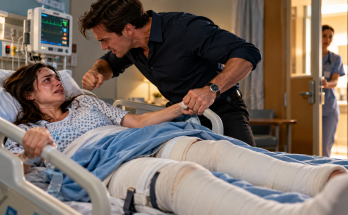
The blanket covered my legs, though the thick shapes of the casts were impossible to hide.
I suddenly felt as if I should apologize for the room.
For the smell.
For the machines.
For the fact that I had not managed to recover quickly enough to make his visit pleasant.
That was my first mistake.
My second was assuming he had come because he was worried.
He did not approach the bed immediately.
He stood near the foot of it and looked around.
His eyes passed over the monitor, the cabinet, and the chair beside the wall.
Then he looked at me.
I waited for him to ask how I was feeling.
I waited for him to say something about my injuries.
I waited for any sign that he had spent the last three weeks thinking about the woman lying in front of him.
Instead, he frowned.
"Rebecca, we're finished with this."
I stared at him.
I thought the medication had made me misunderstand.
"What?"
He gave a short, irritated breath.
"This has gone on long enough."
I tried to lift myself slightly against the pillow, but pain spread through my ribs.
I stopped.
Caleb watched me without moving to help.
"Caleb, you came."
It sounded foolish as soon as I said it.
He glanced at the monitor.
"Get your things together. We're leaving."
I looked at him, then at my legs.
The casts were thick and white, extending almost the entire length of both legs.
They were not decorations.
They were not something I could remove when I felt ready to go home.
"How am I supposed to leave?"
He looked annoyed that I had asked.
"Don't make this difficult."
I swallowed.
"I can't stand."
"Then we'll work something out."
His tone made it sound as if I had failed to complete a simple household task.
I looked toward the doorway.
A nurse had passed by a few minutes earlier.
I considered calling for her, but I did not want to start an argument in front of hospital staff.
Even then, I was thinking about Caleb's embarrassment.
I was trying to protect him from the consequences of his own behavior.
He stepped closer to the bed.
"Do you have any idea how much this place costs?"
I shook my head.
"No."
"Of course you don't."
He spoke as if the answer proved something about me.
"I've been dealing with enough already."
I wanted to ask what he had been dealing with.
I wanted to ask whether Emma had been asking about me.
I wanted to ask why he had waited twenty-one days to visit his injured wife.
But his expression made me hesitate.
I knew that expression.
I had seen it across the kitchen table.
I had seen it when a bill was higher than he expected.
I had seen it when I asked him to explain something he did not want to discuss.
It was the look that warned me the conversation would become my fault if I continued.
I used to believe that recognizing his moods made me a good wife.
I thought I was being considerate.
Now I wonder how many times I mistook fear for understanding.
"How is Emma?" I asked.
Caleb's eyes narrowed slightly.
"She's fine."
"Has she been asking about me?"
"Rebecca."
He said my name like a warning.
I went quiet.
For three weeks, I had imagined Emma asking when I would come home.
I imagined Caleb reassuring her.
I imagined him telling her that her mother was getting better and that we would all be together again soon.
I wanted to know whether those conversations had happened.
I wanted to hear something that connected me to the life I had left behind.
Instead, Caleb looked at the hospital bill clipped to a folder he carried.
I had not noticed the folder when he entered.
It was brown and slightly bent at one corner.
He opened it and looked at a page.
"There's another payment due."
I stared at the paper.
"I don't understand."
"The hospital wants more money."
I waited for him to continue.
He did.
"And I'm not going to keep paying for this."
The words did not make sense at first.
I knew hospitals were expensive.
I knew my treatment would cost money.
I had spent years managing our household finances, so I understood the difference between an unexpected expense and a small inconvenience.
But I had never thought of medical care as a luxury someone could decide I no longer deserved.
"Caleb, the doctors said I need to stay here."
He waved a hand.
"Doctors say all kinds of things."
"They have to make sure my bones heal."
"And how long is that going to take?"
"I don't know."
He closed the folder.
"That's exactly the problem."
I looked at his face.
There was no concern there.
No fear that I might never walk properly again.
No question about whether the pain had become worse.
He seemed angry that the answers were uncertain.
I tried to explain anyway.
"My legs are broken. I can't just go home and take care of myself."
He leaned forward slightly.
"Then stop acting as if you're helpless."
For a moment, I could not speak.
I had not chosen to lie in that bed.
I had not chosen the casts.
I had not chosen the stitches or the fractured ribs.
I had not chosen the hours of pain that made me afraid to move.
Yet there he was, treating my injuries as though I had arranged them to inconvenience him.
I looked at the yellow warning notice attached to my chart.
It reminded hospital staff that I needed assistance.
It was a simple instruction.
Call for help before moving.
The hospital understood my limitations.
My husband did not seem interested in understanding anything that required patience.
"Caleb," I said quietly, "I need you to help me."
He laughed once, without humor.
"Help you?"
I nodded.
I hated how small my voice sounded.
"I'm your wife."
He looked at me for a long second.
Then he said, "You're nothing but a burden."
I felt those words before I understood them.
They seemed to settle over the room.
I looked at the blanket covering my legs.
I looked at the monitor beside me.
I looked at the photograph Emma had drawn.
COME HOME SOON, MOMMY.
I had spent eleven years believing that if I worked hard enough, stayed patient enough, and asked for little enough, Caleb would eventually see everything I did for our family.
I had imagined that my sacrifices were building something.
A home.
A marriage.
A life our daughter could depend on.
But Caleb was standing beside my hospital bed, looking at me as though my survival had become an unpaid bill.
"I gave up my job after Emma was born," I said.
I had not planned to say it.
The words came out before I could stop them.
"I stayed home because you said she needed me. I've handled the house, the bills, everything I could."
His face hardened.
"Are we going to have this conversation now?"
I stared at him.
I had spent years avoiding conversations because he disliked them.
I had postponed my own needs because there was always something more urgent.
I had learned to swallow disappointment before it became an argument.
And now, when I finally spoke about what I had given up, he treated it as an inconvenience.
"I never asked you to make a list," he said.
I felt my face grow hot.
"No. You didn't."
He seemed surprised that I had answered.
I looked away.
I did not want to fight.
I was exhausted, medicated, and in pain.
I wanted him to sit down.
I wanted him to lower his voice.
I wanted him to remember that I was the same person who had cared for him when he was sick, who had stayed up waiting when he worked late, and who had tried to make our home a place where he could rest.
But I could not make him remember those things.
He already knew them.
That was what hurt.
He knew what I had done.
He simply did not believe it meant I deserved his care.
I took a careful breath.
"Please don't be angry with me."
Even now, I can remember saying those words.
I can remember the way I tried to soften my voice, as if I were the one who had done something wrong.
Looking back, that sentence alone makes me ashamed.
Not because I was weak.
Because I had become so accustomed to managing Caleb's feelings that I apologized while lying in a hospital bed with broken bones.
He checked the folder again.
Then he put it on the cabinet.
"We're going home."
I looked at him.
"How?"
He did not answer.
I waited for him to explain.
He did not.
Instead, he reached toward the blanket.
I moved my hand instinctively to protect my legs.
"Caleb, please."
He grabbed the edge of the blanket.
"Enough."
I could see the muscles in his jaw tighten.
"I've had enough of this."
His voice grew louder.
"I'm not going to keep throwing money away on you."
I looked toward the doorway again.
The hallway was visible through the open space.
A cart stood against the wall.
Someone passed carrying a stack of folded linens.
The hospital continued with its ordinary work.
Inside my room, everything had changed.
I knew Caleb was angry.
I knew he wanted me to obey him.
What I did not yet understand was how far he was willing to go to get what he wanted.
Then he pulled the blanket away from my legs.
And when I tried to stop him, he grabbed my arm.
Click here to continue reading: PART 3: I Had Spent Eleven Years Avoiding His Anger, but When His Fingers Closed Around My Arm, I Finally Refused to Move
For Twenty-One Days, I Waited for My Husband to Visit With Flowers, Until I Finally Learned What He Thought My Life Was Worth
Part 2 of 20