Caleb did not apologize the next day.
He did not apologize the day after that either.
There were messages about practical matters.
There were questions about when I would leave the hospital.
There were complaints about the inconvenience of making arrangements.
But there was no acknowledgment of what had happened in my room.
At first, I kept waiting for one.
I imagined a message arriving in which he admitted that he had gone too far.
I imagined him saying he was sorry for hurting me.
I imagined him acknowledging that I had been frightened and that he should never have treated me that way.
I knew an apology would not heal my legs.
It would not make the pain disappear.
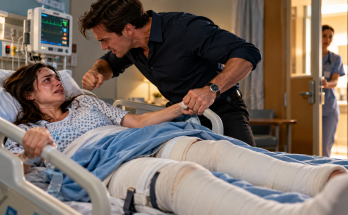
It would not erase the memory of his hands closing around my arm.
But part of me still wanted to hear it.
I wanted proof that the man I had married understood the seriousness of what he had done.
I wanted to believe that the eleven years we had shared had left him with some concern for my well-being.
I wanted a reason to think that the future might be different.
That morning, I checked my phone more often than I wanted to admit.
Each time the screen lit up, I looked for his name.
Each time it was someone else, I felt disappointed.
I was angry with myself for that.
I had been hurt by him, yet I was still waiting for him to make me feel better.
The nurse noticed that I was distracted.
She asked whether I was worried about something.
“I keep thinking he might apologize.”
She sat beside the bed for a moment.
“Would an apology make you feel safe?”
I opened my mouth.
Then I stopped.
I had never separated those two questions.
I had always believed that if someone apologized sincerely, the problem could begin to heal.
Sometimes that was true.
People made mistakes.
People said hurtful things and later understood why they were wrong.
People could take responsibility and change their behavior.
But an apology was not the same as a change.
Caleb could say he was sorry and still expect me to return to the same conditions.
He could admit that he had been angry and still blame me for provoking him.
He could regret the consequences without regretting what he had done.
I did not know which explanation he would offer.
I only knew that I could not judge my safety by words alone.
“I don't know,” I finally said.
The nurse nodded.
“You don't have to decide that right now.”
I looked at her.
Those words had become familiar in the hospital.
You don't have to decide today.
You can take your time.
You can ask for help.
I had spent years believing that every uncomfortable situation required an immediate solution.
If Caleb was angry, I had to calm him down.
If there was a problem with the house, I had to fix it.
If someone was disappointed, I had to explain myself.
Now I was learning that some decisions became clearer when I stopped trying to force them.
After the nurse left, I opened my notebook.
I turned to a blank page and wrote two headings.
What I wanted to hear.
What I needed to see.
Under the first heading, I wrote that I wanted Caleb to acknowledge the harm he had caused.
I wanted him to stop blaming me.
I wanted him to understand that my injuries were real.
Under the second heading, I paused.
What did I need to see?
I wrote that he would have to respect my boundaries.
He would have to accept that I could not be alone with him while I was afraid.
He would have to stop treating my medical needs as an inconvenience.
He would have to take responsibility without turning the conversation into an argument about his feelings.
I stared at the list.
It was not a test I could force him to pass.
It was a way of reminding myself that words were only one part of what mattered.
I could not control whether he changed.
I could decide what I needed before considering any change in our relationship.
Later that afternoon, the support worker returned to discuss the possibility of recovering somewhere other than our home.
She asked whether I had thought about the emotional side of that decision.
I told her I was afraid of what other people might think.
I was afraid relatives would ask questions.
I was afraid Caleb would tell them that I had abandoned him.
I was afraid that Emma would think I had chosen to leave her.
The support worker listened.
Then she reminded me that arranging a safe place to recover was not the same as deciding every question about my marriage.
I could take care of my immediate needs while allowing the larger questions to remain open.
I wrote that down too.
It was becoming a habit.
When someone said something that helped me understand my choices, I put it in the notebook.
I wanted to be able to read the words later, especially when fear made everything confusing again.
That evening, Caleb sent another message.
He said we needed to stop letting other people interfere in our marriage.
I felt my shoulders tighten.
I read the sentence again.
The nurse.
The doctor.
The support worker.
My relative.
None of them had made decisions for me.
They had listened when I described what had happened.
They had helped me understand what I needed.
Caleb called that interference.
I had spent years believing that keeping our marriage private was a sign of loyalty.
I had avoided telling people about arguments because I did not want them to judge him.
I had believed that we should solve our problems between ourselves.
But a problem could not always be solved safely in private.
When one person was afraid of the other, privacy could become isolation.
I did not answer his message.
I showed it to the support worker the next time she visited.
She helped me consider how communication could continue without putting me under pressure.
I did not need to respond to every accusation.
I did not need to defend the people who were helping me.
I did not need to persuade Caleb that my fear was reasonable before taking it seriously.
That night, I thought about the word apology again.
I had apologized to Caleb for things that were not my fault.
I had apologized for asking questions.
I had apologized for being tired.
I had apologized when he became angry, even if I could not identify what I had done wrong.
Sometimes I apologized simply because I wanted the room to become quiet.
I had used the word as a key.
I hoped it would unlock peace.
But peace that depended on me accepting blame for everything was not really peace.
It was silence.
I closed the notebook and rested my hand on the cover.
I still wanted an apology.
I could admit that without feeling ashamed.
I wanted the person I had loved to recognize the pain he had caused.
But I no longer wanted an apology so badly that I would accept anything afterward.
I needed safety.
I needed honesty.
I needed a future in which I could speak without being afraid of what my words might cost me.
Those needs did not disappear just because Caleb might eventually say he was sorry.
Before sleeping, I looked at Emma's drawing of the bench.
Two figures sat beneath the yellow sun.
Their hands nearly touched.
I thought about the kind of relationship I wanted to have with my daughter when she grew older.
I wanted her to know that she could apologize when she made a mistake.
I also wanted her to know that an apology should be followed by responsibility.
I wanted her to understand that forgiving someone did not mean pretending nothing had happened.
I wanted her to see that love could include boundaries.
Those lessons would be difficult to teach if I continued living as though my own safety mattered less than keeping other people comfortable.
I turned off the light.
I did not know whether Caleb would ever offer a sincere apology.
But I no longer wanted to make my recovery depend on hearing one.
Click here to continue reading: PART 16: The Hospital Had Given Me Time to Recover, but It Had Also Given Me Something I Had Not Had at Home: Space to Hear My Own Thoughts
For Twenty-One Days, I Waited for My Husband to Visit With Flowers, Until I Finally Learned What He Thought My Life Was Worth
Part 15 of 20