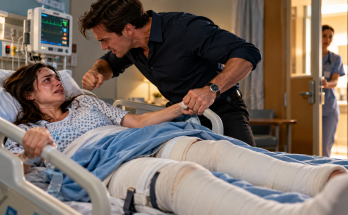
The next morning, I woke before the nurse came in.
For a few seconds, I forgot where I was. I looked at the pale ceiling, listened to the soft beeping beside my bed, and waited for the familiar sounds of home.
There was no coffee machine downstairs.
No television playing in the living room.
No Caleb opening cupboards and complaining that something had been put in the wrong place.
There was only the hospital.
And, for the first time in a long time, the quiet did not frighten me as much as it used to.
My notebook lay on the table beside the bed. The corner of Emma’s latest drawing stuck out between the pages.
I reached for it carefully.
The picture showed a path leading from a front door to a tree. Emma had drawn the path in thick brown lines, and the tree had a green top that was almost too large for its trunk.
She had written my name near the door.
I traced the letters with my finger.
“Soon,” I whispered.
I did not know exactly what soon meant anymore.
I only knew that I wanted to be there when she woke up, when she came home from school, and when she had something small to tell me that she believed was important.
I wanted to hear her ordinary stories.
I wanted to help her with her homework.
I wanted to be her mother without feeling that every decision I made had to pass through someone else first.
The nurse entered with my morning medication.
“Good morning, Rebecca. How did you sleep?”
“Better than I expected.”
She checked the monitor and looked at the notes near the end of my bed.
“Any new pain?”
“My ribs hurt when I move, but nothing feels different from yesterday.”
She adjusted the pillow behind my shoulder.
“Remember, you don't have to prove you're getting better by pushing yourself.”
I nodded.
That sentence stayed with me after she left.
For years, I had treated endurance as proof that I was doing something right.
I endured sleepless nights when Emma was little.
I endured Caleb's complaints about groceries, bills, and the condition of the house.
I endured being interrupted when I tried to explain why something had upset me.
I thought being a good wife meant finding a way to carry more without making anyone else uncomfortable.
Now I was lying in a hospital bed with both legs immobilized, and I could not even sit up without assistance.
There was no pretending I could carry everything.
The social worker came by after breakfast.
She brought a folder of information about temporary accommodation, home support, and the practical arrangements I would need when I was discharged.
She placed it on the table without opening it.
“I spoke with the discharge team,” she said. “They want to understand what kind of place would be safe and suitable for your recovery.”
I looked at the folder.
“Can I stay with my relative?”
“We can explore that. We would need to discuss the space available, the assistance you will need, and how you would get to follow-up appointments.”
“I don't want to go back to the house yet.”
Saying it aloud made my throat tighten.
The social worker did not look surprised.
“You're allowed to say that.”
I looked down at my hands.
“I keep thinking I should be able to go home. It's my house too. Emma is there. My things are there.”
“Those are important reasons to care about the house,” she said. “But they don't mean you have to return before you feel safe.”
I rubbed the edge of the blanket between my fingers.
“I don't know how Caleb will react if he finds out.”
“We can discuss how to communicate the discharge plan without putting you in a position where you have to negotiate with him alone.”
I breathed out slowly.
That was the part I had been afraid to ask for.
I did not want another argument in a hospital room.
I did not want Caleb standing over me with that brown folder, telling me that other people were interfering in our marriage.
I did not want to have to convince him that being punched in the stomach while lying in a hospital bed was serious.
I had already explained what happened.
I did not owe him another private hearing.
“Please help me arrange it,” I said.
The social worker opened the folder.
We talked about transportation, medication, follow-up appointments, and the assistance I would need while my legs remained in casts.
She explained that I should not promise a discharge date until the medical team confirmed that I could safely leave.
I appreciated that.
Everything in my life seemed to be moving toward a decision, but my body still needed time.
I could not make my bones heal faster because I was frightened of what waited outside the hospital.
Before she left, she asked whether I wanted help contacting my relative.
“Yes.”
“Would you like to speak with them yourself first?”
I thought about it.
“Yes. I want to explain it in my own words.”
She gave me the phone and stepped out to give me privacy.
My hands shook when I dialed.
When my relative answered, I could hear a television playing somewhere in the background.
“Rebecca?”
“It's me.”
“How are you feeling?”
“Still sore. Still stuck in this bed.”
There was a pause.
“I'm glad you called.”
I swallowed.
“I need to ask you something.”
“Go ahead.”
“The hospital is talking about where I can recover after discharge. I don't think I should go straight back to the house.”
I waited for the questions.
I expected to have to defend myself.
Instead, my relative asked, “Do you have somewhere you could stay?”
“I was hoping you might let me stay with you, if it is possible.”
The answer did not come immediately.
I heard movement on the other end, then the television grew quieter.
“Of course we'll talk about it,” my relative said. “We'll make sure we understand what help you'll need. You shouldn't have to work this out alone.”
My eyes filled.
“Thank you.”
“You don't need to thank me for listening.”
I pressed the phone against my ear.
“I don't want to make trouble for anybody.”
“Rebecca, you're recovering from a serious accident. You were hurt again in that room. Asking for somewhere safe to recover isn't making trouble.”
I closed my eyes.
Nobody had said it quite that plainly before.
We talked about the practical details.
There would need to be enough room for me to rest, and someone would need to help with the things I could not do alone.
My relative did not make promises that might prove impossible.
They said we would work through the arrangements with the hospital.
That honesty made me trust the offer more, not less.
When the call ended, I held the phone for a moment before setting it down.
The room looked exactly as it had before.
The same pale walls.
The same monitor.
The same yellow fall-risk notice near the bed.
But I had made a decision that did not depend on Caleb agreeing with it.
I wrote in my notebook.
Possible place to recover: relative's home.
Underneath, I wrote:
Ask discharge team what support is needed.
Then I added:
Do not confuse going somewhere else with abandoning Emma.
That last sentence was the one I needed most.
Caleb had a way of making every disagreement sound like a choice between him and the family.
If I questioned him, I was being difficult.
If I wanted time to rest, I was neglecting responsibilities.
If I needed help, I was making him look bad.
I had spent so long trying to prove that I loved my family that I had started believing I could only prove it by making myself smaller.
I was not going to let that idea decide where I recovered.
Later that afternoon, a nurse brought Emma's newest message.
It was short.
Mommy, I hope your legs feel better. I made another picture. Daddy says you need to rest. I miss you.
I read it twice.
There was no accusation in her words.
No anger.
Just a little girl trying to understand why her mother was not coming home.
I asked the nurse if I could send a message back.
She helped me make sure I had the right contact.
I wrote slowly, because my hands were tired.
I miss you too, sweetheart. I'm getting the help I need so my body can heal. None of this is your fault. I love you every day, even when we're apart.
I read the message before sending it.
I wanted to write more.
I wanted to explain that grown-up problems were not her job to solve.
I wanted to tell her that she did not need to choose between her parents.
But I knew a message from a hospital bed was not the place to put all my fear into words.
I sent what I could.
Then I placed her drawing beside the notebook.
In the evening, Caleb sent another message.
We need to talk about the discharge plan. You can't keep letting other people make decisions for our family.
I stared at the screen.
I felt the old reflex rise inside me.
I wanted to explain that the hospital was helping me because I was injured.
I wanted to reassure him that I was not trying to punish him.
I wanted to say that I still cared about Emma and that I had not stopped caring about our home.
My fingers moved toward the keyboard.
Then I stopped.
I looked at the yellow notice beside my bed.
I remembered the visitor log.
I remembered the nurse entering the room just as Caleb drew his arm back again.
I remembered how quickly the pain had spread through my stomach and how I had struggled to breathe.
The facts did not change because Caleb disliked the consequences.
I put the phone facedown.
I did not reply that evening.
Instead, I wrote the message in my notebook, along with the date and time.
I did not write an insult about him.
I did not guess what he intended.
I recorded what he had actually said.
When the nurse came in for her final check, she noticed the notebook open on the table.
“Doing some writing?”
“Trying to keep things straight.”
“That's a good idea, especially when there are a lot of conversations happening.”
I nodded.
Before she left, I asked whether the hospital had received any further requests from Caleb to visit.
She checked the information available to her.
“Nothing new that I can see. If that changes, we'll follow the visitor arrangements in place.”
“Thank you.”
After she left, I turned off the bedside lamp.
My legs ached.
My ribs hurt when I shifted.
I was still afraid of what would happen when Caleb learned that I might recover somewhere else.
But I no longer believed that fear meant I had to obey him.
For the first time since the accident, I could imagine leaving the hospital without going straight back into the same situation.
It was not a complete plan.
It was one step.
For that night, one step was enough.
Click here to continue reading: PART 18: The Brown Folder Had Once Looked Like a Threat, but the Papers I Needed Most Were the Ones I Began Gathering for Myself
For Twenty-One Days, I Waited for My Husband to Visit With Flowers, Until I Finally Learned What He Thought My Life Was Worth
Part 17 of 20