The next day, I received another message.
This one was shorter.
Caleb wanted to know when I would be discharged.
He said the house was becoming difficult to manage without me.
I read the words slowly.
At first, I felt the familiar urge to apologize.
I imagined the kitchen needing attention.
I imagined laundry waiting in baskets.
I imagined Emma's school things scattered near the front door.
I imagined Caleb coming home after work and finding tasks he expected me to have completed.
For years, those pictures had been enough to make me feel responsible.
Even when I was sick, I thought about what needed doing at home.
Even when I was exhausted, I worried that Caleb might have to handle something himself.
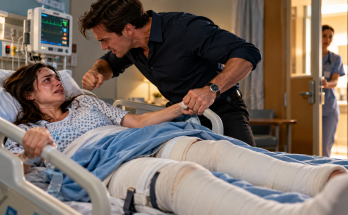
Now I was lying in a hospital bed with both legs in casts, and his message had brought that old feeling back.
The house was difficult to manage without me.
Not that he missed me.
Not that he was worried about my recovery.
Not that he regretted what had happened.
The house.
I placed the phone down.
I felt a familiar sadness, but it was mixed with something else.
Clarity.
I had spent years telling myself that Caleb relied on me because he valued what I did.
Perhaps he did rely on me.
But relying on someone was not the same as caring for them.
He had depended on the work I did at home.
He had depended on my ability to remember details.
He had depended on my willingness to put my own needs aside.
Yet when I needed him to help me through a medical crisis, he had treated me as an expense.
I could no longer ignore that difference.
I did not answer his message.
Instead, I asked the nurse to contact the support worker and explain that Caleb was trying to discuss my return home.
The support worker visited later that morning.
I showed her the message.
She read it without commenting on his character.
Then she asked what I wanted to happen next.
“I don't want to discuss discharge arrangements with him alone.”
She nodded.
“We can make sure the hospital team knows that.”
I felt a small release of tension.
I had expected to be asked to explain why.
I had expected to defend my decision.
Instead, she treated it as information that mattered.
We discussed what I would need after discharge.
I would need help moving around.
I would need assistance with some daily tasks.
I would need follow-up care and a place where I could rest without fear of another confrontation.
Those were practical needs.
They were not punishments.
I had to remind myself of that.
I was not trying to make Caleb suffer by refusing to be alone with him.
I was trying to recover from my injuries.
I was trying to prevent another incident.
I was trying to make sure Emma did not have to witness something similar.
The support worker explained that the hospital would consider my medical needs and safety concerns when planning the next steps.
I thanked her.
After she left, I asked for a notebook.
The nurse brought me one with a plain blue cover.
I opened it to the first page.
For a while, I did not know what to write.
Then I began listing the things I needed to remember.
My next medical appointment.
The questions about our accounts.
The information I needed before making decisions about the house.
The arrangements for seeing Emma.
I left space between each item.
I did not want the page to look like an impossible task.
I wanted to be able to read it without feeling overwhelmed.
When I finished, I turned to the next page.
I wrote one sentence.
I am not responsible for making Caleb comfortable with my safety.
I stared at it for a long time.
The words felt harsh.
I nearly crossed them out.
Then I remembered how he had looked at me when I told him I could not stand.
I remembered the way he had treated my refusal as disrespect.
I remembered the nurse stepping between us.
I kept the sentence.
That afternoon, the hospital arranged another conversation about the incident.
I was asked to confirm the account I had given the staff.
I described what happened again.
I did not add anything I could not remember.
I did not guess at what Caleb had been thinking.
I explained the sequence as clearly as I could.
He had arrived with paperwork.
He had demanded that I leave.
I had told him I could not stand.
He had grabbed my arm and tried to pull me from the bed.
I had refused.
He had struck me.
The monitor had sounded.
The nurse had entered.
Those were the facts.
I did not need to make the story more dramatic.
It was already serious enough.
When the conversation ended, I felt exhausted.
My ribs ached.
My hands were cold.
I asked for a little time alone.
The nurse closed the door partway and let me rest.
I looked at the notebook on the cabinet.
The sentence I had written was still visible.
I am not responsible for making Caleb comfortable with my safety.
I read it again.
Then I closed the notebook.
I had not solved my marriage.
I had not decided what would happen next.
But I had stopped trying to convince myself that protecting my husband from embarrassment was more important than protecting my body.
That evening, Emma sent me a message through the arrangements the hospital had made.
It contained a photograph of another drawing.
This one showed two people sitting on a bench beneath a large yellow sun.
One had brown hair.
The other had shorter hair and a small red bow.
There were birds above them.
At the bottom, Emma had written that she wanted to take me to the park when I was better.
I smiled.
I looked at the drawing for a long time.
I imagined sitting beside her one day, perhaps not for very long at first.
I imagined listening to her talk about school.
I imagined helping her choose an ice cream flavor.
I imagined walking slowly, with whatever support my recovery required.
Those things seemed far away.
But they were possible things to work toward.
I wrote back that I loved the picture and that I wanted to go to the park with her too.
I did not promise a date.
I did not tell her that I would be home soon.
I told her that I was getting stronger and that I was thinking about her.
Then I placed the phone down.
For years, I had treated promises as a way to keep other people calm.
I had promised Caleb that I would try harder.
I had promised myself that things would improve.
I had promised Emma that our family would always be together.
Some promises had been made out of love.
Others had been made because I was afraid of what would happen if I did not make them.
I was beginning to understand that an honest promise had to leave room for reality.
I could promise Emma that I would love her.
I could promise to tell her the truth in a way she could understand.
I could promise to keep working toward a safe life for both of us.
I could not promise that Caleb would change.
I could not promise that our marriage would return to what it had been.
I could not promise that nobody would ever be hurt again.
Those were not things I controlled.
I turned off the phone and rested my head against the pillow.
The hospital room was quiet.
The monitor kept its steady rhythm.
For the first time in a long while, I allowed myself to think about the future without making Caleb the center of every decision.
I did not know what that future would look like.
But I knew I had a right to help choose it.
Click here to continue reading: PART 12: I Had Spent Years Keeping Our Family Together, but My Daughter’s Drawing Helped Me See That Together Was Not the Same as Safe
For Twenty-One Days, I Waited for My Husband to Visit With Flowers, Until I Finally Learned What He Thought My Life Was Worth
Part 11 of 20