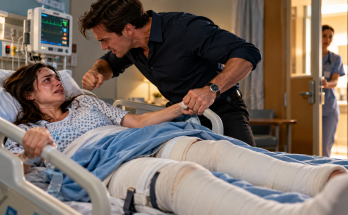
The following morning, the doctor examined my legs and asked about the pain in my ribs.
He checked the swelling around my wrist and reminded me that recovery would take time.
“You're making progress,” he said. “But progress doesn't mean you're ready to manage everything on your own.”
I almost laughed.
I had spent years managing everything on my own.
Now a doctor was telling me that I needed help, and I was trying to learn how to accept it without feeling ashamed.
“What happens next?” I asked.
“We'll keep reviewing your condition. The discharge team will work with you on the support you need. You shouldn't leave until those arrangements are safe.”
I nodded.
I had begun to understand the difference between wanting to leave and being ready to leave.
I wanted to see Emma.
I wanted to sleep somewhere that did not make my stomach tighten when I heard footsteps outside the door.
I wanted to stop waking up with the memory of Caleb's hands on my arm.
But I also needed to be able to get through a day without putting myself at risk.
That afternoon, the social worker returned.
She had spoken with the discharge team and had more questions about the place where I might recover.
We talked about the layout, access to a bathroom, transportation, and the possibility of arranging help for daily tasks.
The conversation was ordinary.
It was also the first time in a long while that my needs were being treated as facts instead of complaints.
When we finished, she asked whether I had any concerns about money.
I looked at the notebook.
“Yes,” I said. “I don't know exactly what I can afford.”
“Do you have access to your financial records?”
“I have access to some of our accounts.”
“Would it help to organize the information you have, so you can understand your options?”
I nodded.
I had avoided looking too closely at our finances because Caleb always said he was handling them.
I knew the household bills.
I knew when the mortgage was due.
I knew the cost of Emma's school supplies and the amount we usually spent at the grocery store.
But I did not always know where the money went after it entered our accounts.
That had not seemed important when our marriage felt secure.
Now it seemed important that I understand what belonged to me, what obligations existed, and what I could realistically manage.
The social worker did not tell me to empty an account or make a sudden financial move.
She said I should gather accurate information and seek appropriate advice before making decisions that could affect the household or my future.
That sounded sensible.
I did not want revenge.
I wanted to know where I stood.
When she left, I asked a nurse if she could help me reach the small bag of belongings the hospital had kept for me.
The nurse brought it over and set it on the table.
Inside were my purse, my phone charger, a few personal items, and the clothes I had been wearing when I was admitted.
My wallet felt strangely heavy in my hand.
I opened it and checked the cards.
My identification was there.
So was my bank card.
I put everything back carefully.
I had not lost my identity in the accident.
I had not stopped being a person who could learn, plan, work, or make decisions.
My body was injured.
My confidence was injured too.
Neither meant I had to surrender every choice to Caleb.
Later, I opened the banking app on my phone.
I did not know what I expected to find.
At first, I only checked the current balance and the most recent household payments.
The mortgage payment was listed.
The electricity bill was there.
There were grocery purchases, fuel charges, and ordinary expenses I recognized.
Then I noticed several withdrawals I could not immediately explain.
I read the dates.
I read the amounts.
I checked whether any of them matched bills I remembered paying.
I did not find an answer.
I wrote the transactions down in my notebook, including the dates and the amounts shown on the screen.
Beside each one, I wrote:
Need to verify.
I did not label them theft.
I did not decide Caleb had taken money for some secret purpose.
I knew too little.
There could be explanations I did not yet understand.
But I was no longer willing to pretend that questions were dangerous simply because Caleb might dislike them.
I took screenshots of the relevant records and saved copies where I could access them safely.
I made sure not to alter any account information or move money just because I felt frightened.
The purpose was to understand, not to strike back.
When I finished, my hand was sore.
I put the phone down and rested.
The brown folder from Caleb's visit came back into my mind.
He had placed it near the end of my bed as if it contained a final decision about my life.
I still did not know everything that had been inside it.
I remembered the way he had spoken about money, as if my medical treatment were an insult directed at him.
I remembered him telling me to get out of bed.
I remembered his grip on my arm.
Whatever papers he had brought, none of them had given him the right to hurt me.
That was the clearest fact I had.
In the afternoon, my relative called to discuss the possible recovery arrangements.
We talked about the help I would need and the limits of what they could provide.
They were willing to help, but they also wanted to make sure the hospital understood my medical needs.
I appreciated that they were not treating love as a substitute for practical planning.
“I don't want to become a burden,” I said.
“You're family,” they replied. “We'll work out what is realistic.”
I looked at the blanket over my legs.
“I've spent a lot of time worrying about being a burden.”
“Then perhaps this is a chance to let people help you without deciding what you're worth by how much you can do for them.”
I did not answer immediately.
I wanted to believe that.
I wanted to believe I could accept help without paying for it with endless apologies.
“I'm trying,” I said.
“That is enough for today.”
After the call, I looked at the three drawings Emma had sent.
The house with the red roof.
The two figures sitting beneath the yellow sun.
The path leading toward the tree.
They were not evidence of anything except that Emma missed me and was trying to express it.
Still, they reminded me what I wanted to protect.
I wanted her to grow up knowing that love did not mean accepting every kind of treatment.
I wanted her to see adults apologize when they caused harm.
I wanted her to know that she could ask questions without being accused of disloyalty.
I could not teach her those things by pretending nothing had happened.
But I also did not want to frighten her with details she was too young to carry.
I would need help finding the right words.
That evening, the nurse asked whether I wanted to speak with someone from the hospital's support service again.
“Yes,” I said. “I have questions about the financial advice they mentioned.”
She made a note.
“Someone can discuss what support is available and what steps make sense for your situation.”
I thanked her.
When I was alone again, I wrote a short list.
Ask what financial records I should gather.
Ask how to keep copies safely.
Do not make decisions while frightened.
Find out what I can manage independently.
The last item made my chest tighten.
I had once worked in accounting.
I had understood budgets, invoices, and the difference between an expense and a liability.
I had given up that career after Emma was born because Caleb wanted a parent at home full-time.
At the time, we had treated it as a family decision.
I had believed I could return to work when the time was right.
Then one year passed, and another.
I became the person who knew every school date, every household appointment, every missing shoe.
I had not forgotten how to think.
I had simply stopped using that part of myself outside the home.
I wondered what it would feel like to work again someday.
Not tomorrow.
Not while I was still unable to stand without help.
But someday.
The thought did not solve my financial questions.
It gave me something to look toward.
Caleb sent another message late that evening.
You are making this bigger than it needs to be. We should be dealing with this as husband and wife.
I read it once.
I noticed what was missing.
There was no mention of the punch.
No question about the pain.
No acknowledgment of the nurse who had entered the room.
He wanted to discuss the consequences without discussing what he had done.
I put the phone down.
Then I picked it up again and saved the message with the others.
I did not send a reply.
I was learning that I could preserve information without turning every message into an argument.
Before sleeping, I checked Emma's drawing one more time.
The little path was still there, leading away from the front door.
I had once thought home meant the place where I had spent eleven years of my marriage.
Now I understood that home also had to mean a place where I could rest without being afraid.
I did not know what would happen to my marriage.
I did not know what the unexplained transactions meant.
I did not know how long my recovery would take.
But I had begun gathering the information I needed to answer those questions.
For the first time, I was not waiting for Caleb to explain my life to me.
Click here to continue reading: PART 19: When I Finally Saw Emma Again, I Had to Learn How to Hold Her Close Without Asking Her to Carry the Pain Between Her Parents
For Twenty-One Days, I Waited for My Husband to Visit With Flowers, Until I Finally Learned What He Thought My Life Was Worth
Part 18 of 20