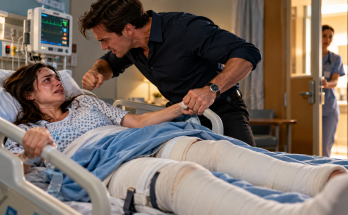
The hospital did not promise me a discharge date that week.
My doctor wanted to see more progress, and the team needed to confirm that the recovery arrangements would work.
I was disappointed, but I understood.
I had spent years believing that if I wanted something badly enough, I should be able to make it happen through effort.
Healing did not work that way.
My bones did not care how much I missed Emma.
My ribs did not heal faster because I was afraid Caleb would tell her I had chosen to stay away.
I had to let the medical team do its work.
While I waited, the social worker helped arrange a conversation about seeing Emma.
We discussed what might be possible and how to keep the visit calm.
I did not want Emma to walk into a room filled with adult tension.
I did not want her to feel that she had to comfort me or explain what Caleb had said at home.
I wanted to see my daughter.
That was enough.
The day of the visit, I spent far too long looking at my hair in the small mirror.
I could not stand up to adjust it.
I could not change my clothes without assistance.
A nurse helped me make myself comfortable and brought the blanket up over my legs.
“You look fine,” she said.
“I don't feel fine.”
“You don't have to feel fine to see someone who loves you.”
I swallowed.
“What if she asks why I haven't come home?”
“Then you can answer gently and honestly, in words she can understand. You don't have to explain everything at once.”
I nodded.
I had been planning explanations in my head for days.
Every version sounded either too vague or too frightening.
I wanted to protect Emma.
I was beginning to understand that protecting her did not mean pretending nothing had happened.
It meant not asking her to carry the parts that belonged to adults.
When the door opened, I saw Emma first.
She stood close to the person who had brought her, holding a folded sheet of paper against her chest.
For a moment, neither of us spoke.
Then she ran toward the bed.
I wanted to sit up and wrap both arms around her.
My ribs stopped me.
The nurse gently helped Emma approach from the side, where she could reach me without climbing onto my injured legs.
“Mommy!”
Her voice broke on the word.
I reached for her with both arms.
She leaned carefully against my shoulder, and I held her as tightly as I could without hurting myself.
“Oh, sweetheart,” I whispered. “I've missed you.”
“I missed you every day.”
“I know.”
She pulled back to look at my face.
“Are your legs still broken?”
“Yes, baby. They need more time to heal.”
“Can you walk?”
“Not yet.”
Her eyes filled with tears.
I brushed a strand of hair away from her face.
“But I'm getting help, and the doctors are taking care of me.”
“Are you coming home today?”
There it was.
The question I had rehearsed for.
I felt my throat tighten.
“Not today.”
Emma looked down at the paper in her hands.
“Daddy said you might come home soon.”
“I hope I can see you more soon,” I said. “But the doctors need to make sure I have the right help while I get better.”
“Why can't you come home?”
I took a breath.
“Because my body needs a safe place to rest while it heals. The grown-ups are working on that.”
She studied my face.
“Did I do something wrong?”
The question hurt more than my ribs.
“No.”
I answered too quickly, then repeated it more slowly.
“No, sweetheart. You did nothing wrong. Not one thing.”
“Because I asked when you were coming back?”
“No. You can always ask me questions.”
She rubbed the edge of the folded paper.
“Daddy gets angry when people ask too many questions.”
I felt the room go very still.
I wanted to ask what else she had heard.
I wanted to know how often he had spoken that way.
I wanted to find out whether she had been frightened.
But I did not want to turn her visit into an interview.
I kept my voice gentle.
“Sometimes grown-ups have trouble handling their feelings. But it is their job to take care of those feelings. It is not a child's job.”
Emma looked at me carefully.
“Even if they're really angry?”
“Even then.”
She leaned closer.
“Are you angry with Daddy?”
I looked at her small face.
I could have said no to make the moment easier.
I could have said yes and watched her try to decide what that meant for her.
Instead, I told her the truth in a way she could carry.
“I have some difficult feelings about what happened, and the grown-ups are going to work through them. You don't have to fix anything between us.”
She seemed to think about that.
“Can I still love both of you?”
My eyes filled.
“Yes. Always. You never have to choose which parent you love.”
She pressed her cheek against my shoulder.
I closed my eyes and held her.
For a little while, we did not talk about the house or the hospital.
Emma told me about a class activity and a girl who had brought the wrong color paper.
She told me that someone had forgotten a lunchbox.
She told me that the teacher had put a new picture on the classroom wall.
I listened as if every detail mattered.
Because it did.
These were the pieces of her ordinary life I had been missing.
When she showed me the folded paper, it was another drawing.
This one had a yellow sun, a small house, and two people sitting side by side.
The figures had no faces.
One was taller than the other.
Above them, Emma had drawn a row of little blue shapes that might have been clouds.
“It's us,” she said.
“I can see that.”
“I'm sitting with you.”
I touched the edge of the paper.
“I love it.”
“I made it so you wouldn't be lonely.”
I could not hold back my tears then.
Emma's face changed immediately.
“Are you sad because of me?”
“No, sweetheart.”
I wiped my cheek with the back of my hand.
“I'm crying because I love you so much, and I missed you. You don't have to make me feel better.”
She looked uncertain.
I took her hand.
“You don't have to make pictures to keep me safe. You can draw because you like drawing. You can play. You can laugh. I'll always love you.”
She nodded, though I knew she might need to hear it many more times.
The visit did not last long.
Emma became restless, and I grew tired.
When it was time for her to leave, she held my hand until the last possible moment.
“Will you call me?”
“Yes. We'll work out when we can talk.”
“Promise?”
“I promise I'll do my best to keep talking with you.”
I chose those words carefully.
I could not promise what the adults would arrange.
I could promise that I would keep trying to be present for her.
After she left, the room felt larger.
The folded drawing lay on the table beside the others.
I stared at it until the nurse came in to check on me.
“How did it go?”
“Good,” I said, then shook my head. “Hard. But good.”
“That's understandable.”
I wiped my face.
“She thinks she might be responsible.”
The nurse pulled the chair closer.
“Children often try to make sense of things by wondering what they could have done differently. Keep reassuring her that the adult problems aren't her fault.”
“I told her.”
“And you can tell her again.”
I nodded.
After the nurse left, I wrote down the words Emma had asked me.
Did I do something wrong?
Beneath them, I wrote my answer.
No. None of this is your fault.
I wanted to remember that question.
Not so I could use it against Caleb.
Not so I could build a case out of a child's confusion.
I wanted to remember how much care it would take to help Emma feel safe while the adults worked through the truth.
Later, Caleb sent a message.
Emma said she saw you. I hope you didn't fill her head with things about me.
I stared at the screen.
I thought about Emma's hand in mine.
I thought about the way she had asked whether she could love both of us.
I had not told her that Caleb was a bad person.
I had not asked her to take sides.
I had told her that grown-ups were responsible for their own feelings and that she did not have to fix the marriage.
I was not ashamed of that.
I saved the message and set the phone down.
Then I wrote one more line in the notebook.
My daughter deserves the truth in words she can understand, without being made responsible for it.
The next morning, I asked the social worker how to keep future conversations with Emma focused on her needs.
She said we could continue discussing that with the support team and any appropriate professionals involved in the family's arrangements.
I was grateful.
I could not control every conversation Emma had at home.
I could control whether I used my time with her to frighten her, pressure her, or ask her to carry my anger.
I would not do those things.
That afternoon, my relative called to say that the possible recovery arrangement still looked workable, pending the hospital's assessment and the practical details.
I thanked them.
I did not apologize for needing help.
The words almost came out automatically.
Instead, I said, “I'm grateful you're willing to work through it with me.”
When the call ended, I looked at Emma's drawing again.
Two figures sat beneath the yellow sun.
Neither figure was holding the other in place.
They were simply sitting together.
For that moment, the picture felt like a promise I could keep.
I could not make every part of our family life peaceful.
I could not undo what happened in the hospital room.
But I could keep showing Emma that love was not a demand to choose sides.
And I could keep making decisions that gave both of us a better chance to feel safe.
Click here to continue reading: PART 20: The Door Opened Again, but This Time I Was Not Alone, and I Finally Understood That Leaving Safely Was Not the Same as Losing Everything
For Twenty-One Days, I Waited for My Husband to Visit With Flowers, Until I Finally Learned What He Thought My Life Was Worth
Part 19 of 20