I used to believe that being a good wife meant knowing how much pain you could endure without making anyone uncomfortable.
I was wrong.
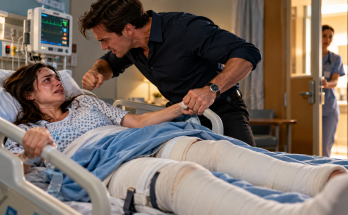
I learned that in a hospital bed, with both legs broken, my ribs aching with every breath, and my husband standing beside me as if I had ruined his entire life.
My name is Rebecca Walker.
I was thirty-six years old when the accident happened.
I had been married to Caleb for eleven years, and we had a daughter named Emma who was eight.
Before the accident, I thought I understood my marriage.
I knew Caleb could be impatient.
I knew he hated being questioned.
I knew that if he came home in a bad mood, the safest thing I could do was keep my voice low and avoid bringing up anything that might upset him.
But I had never imagined that he would look at me in a hospital bed and tell me I was no longer worth the money it took to keep me alive.
That was something I had never prepared myself for.
The hospital room was quiet except for the machines.
There was a monitor beside my bed, a small cabinet near the window, and a plastic cup of water that I could barely reach without making my wrist hurt.
The room smelled of disinfectant and coffee that had been sitting too long.
Someone had left a folded towel on the chair beside the wall.
A nurse had placed my medication chart near the foot of the bed, where anyone entering could see it.
Everything had a place.
Everything had a purpose.
Except me, apparently.
Beep.
I breathed in carefully.
Beep.
I let the air out.
That was how I passed some of the longer hours.
I listened to the monitor and tried to match my breathing to its steady rhythm.
My legs were held in heavy casts that extended from my thighs to my feet.
Even the smallest movement sent pain through my body.
My ribs were fractured.
There were stitches beneath my hair, and my left wrist was swollen enough that the hospital band around it felt uncomfortably tight.
The doctors had explained my injuries more than once.
I understood that recovery would take time.
I understood that I would need help.
What I did not understand was why my husband seemed to consider those facts personal insults.
For twenty-one days, I waited for Caleb to come.
At first, I imagined the ordinary things he might bring.
A clean nightgown.
My phone charger.
A cup of the coffee I liked.
Something small from home that would remind me that I still belonged somewhere outside that room.
I pictured him standing in the doorway with a tired smile, apologizing for being late.
I pictured him asking whether the doctors thought I would walk normally again.
I pictured him sitting beside me and taking my hand.
Those were not unreasonable things to want from a husband.
At least, I did not think they were.
But the first day passed without him.
Then the second.
Then the third.
Each time footsteps approached my door, I looked up.
Sometimes it was a nurse.
Sometimes it was a doctor.
Sometimes it was a member of the hospital staff carrying supplies.
Never Caleb.
I told myself he was busy arranging things at home.
Someone had to take Emma to school.
Someone had to buy groceries and keep track of the bills.
Someone had to explain why her mother had disappeared from the house.
I could think of a hundred reasons for his absence.
I was good at that.
I had spent years finding reasons why Caleb's behavior was not as bad as it seemed.
When he forgot an important date, I reminded myself that work was stressful.
When he spoke sharply to me in front of other people, I told myself he was tired.
When he complained that I spent too much money on groceries, I started comparing prices at different stores.
If he came home angry, I checked the house for things I might have forgotten to do.
I made myself responsible for the atmosphere around him.
If he was happy, I felt relieved.
If he was upset, I felt guilty.
Looking back, that habit embarrasses me more than I can explain.
I thought I was protecting my family.
I was teaching myself to disappear.
After Emma was born, I left my accounting job.
It had not been an easy decision.
I liked my work.
I liked having my own responsibilities, my own colleagues, and money that came from something I had done with my own hands.
But Caleb said Emma needed a parent at home.
He earned more than I did, he explained, and childcare would cost too much.
He said it would only be temporary.
I agreed because I thought we were making a decision together.
Temporary became eleven years.
I learned how to stretch a grocery budget.
I paid the household bills at the kitchen table after Emma went to sleep.
I packed Caleb's lunches and remembered the appointments he forgot.
I went to school meetings, bought birthday presents, arranged playdates, and kept track of the clothes Emma outgrew.
When Caleb needed a document printed or a payment made, he asked me.
When Emma was sick, I stayed home.
When the car needed servicing, I arranged it.
I did all those things because they needed doing.
I never kept a list.
I never expected applause.
I believed that marriage meant two people helping each other carry the weight of a life.
I did not realize how easily one person could begin treating the other as part of the furniture.
Caleb never announced that my work at home had become worthless.
He did not need to.
He showed me in smaller ways.
If I mentioned being tired, he would point out that I had not spent the day at an office.
If I bought something for myself, he wanted to know why it was necessary.
If I asked him to help with Emma, he sometimes sighed as though I had interrupted something important.
I learned to ask for less.
Then I learned to expect less.
Eventually, I started calling that compromise.
The hospital gave me too much time to think about those years.
There was nowhere to go.
I could not get up and walk around the room.
I could not clean something to distract myself.
I could not stand at the kitchen counter and convince myself that everything was fine because dinner was ready and the bills were paid.
I had to lie still and face my own thoughts.
That was harder than I expected.
On the fourth day, a nurse helped me adjust the small photograph taped to the wall beside my bed.
It was a picture Emma had drawn for me.
The paper had been folded in half before someone brought it to the hospital, leaving a faint crease down the middle.
Emma had drawn herself with long brown hair, although her hair was actually cut just above her shoulders.
She had drawn me beside her.
We were holding hands beneath a yellow sun.
The house in the picture had a red roof, and there were flowers growing beside the front door.
Across the bottom, in uneven letters, she had written:
COME HOME SOON, MOMMY.
I asked the nurse to put it where I could see it.
She used a piece of tape to secure the corners.
"There," she said. "Now you have something cheerful to look at."
I thanked her.
After she left, I stared at the picture until my eyes began to sting.
Emma was the reason I kept telling myself I would get through the accident.
I wanted to see her again.
I wanted to sit beside her while she did her homework.
I wanted to hear her complain about vegetables and tell me stories about children in her class.
I wanted to tuck her into bed and listen to her talk about the things that seemed important to an eight-year-old.
I wanted my ordinary life back.
Most of all, I wanted her to feel safe.
That thought followed me through every painful hour.
I did not know then how much I would need to remember it.
The accident itself came back to me in pieces.
A normal afternoon.
A road I had traveled many times.
The sudden confusion of a moment when everything changed too quickly for me to understand it.
I remembered the noise.
I remembered glass.
I remembered struggling to work out where my body was in relation to the car.
Then there were voices, flashing lights, and people asking me questions I could not answer properly.
I remembered trying to move my legs.
I remembered the fear when they would not respond the way I expected.
After that, the memories became less clear.
There were emergency workers.
There was the feeling of being moved.
There were bright lights above me.
I heard someone say my name.
Rebecca Walker.
I held on to those words because they belonged to me.
I was still Rebecca.
I was still Emma's mother.
I was still a person who had been living an ordinary life only hours before.
My hospital admission was recorded at 6:42 p.m.
I learned the time later because I asked a nurse when I had arrived.
For some reason, knowing the exact minute mattered to me.
Perhaps it made the whole thing feel real.
Perhaps I wanted a point in the day I could return to and say, this was where everything changed.
The doctors explained that my injuries would require patience.
They told me not to attempt to stand.
They reminded me to call for help before moving.
A yellow warning notice was attached to my chart to make sure everyone understood that I was at risk of falling.
I followed their instructions.
I asked questions when I needed to.
I tried not to complain unless something was genuinely wrong.
Even in the hospital, I worried about being difficult.
I worried that the nurses were busy.
I worried that someone might think I was exaggerating.
It took me several days to recognize how unreasonable those worries were.
I had broken bones.
I was in pain.
I needed help.
That should have been enough.
Still, whenever I heard someone mention visitors, my thoughts returned to Caleb.
I wondered whether he had called.
I wondered whether he had asked about my condition.
I wondered whether he had spoken to Emma about when she might see me.
Nobody seemed to have an answer that made me feel better.
I tried calling home when I was allowed to use my phone.
Sometimes I reached voicemail.
Sometimes the call went unanswered.
I sent Caleb a message asking him to bring Emma's latest drawing if he visited.
I sent another asking whether Emma was doing all right.
I kept the messages short because I did not want to sound demanding.
He did not come.
I told myself there was still time.
The first week passed.
Then the second began.
My body changed slowly.
The swelling around my wrist became less severe, but the pain in my ribs remained sharp whenever I moved too quickly.
I learned how to ask for help turning in bed.
I learned which position made it easiest to breathe.
I learned to wait for the nurses rather than trying to reach something on my own.
There were humiliations in that process.
I had always been the person who handled things.
Now I had to ask someone to move a cup of water a few inches.
I had to wait for assistance with tasks I had once done without thinking.
Sometimes I cried after the nurses left.
Not because they had treated me badly.
They were kind.
I cried because I missed being independent.
I missed my kitchen.
I missed Emma's voice coming from the next room.
I even missed the ordinary irritation of finding Caleb's shoes in the hallway when he had been asked to put them away.
I wanted the life I knew, including the parts that had hurt me.
That was another thing I had not understood about unhappy marriages.
You could recognize that something was wrong and still miss it when it was gone.
By the beginning of the third week, I had stopped expecting flowers.
I lowered my expectations one small step at a time.
First, I stopped imagining Caleb arriving with a thoughtful gift.
Then I stopped expecting him to stay long enough for a proper conversation.
Finally, I told myself that if he simply appeared at the door, I would be grateful.
I was ashamed of how little I required from him.
But I still wanted him there.
I wanted him to look at my casts and understand that I had not chosen this.
I wanted him to sit beside me and say that he was glad I had survived.
I wanted to believe that eleven years meant something to him.
On the twenty-first day, I woke to the same pale light coming through the hospital window.
My legs felt heavy.
My ribs hurt.
The monitor kept its steady rhythm.
I looked at Emma's drawing and read the words at the bottom again.
COME HOME SOON, MOMMY.
I whispered that I would.
I meant it.
I had no idea that, before the day ended, I would begin to understand that surviving the accident was not the only thing I needed to do.
I would have to survive the person I had spent eleven years calling my husband.
Click here to continue reading: PART 2: The Man Who Finally Walked Through My Hospital Door Was Not Carrying Flowers, and His First Words Made Me Wish He Had Stayed Away
For Twenty-One Days, I Waited for My Husband to Visit With Flowers, Until I Finally Learned What He Thought My Life Was Worth
Part 1 of 20