The following morning, I woke to the sound of a cart moving down the hallway.
Someone was talking quietly near the nurses' station.
The light through the window had turned the wall a pale shade of gold.
I looked at Emma's newest drawing.
It had been placed beside the first one.
The two pictures were different.
In the first, Emma had drawn a house.
In the second, she had drawn us sitting together on a bench.
Neither picture showed Caleb.
I did not know whether that meant anything.
Children draw what they are thinking about at the moment.
I would not turn her pictures into evidence of something she had not said.
Still, I found myself wondering what she understood about our family.
Had she noticed how often I went quiet when Caleb became angry?
Had she learned to check his mood before asking for something?
Had she ever mistaken my silence for happiness?
The questions hurt.
I could not answer them.
But I could make sure I did not ask Emma to take responsibility for the answers.
The nurse came in to check my condition.
She asked whether I wanted the curtains opened a little more.
I said yes.
The morning light spread across the wall.
I could see the drawings more clearly now.
The red roof.
The yellow sun.
The little bench.
The birds above our heads.
I smiled before turning back toward the nurse.
My body was still healing.
There were days when the pain seemed to make every hour longer.
I needed help with ordinary things.
I could not get out of bed by myself.
I could not walk to the bathroom.
I could not prepare a meal or pick up something I had dropped.
I was learning patience because I had no choice.
But I was also learning that needing help did not make me useless.
The nurses helped me because I needed care.
They did not expect me to earn their kindness.
They did not tell me that I was a burden.
They did not remind me how much my treatment cost whenever I asked for assistance.
Their care was not perfect.
They were busy people working long shifts, and sometimes I had to wait.
But when they were delayed, they explained why.
When I said something hurt, they listened.
When they could not answer a question, they tried to find someone who could.
That was what respect looked like in ordinary moments.
I had not realized how much I needed those moments until I experienced them.
Later, the support worker came to discuss possible arrangements for my recovery.
We talked about the practical problems I would face if I returned to the house too soon.
I could not safely manage the stairs without assistance.
I would need help preparing food.
I would need someone to make sure I could reach the things I needed.
I would have medical appointments to attend.
Those details were important even without the situation with Caleb.
With the safety concerns added, the decision became more complicated.
I listened carefully.
Then I asked whether staying somewhere else temporarily might be possible.
The support worker said we could explore options.
I felt both relief and sadness.
I had imagined recovering in my own bedroom.
I had imagined Emma sitting beside me while I rested.
I had imagined the ordinary comfort of familiar things.
But I had also imagined Caleb entering the room whenever he wanted.
I had imagined another argument.
I had imagined being unable to get away if he became angry again.
I could not ignore those possibilities just because I wished they did not exist.
The support worker reminded me that a temporary arrangement did not require me to make every long-term decision immediately.
I wrote that down.
Temporary did not mean failure.
It meant taking the time I needed to recover and decide what came next.
After she left, I looked at the list in my notebook.
The financial questions were still there.
The questions about Emma were still there.
The uncertainty about my marriage remained.
But I added another line.
Find a safe place to recover.
I underlined it once.
I did not underline it because it was more important than Emma or my health.
I underlined it because I had been treating my own safety as something that could wait until every other problem was solved.
It could not wait.
That afternoon, I spoke with my relative again.
She asked how I was doing.
I told her the truth.
I was frightened.
I was angry.
I missed Emma.
I did not know whether my marriage could survive what had happened.
I also did not know whether I wanted it to survive in the same form.
Saying those things aloud made me feel disloyal.
I had spent years defending Caleb when people questioned his behavior.
I had explained his work stress.
I had described the good things he did.
I had tried to make sure other people saw the man I wanted him to be.
Now I was admitting that I did not know what kind of husband he would be when I needed him most.
My relative listened.
She did not tell me what decision to make.
She reminded me that I could take things one step at a time.
I thanked her.
After the call, I felt tired but lighter.
I had not needed to defend myself.
I had not needed to make Caleb sound better than he had behaved.
I had simply told the truth.
The next day, I asked the nurse whether Emma's visit could be arranged when the hospital considered it appropriate.
The nurse said she would continue working with the staff and the people helping with my situation.
I nodded.
I wanted to see Emma.
I wanted to hold her hand and tell her that I loved her.
I wanted to reassure her without pretending I knew exactly what would happen next.
I was learning that honesty could be gentle.
I did not have to tell an eight-year-old every detail about an adult problem.
I could tell her that I was healing.
I could tell her that grown-ups were helping me make safe plans.
I could tell her that she was not responsible for bringing us together.
Most of all, I could keep showing up for her in the ways available to me.
That evening, I studied the picture of the bench.
Emma had drawn the two figures close together.
Their hands almost touched.
There was a small gap between their shoes.
I wondered what she had been thinking when she made it.
Perhaps nothing at all.
Perhaps she had simply run out of room on the paper.
I did not need to know.
I could love the picture without asking it to explain my daughter's feelings.
I could love my daughter without expecting her to reassure me.
I could be honest about my own fear without making it hers to carry.
Those distinctions mattered.
I had spent years believing that keeping a family together was the same as keeping everyone happy.
I now knew that neither was the same as keeping people safe.
A family could share a house and still feel lonely.
A marriage could last eleven years and still contain things that should never have happened.
A mother could love her child deeply and still need help protecting the life they shared.
None of those truths meant that the years had been meaningless.
They meant I had to look at them honestly.
I turned toward the window.
Outside, the day was fading.
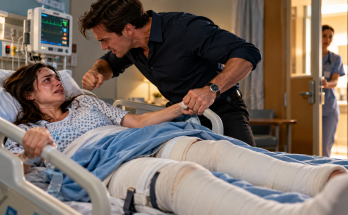
The glass reflected part of the room, including the edge of the bed and the pale shape of my casts beneath the blanket.
I could not see the person I had been before the accident.
I could only see the person I was now.
An injured woman.
A mother missing her daughter.
A wife who no longer knew whether she could return to her marriage.
A person who had begun asking for help.
I was not ready to make every decision.
I was not ready to forgive Caleb.
I was not ready to explain our situation to everyone who might ask.
But I was ready to stop calling my own needs unreasonable.
I looked at the notebook one last time before the nurse dimmed the lights.
The words I had written were still there.
Find a safe place to recover.
I closed the cover and placed it beside my phone.
Then I looked at Emma's drawings.
I wanted to go home to her.
I still did.
But I was beginning to understand that my promise to love her did not require me to return to the same conditions that had brought me so close to losing myself.
I could build something different.
I did not know how yet.
For the first time, I allowed myself to believe that not knowing was not the same as having no choice.
Click here to continue reading: PART 13: I Had Finally Stopped Making Excuses for Caleb, but I Was Not Prepared for How Quickly He Tried to Make Me Doubt Myself Again
For Twenty-One Days, I Waited for My Husband to Visit With Flowers, Until I Finally Learned What He Thought My Life Was Worth
Part 12 of 20