The doctor returned after I had been given time to rest.
My stomach still hurt.
The nurses had adjusted my position, and the monitor had settled into a steadier rhythm.
I could breathe more easily than before, although every breath reminded me that my body had already endured more than enough.
The doctor pulled a chair beside the bed.
A nurse stood nearby with a fresh sheet of paper.
“Rebecca, we're going to ask you a few questions about what happened.”
I nodded.
“You can take your time.”
I looked down at my hands.
I had answered questions all my life.
I had answered questions from teachers, employers, bank representatives, and doctors.
I had spent years explaining household expenses to Caleb.
I knew how to organize information and make it clear.
But I had never been asked to describe my marriage while trying to understand whether I was safe from my husband.
The doctor asked me to explain what had happened from the moment Caleb entered the room.
I told him about the folder.
I told him about the bill.
I told him that Caleb wanted me to leave the hospital.
I explained that I had refused because I could not stand or move my legs safely.
Then I described what he had done.
The words sounded different when spoken aloud.
I had spent so many years softening my descriptions of Caleb's behavior that I almost did it again.
I nearly said he had lost his temper.
I nearly said we had argued.
I nearly said things had gotten out of hand.
But those phrases left out the part that mattered.
He had grabbed me.
He had pulled me.
He had hit me.
So I said those things plainly.
The nurse wrote down my answers.
Nobody interrupted me.
When I finished, the doctor asked whether I had experienced any similar physical incidents before.
I stared at him.
The question brought back memories I had never placed together.
There had been arguments when Caleb stood too close to me.
There had been times he grabbed an object from my hand so sharply that my fingers hurt.
There had been moments when he slammed a cupboard door or struck the kitchen counter because I had disagreed with him.
I had told myself those things did not count.
He had never done exactly what he had done in the hospital.
At least, that was what I had believed.
I hesitated.
The doctor did not rush me.
Finally, I shook my head.
“Not like this.”
He nodded and made a note.
I wondered whether I had answered honestly.
I wondered whether there were other things I had forgotten or deliberately pushed aside.
Memory is strange when you have spent years protecting someone.
You remember the good days easily.
You remember the funny things they said.
You remember the holiday when everything went well and the evening they brought home your favorite food.
The painful moments become smaller.
You explain them away.
You arrange them so they do not threaten the life you are trying to maintain.
I had done that for years.
I could not undo it all in one afternoon.
The doctor explained that they wanted to monitor my symptoms and check whether the new pain suggested an additional injury.
He told me to alert the nurses if my breathing became difficult or if the pain changed.
I listened carefully.
I asked a few questions.
When he finished, I thanked him.
He looked at me for a moment.
“You don't need to apologize for needing medical care.”
I had not realized I was about to.
My mouth had already begun forming the words.
The doctor left to arrange the next steps.
The nurse stayed.
She asked whether I wanted someone from the hospital's support team to speak with me.
I said yes before I had time to reconsider.
I was surprised by my own answer.
For years, I had avoided telling anyone about the problems in my marriage.
I did not want my family to worry.
I did not want Caleb to feel embarrassed.
I did not want friends to ask questions I could not answer.
I had convinced myself that private problems should stay private.
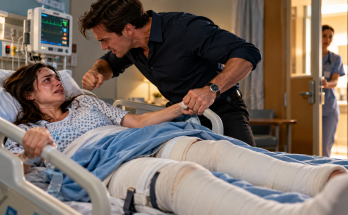
But my private problem had become a man standing over my hospital bed with his fists raised.
I could no longer pretend that keeping it secret made it harmless.
While I waited, the nurse brought me fresh water.
She placed the cup where I could reach it without stretching.
Then she straightened the blanket over my legs.
Her movements were simple and careful.
I watched her and thought about how little it took to make someone feel respected.
She did not need to know my entire life story.
She did not need to agree with every decision I had ever made.
She only needed to recognize that I was injured and treat me accordingly.
I had spent years asking for less than that.
When the support worker arrived, she introduced herself and pulled a chair beside my bed.
She spoke quietly.
She explained that her job was to help patients think through their immediate safety and understand what support might be available.
She did not tell me what I had to do.
She asked what I wanted.
That question made me uncomfortable.
I was so accustomed to responding to other people's needs that I struggled to answer.
“I want to get better,” I said.
She nodded.
“What else?”
I looked toward Emma's drawing.
“I want to see my daughter.”
“What would help you feel safe while you're here?”
I thought of Caleb standing over me.
I thought of the way I had flinched when he reached toward me.
“I don't want him alone in my room again.”
She wrote that down.
“That's something we can discuss with the hospital team.”
I felt my shoulders loosen slightly.
It was the first practical decision I had made that day without considering Caleb's reaction.
The support worker asked whether I had somewhere else I could stay if I did not feel safe returning home.
I did not know.
Our house was in both our names.
Our bills came from the account I had helped manage.
My belongings were there.
Emma's school was there.
The furniture, the photographs, and the small things I had collected over the years were all there.
I had built my daily life around that house.
The thought of leaving it felt impossible.
But the thought of returning with Caleb after what had happened felt worse.
“I need time to think,” I said.
“You can have time.”
She did not demand an answer.
We talked about Emma.
I explained that my daughter was eight and that she had been staying at home while I was in the hospital.
I did not know exactly what Caleb had told her about the accident.
I did not know whether he had explained why he had not visited.
I worried about what she might be thinking.
The support worker listened.
She suggested that the hospital team could help arrange communication with Emma in a way that did not put pressure on me.
I agreed.
After she left, I asked the nurse whether I could use my phone.
She brought it from the cabinet and placed it in my hand.
The screen had several notifications.
Most were ordinary messages and reminders.
I looked for something from Caleb.
There was a message I had received the previous week asking whether I knew where a household document was kept.
I remembered reading it while waiting for medication.
I had answered with the location.
He had not asked how I was feeling.
He had not asked whether I was sleeping.
He had not asked whether I needed anything.
I scrolled farther.
There was a message from a friend asking how I was recovering.
I had replied that I was doing better.
I had added a smiling face because I did not want her to worry.
I stared at that little symbol.
I had told people I was doing better because it was easier than explaining how lonely I felt.
I had told myself I was protecting them from worry.
Maybe I was also protecting the version of my marriage I wanted them to believe in.
I placed the phone on my chest and closed my eyes.
I could not solve everything that afternoon.
I could not decide where I would live.
I could not know what Caleb would say to Emma.
I could not change eleven years of habits in a single conversation.
But I could stop pretending that the hospital incident had been a misunderstanding.
I could tell the truth about what happened.
I could ask for help.
Those were small decisions.
They were also mine.
Later that afternoon, a staff member came to explain that Caleb would not be allowed to return to my room without the hospital team addressing the incident.
I felt relief.
Then guilt followed.
I had not expected guilt to arrive so quickly.
I imagined Caleb standing in the hallway, angry because he had been asked to wait.
I imagined him telling someone that I had exaggerated.
I imagined him saying that I had made him look like a bad husband.
I wanted to explain myself to him.
I wanted to say that I had not planned any of this.
I wanted to reassure him that I was not trying to punish him.
Then I remembered the pain in my stomach.
I remembered his hand around my arm.
I remembered the way he had ignored my request to stop.
I let the guilt remain without obeying it.
That was new for me.
I did not have to make the feeling disappear before I could make a decision.
I could feel guilty and still protect myself.
I could miss my husband and still refuse to be alone with him.
I could want my family together and still recognize that the situation was not safe.
That evening, the nurse checked the photograph on the wall.
The loose corner had come away completely.
She asked whether I wanted her to tape it back.
“Yes, please.”
She smoothed the paper against the wall and secured all four corners.
The picture sat straight again.
For a long time, I looked at the little house.
I did not know what the next weeks would bring.
But I knew one thing.
I would not let anyone tell me that what had happened in that room was nothing.
Click here to continue reading: PART 7: I Had Always Managed Our Family’s Money, but the Brown Folder Beside My Bed Made Me Question What Caleb Had Really Come to Collect
For Twenty-One Days, I Waited for My Husband to Visit With Flowers, Until I Finally Learned What He Thought My Life Was Worth
Part 6 of 20