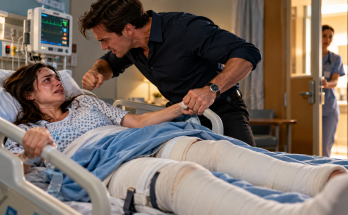
The following morning, I woke before the nurse arrived.
The room was quiet.
My stomach remained tender, but the pain had become easier to describe.
I could tell the nurse where it hurt and when it worsened.
That felt like progress.
She checked my medication and asked whether I had slept.
“A little.”
She adjusted the pillow behind my shoulders.
“Let us know if anything changes.”
I nodded.
After she left, I looked toward the cabinet.
The brown folder Caleb had brought was gone.
I did not remember anyone taking it.
For a moment, I wondered whether I had imagined the whole thing.
Then I remembered the folder opening in his hands.
I remembered the pages sticking out.
I remembered the way he had spoken about the next payment.
The memory was too clear to dismiss.
I asked the nurse whether the hospital had kept any paperwork Caleb brought into the room.
She said she would check with the staff.
I did not know why the folder mattered so much.
It was only paperwork.
But I had spent years handling our household bills, and I knew how Caleb behaved when money became an argument.
He liked figures when they supported his position.
He disliked explanations that complicated his decisions.
When I had worked as an accountant, I learned to look at the details before accepting a conclusion.
A total meant very little without knowing what had been added together.
A payment did not tell you who had agreed to make it.
A signature did not tell you whether the person signing understood what they were accepting.
I had not worked in an office for years, but those habits had stayed with me.
I wanted to know what was in the folder.
Not because I believed it explained his behavior.
Nothing could make what he had done acceptable.
I wanted to understand what he had been trying to accomplish when he walked into my room.
The nurse returned later and explained that the hospital had documented the incident.
She could not answer every question about the paperwork, but she told me the appropriate staff members would handle it.
I thanked her.
Then I asked whether I could speak with someone about my financial situation.
She arranged for the support worker to return.
When the woman arrived, I explained that I had not worked outside the home since Emma was born.
I told her that I had managed the household bills, but Caleb usually handled conversations about major expenses.
I had access to our accounts for ordinary payments.
I knew our monthly costs.
I did not know exactly what arrangements Caleb had made while I was in the hospital.
The support worker listened and suggested that I gather whatever information I could safely access before making decisions about returning home.
She reminded me that I did not have to settle everything immediately.
I was grateful for that.
I had spent so much time worrying about the next bill, the next argument, and the next demand that I had forgotten how to consider a problem one step at a time.
That afternoon, I asked for my phone again.
I opened the banking application.
The screen took a moment to load.
I knew the account.
I had used it to pay for groceries, school supplies, utilities, and the other expenses that kept our household running.
The balance was lower than I expected.
I checked the recent transactions.
There were ordinary purchases.
There were payments I recognized.
There were also several larger withdrawals I could not immediately explain.
I looked at the dates.
Some had occurred while I was in the hospital.
Others were from the days before the accident.
I did not know whether they were connected to my treatment.
I did not know whether Caleb had moved money for household expenses.
I could not draw a conclusion from a screen full of figures.
But I knew I needed to understand what I was looking at.
I took screenshots of the transactions and saved them.
My hands were still unsteady, so I had to try more than once.
I felt strange doing it.
I had never thought of keeping financial records as something that might protect me from my husband.
I had always thought of the records as a way to make our family function.
I remembered the kitchen table where I paid the bills.
I remembered Emma sitting nearby with crayons while I checked due dates.
I remembered Caleb asking whether I had paid a particular account, then walking away before I could explain the rest of the month's expenses.
Those memories had once seemed ordinary.
Now they made me wonder how much of our financial life I truly understood.
I did not accuse him of anything.
I did not know enough to do that.
I simply began keeping track.
When the support worker returned, I told her I had found transactions I did not recognize.
She advised me to preserve the records and seek appropriate financial guidance before making assumptions.
She also reminded me not to confront Caleb alone while I was worried about my safety.
I agreed.
I had no intention of calling him and demanding an explanation.
I was not strong enough for another confrontation.
More importantly, I was beginning to understand that I did not need to settle the question of money before protecting myself.
The two problems were related.
They were not the same.
Whatever the folder contained, it did not give Caleb the right to hurt me.
That evening, I asked the nurse whether Emma could visit when arrangements were possible.
The nurse said she would help me find out.
I wanted to see my daughter more than I wanted answers about the account.
I wanted to hold her hand.
I wanted to tell her I loved her.
I wanted to see whether she had been sleeping well.
I worried that she might think I had chosen to stay away.
Children often try to explain things with the information they have.
Emma might have heard that I was sick.
She might have heard that I could not come home.
She might have been told that I was making things difficult.
I did not know.
The uncertainty hurt more than I expected.
I asked whether I could send her a voice message.
The nurse helped me position the phone so I could record without straining.
I spoke slowly.
“Hi, sweetheart. It's Mommy.”
I paused.
I had rehearsed what I wanted to say.
Now that I was recording, the words seemed too small.
“I miss you very much. I'm getting care here, and the doctors are helping me get better.”
I took a breath.
“I love you. None of this is your fault, and you don't have to worry about fixing anything.”
My voice trembled on the last sentence.
I stopped recording.
I listened to it once.
Then I sent it through the arrangement the hospital had helped me make.
I did not know when Emma would hear it.
I only knew I had finally said something I should have said long ago.
She was not responsible for keeping our family peaceful.
She was not responsible for her father's feelings.
She was not responsible for my injuries.
She was a child.
She deserved to be a child.
The next morning, the support worker brought me information about financial counseling and practical assistance for patients who might not be able to return immediately to their homes.
I read the pages slowly.
There were phone numbers.
There were explanations of services.
There were spaces to write down questions.
I had spent years believing that I could handle everything if I stayed organized.
Now I was learning that being organized did not mean doing everything alone.
I wrote three questions on the back of a spare sheet.
How could I understand the accounts?
What would I need if I could not return home immediately?
How could I arrange to see Emma safely?
I stared at the list.
It was not a plan for my whole future.
It was a beginning.
When the nurse came to check on me, she noticed the paper beside my phone.
“Making a list?”
I nodded.
“Trying to.”
She smiled gently.
“One thing at a time.”
I looked at the three questions again.
One thing at a time.
For the first time in years, I did not feel that I had to solve every problem before I was allowed to rest.
I folded the paper and placed it beside the photograph.
The drawing showed a house with a red roof.
I still loved that picture.
I still wanted Emma to have a home where she felt safe.
But I was beginning to understand that the house itself could not guarantee that feeling.
A home was not safe simply because the bills were paid and the front door had a familiar lock.
It had to be a place where people could say no without being hurt.
It had to be a place where pain was taken seriously.
It had to be a place where a child could see love without learning to fear the person offering it.
I did not know yet whether Caleb and I could ever have that kind of home together.
I only knew I could no longer pretend that the old one had been enough.
Click here to continue reading: PART 8: When I Finally Spoke to Emma, I Realized I Could Not Promise Her Everything Would Return to Normal, Only That I Would Tell Her the Truth
For Twenty-One Days, I Waited for My Husband to Visit With Flowers, Until I Finally Learned What He Thought My Life Was Worth
Part 7 of 20