The call came two days later.
A nurse brought my phone and told me the arrangements had been made for me to speak with Emma.
I sat as upright as I could manage.
The pillow supported my back.
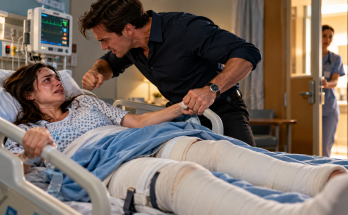
My legs remained fixed in their casts, and my ribs still hurt when I breathed too deeply.
I wiped my palms against the blanket.
I had imagined this conversation many times.
In some versions, Emma cried as soon as she heard my voice.
In others, she talked happily about school and asked when I was coming home.
I had prepared answers for questions I thought she might ask.
I had not prepared for the possibility that she might be quiet.
The phone rang.
Then I heard her voice.
“Mommy?”
I closed my eyes.
“Hi, sweetheart.”
“Are you coming home today?”
The question was so simple that I could not answer immediately.
I wanted to say yes.
I wanted to tell her that I would be home by dinner, that I would tuck her into bed, and that everything would be as it had been before the accident.
But I did not know when I would be able to leave the hospital.
I did not know where I would go afterward.
I did not know what Caleb had told her.
I could not promise something just because I wanted it to be true.
“Not today, sweetheart. The doctors are still helping me heal.”
There was a pause.
“Are your legs still broken?”
“Yes.”
“Both of them?”
“Yes, both.”
Another pause followed.
I imagined her sitting somewhere with the phone held close to her ear.
I wished I could see her face.
“Does it hurt?”
“Sometimes.”
I tried to keep my voice calm.
“But I'm getting help, and I'm taking care of myself.”
She was quiet for a moment.
Then she asked, “Did you get my picture?”
I looked at the wall.
The drawing was still there, its corners secured with tape.
“I did. It's right beside my bed.”
“Is the house still red?”
I smiled despite the pain.
“Yes. And the sun is yellow.”
“I made the sun bigger because I thought you needed more sunshine.”
That was the moment I began to cry.
I turned my face slightly toward the pillow.
I did not want her to hear me crying and believe she had done something wrong.
“It's beautiful, sweetheart.”
“Daddy said you have to get better before you come home.”
I held my breath.
There it was.
The first piece of information about what Caleb had told her.
I did not know whether he had explained anything else.
I did not know whether she had seen him angry.
I did not know whether she had heard him complain about the hospital.
I could not question her as though she were responsible for reporting on him.
She was eight.
She needed her mother, not another problem to solve.
“The doctors are helping me get better,” I said.
“Are you sad?”
I looked at the photograph.
“Yes, a little.”
“Because you miss me?”
“Very much.”
“I miss you too.”
I pressed the phone closer to my ear.
“I love you, Emma.”
“I love you, Mommy.”
We sat quietly for a few seconds.
Then she began telling me about a class activity.
Her teacher had asked the children to draw something they wanted to do with their families.
Emma had drawn us walking in a park.
She said she had included a bench because she liked sitting beside me when we got tired.
I listened to every detail.
I asked what color she had used for the trees.
I asked whether she had drawn the little pond near the playground.
I asked whether she had remembered to put birds in the sky.
She answered each question with the seriousness of someone describing an important event.
For those few minutes, I was simply her mother.
I was not a patient.
I was not a woman trying to understand what had happened in her marriage.
I was not a person frightened of going home.
I was the person listening to her daughter describe a drawing.
It felt like being given a small part of my life back.
Then Emma asked another question.
“Are you going to be okay?”
I looked at the ceiling.
I wanted to give her certainty.
I wanted to tell her that I would recover quickly and that nothing bad would happen again.
But I had already spent too many years using comforting words to cover things I did not understand.
I could not do that to her.
“The doctors are taking care of my body,” I said. “And I'm getting help with everything else, too.”
“What does that mean?”
“It means I don't have to handle everything by myself.”
She seemed to consider that.
“Like when I ask you to open the jam jar?”
I laughed softly.
“Exactly like that.”
“Because I can't open it when it's stuck.”
“Sometimes grown-ups need help with things that are stuck, too.”
She laughed.
The sound filled the room.
I held on to it.
After a while, she asked when she could visit.
I told her the hospital team was helping us work that out.
I said I wanted to see her as soon as it could be arranged.
I did not promise a date.
I did not tell her that everything would be normal when she arrived.
I only told her the truth I knew.
“I want to see you very much, sweetheart.”
“I'll bring you another picture.”
“I would love that.”
When the call ended, I kept the phone in my hand.
I stared at the dark screen.
I had been afraid that telling Emma anything less than a perfect story would hurt her.
But she had not asked me to explain my marriage.
She had asked whether I was coming home.
She had asked whether I was hurting.
She had asked whether I would be okay.
She needed honest answers that she could understand.
She did not need me to pretend that I had control over everything.
The nurse came in a little later.
She noticed my wet cheeks and handed me a tissue.
“How did it go?”
“Good,” I said.
Then I thought about the word.
It had not been easy.
I had cried.
I had avoided questions I could not answer.
I had admitted that I was sad.
But Emma had heard my voice.
She knew I was thinking about her.
She knew I loved her.
“Yes,” I said again. “It was good.”
That afternoon, the support worker returned to discuss the next steps.
She asked whether I still wanted Caleb kept away from my room unless the hospital team arranged otherwise.
I said yes.
This time, the answer came without a long pause.
She asked whether I had thought more about where I might go after discharge.
I told her I had begun considering alternatives.
I could not care for myself alone yet.
I would need help with basic tasks until my injuries improved.
I would also need a safe place to recover.
She explained that we could continue looking at practical options while the doctors assessed my progress.
I wrote down the information.
Then I asked whether I could have a copy of the hospital's documentation of the incident when it was appropriate.
She said she would help me understand the process.
I wanted a record.
Not because I had decided to punish Caleb.
Not because I knew what would happen to our marriage.
I wanted something that could not be changed by an argument later.
I wanted the facts written down somewhere outside my memory.
For years, I had allowed Caleb's version of events to replace my own.
He would explain what I had meant.
He would tell me why I had reacted.
He would insist that a disagreement had happened differently from the way I remembered it.
Eventually, I began questioning myself.
I no longer wanted to live that way.
The support worker left me with the information.
I read it twice and placed it beside my list of questions.
There were still many things I did not know.
I did not know whether Caleb would apologize.
I did not know whether he would blame me.
I did not know whether he would tell Emma that I had refused to come home.
I did not know what our finances would look like when I could finally review them properly.
But I knew I could ask questions.
I knew I could keep records.
I knew I could tell the truth about what had happened in that room.
Those facts did not solve everything.
They gave me somewhere to begin.
That evening, I looked at Emma's drawing before the nurse dimmed the lights.
The paper showed a house with a red roof, flowers by the door, and a yellow sun above it.
I had once looked at the picture as a promise that I would return to the life I knew.
Now I saw something else.
It was a picture made by a child who wanted her mother home.
It did not say that I had to return to the same marriage.
It did not say that I had to pretend nothing had happened.
It did not say that love required me to accept being hurt.
It only said that Emma wanted me.
I could work with that.
I could recover.
I could ask for help.
I could find a way to be her mother without teaching her that a woman must endure anything to keep a family together.
I reached toward the picture as far as my arm allowed.
My fingers could not quite touch the paper.
So I let my hand rest on the blanket.
For the first time since the accident, I did not feel that I had to make a promise about what my future would look like.
I only had to keep moving toward a life in which my daughter and I could feel safe.
Click here to continue reading: PART 9: I Thought the Worst Part Would Be Learning to Walk Again, Until I Realized I Had to Rebuild a Life I Barely Recognized
For Twenty-One Days, I Waited for My Husband to Visit With Flowers, Until I Finally Learned What He Thought My Life Was Worth
Part 8 of 20