The morning after I spoke with Emma, I woke up thinking about the word home.
It had always meant one place to me.
Our house.
The kitchen table with the small scratch near one corner.
The hallway where Emma left her schoolbag.
The bedroom where Caleb and I had slept for eleven years.
I knew where everything belonged.
I knew which cupboard held the mugs and which drawer stuck whenever I pulled it too quickly.
I knew how the front door sounded when it closed properly.
For years, those familiar things had made me feel settled.
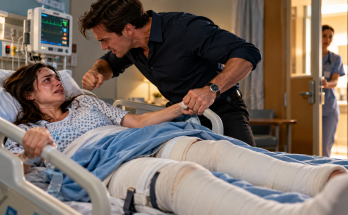
Now I could not picture myself walking through that door without remembering what had happened in the hospital.
I tried to push the thought away.
My legs were still in casts, and I had enough physical problems to occupy my mind.
The doctors were discussing my recovery.
The nurses were helping me manage my pain.
I needed to concentrate on getting stronger.
But the questions about home followed me through the day.
A nurse came in to check my medication.
She asked whether I had slept well.
I told her I had.
It was only partly true.
I had slept for a few hours, then awakened thinking about Caleb's face when I refused to move.
I remembered the surprise in his eyes.
I remembered how quickly it turned into anger.
I remembered the monitor sounding while he stood over me.
The memory made my stomach tighten.
I took a slow breath.
The nurse noticed my expression.
“Are you hurting?”
“A little.”
She checked the chart and asked me to describe the pain.
I answered honestly.
That had become one of the small changes I was trying to make.
If something hurt, I said so.
If I needed help, I asked.
I did not apologize before speaking.
It sounds simple.
For me, it was not.
Later that morning, the doctor explained that my injuries would continue to require careful management.
My legs would need time to heal.
My ribs would remain painful for a while.
I would need assistance with everyday activities after leaving the hospital.
I listened and asked what I could reasonably expect to do on my own.
He answered without making me feel foolish for asking.
I wrote down a few details.
Then I asked about the possibility of going home.
The doctor did not tell me that I could never return.
He simply explained that my discharge plan had to account for my medical needs and the support available to me.
I understood what he meant.
I could not be sent somewhere I could not safely manage.
And after what had happened, the question was no longer only whether I could get through the front door.
It was whether I would be safe once I was inside.
The support worker came by after lunch.
She had brought the information we discussed earlier, along with a few additional questions about my circumstances.
She sat beside the bed and asked whether I had made any decisions.
I looked at the paper in my hands.
“No final decisions.”
“That is all right.”
“I still don't know what to do about my marriage.”
She nodded.
“You don't have to decide that today.”
I looked toward the window.
For years, I had believed that marriage was a problem I had to solve by finding the right balance between two people.
If Caleb was unhappy, I tried to understand why.
If we argued, I looked for the words that might settle things.
If he refused to discuss something, I waited until he was in a better mood.
I thought every problem had a solution if I was patient enough.
Now I was beginning to understand that a marriage could not be repaired by one person doing all the work.
I could not make Caleb respect me by becoming easier to control.
I could not make him care about my pain by pretending it was smaller.
I could not create a safe home by accepting responsibility for his anger.
“I keep thinking that perhaps things could have been different if I had handled him better,” I admitted.
The support worker let the words sit for a moment.
“What happened was his responsibility.”
I looked down.
I had heard similar words from the nurse, but I still struggled to accept them.
I wanted a reason that made the past easier to understand.
If I had caused the problem, then perhaps I could fix it.
If I had chosen the wrong words, perhaps I could choose better ones.
If I had failed as a wife, perhaps I could become a better one.
That way of thinking gave me something to do.
It also kept me from looking directly at what Caleb had chosen to do.
The support worker did not tell me what my marriage meant.
She did not tell me whether to leave him.
She reminded me that I could make decisions based on my safety and Emma's needs.
I thanked her.
After she left, I took out the list of questions I had written earlier.
I crossed out the first one only after adding a note beside it.
Understand the accounts before making any financial decisions.
The second question remained.
Where could I recover safely if I could not return home?
The third remained too.
How could I arrange to see Emma?
I read them twice.
They were practical questions.
They did not require me to predict the rest of my life.
I could begin there.
That afternoon, the nurse helped me call a relative who had offered support when she heard about the accident.
I had not wanted to involve anyone before.
I was afraid that telling the truth would make the situation permanent.
Once someone knew what Caleb had done, I could not return to pretending it had never happened.
But the pretending had already cost me too much.
When my relative answered, I tried to speak normally.
We talked briefly about my injuries.
She asked how I was managing.
I almost said I was fine.
Instead, I told her that Caleb had come to the hospital and hurt me.
There was a long silence.
Then she asked whether I was safe.
The question nearly broke me.
I had spent so long worrying about whether Caleb was upset that I had stopped asking whether I was safe.
“Yes,” I said. “I'm safe here.”
She asked what I needed.
I told her I was still working that out.
She did not demand a complete explanation.
She did not tell me I should have left years ago.
She did not ask why I had tolerated his behavior.
She simply said she was sorry and that she wanted to help.
I cried after we ended the call.
Not because the conversation had gone badly.
Because it had not.
I had expected judgment.
Instead, someone had listened.
That evening, I looked at Emma's drawing.
The paper was still straight against the wall.
The red roof, the flowers, and the yellow sun were exactly as she had drawn them.
I wondered what she would remember about this time when she was older.
Would she remember the accident first?
Would she remember waiting for me to come home?
Would she remember the things her father said?
I could not control every memory she would carry.
But I could choose what I did next.
I could make sure she knew that none of this was her fault.
I could make sure she did not have to choose between loving her parents and telling the truth.
I could show her that asking for help was not a betrayal.
I could show her that love did not require silence.
Those were things I could begin doing even while I was still lying in a hospital bed.
Before the lights were dimmed, I asked the nurse to leave my phone within reach.
I checked whether there was a message from Emma.
There was not.
I was disappointed, but I did not let myself turn that disappointment into a story about being forgotten.
She was a child.
She had a life beyond this room.
She was allowed to play, learn, laugh, and have ordinary days while I recovered.
I placed the phone beside the water cup.
Then I looked at the three questions on my paper.
I did not have all the answers.
For once, I allowed that to be enough.
Click here to continue reading: PART 10: The First Time I Looked Closely at Our Bank Account, I Realized I Needed Facts More Than I Needed Another Explanation From Caleb
For Twenty-One Days, I Waited for My Husband to Visit With Flowers, Until I Finally Learned What He Thought My Life Was Worth
Part 9 of 20