The first message arrived just after breakfast.
I was sitting against my pillows, trying to finish the water beside my bed, when my phone vibrated on the cabinet.
Caleb's name appeared on the screen.
I stared at it for several seconds.
I had grown used to seeing his name without feeling happy.
That was a change I had not expected.
For years, his messages had been part of my daily routine.
He would ask about dinner, remind me about a bill, or tell me he needed something from the store.
I usually answered quickly.
Even when I was busy, I found a way to reply.
I had treated his requests as responsibilities that could not wait.
Now I let the phone vibrate once more before picking it up.
His message asked when I planned to stop making things difficult.
There was no question about my recovery.
No mention of the pain I had described to the doctors.
No apology for what had happened in the room.
I read it twice.
Then I placed the phone on the blanket.
My stomach tightened, and I had to remind myself to breathe slowly.
I knew that feeling.
It was the same one I used to get when I heard his car pull into the driveway after a difficult day.
I would begin reviewing the house in my mind.
Was dinner ready?
Had I paid the bill he mentioned?
Was Emma's schoolbag packed?
Had I forgotten anything that might give him a reason to complain?
I had learned to prepare for his mood before he even entered the house.
That morning, I caught myself doing it again.
I began wondering what I had done to make him send the message.
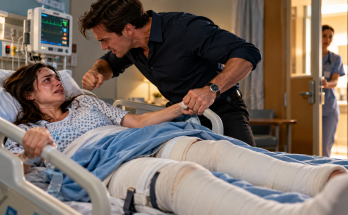
Then I remembered the hospital bed.
I remembered his hand around my arm.
I remembered the pain when he struck me.
I had not created those things by asking him to stop.
I did not need to accept responsibility for his response.
I reached for my notebook and opened it to the page with the sentence I had written earlier.
I am not responsible for making Caleb comfortable with my safety.
I read it slowly.
Then I turned the page and wrote down the date and time of his message.
I did not know whether I would ever need that information.
I simply wanted a clear record of what had happened.
When the nurse came in, she found me looking at the phone.
“Everything all right?”
“I received another message from my husband.”
She glanced at me.
“Would you like me to contact the support worker?”
I nodded.
It was still difficult to ask for help.
But I was beginning to understand that I did not have to wait until something became unbearable before speaking.
The support worker arrived later that morning.
I showed her the message and explained that Caleb wanted to discuss my return home.
She listened without making assumptions about what he intended.
Then she asked what I wanted to happen.
“I want to focus on getting better without arguing with him.”
“That sounds reasonable.”
“I also don't want to be alone with him.”
She wrote that down.
I watched her pen move across the paper.
It was a small thing, but I felt less alone knowing that my concern was being taken seriously.
We discussed how future communication could be handled through appropriate arrangements while the hospital worked on my discharge plan.
I did not have to answer Caleb immediately.
I did not have to defend my decision in a private conversation.
I could allow other people to help keep the discussion focused on my medical needs and safety.
That afternoon, Caleb sent another message.
This time, he said I was embarrassing him.
I felt the old guilt rise before I finished reading.
I pictured him explaining the situation to relatives.
I imagined him telling people that I had turned a family disagreement into something much larger.
I wondered whether anyone would believe me if he denied what had happened.
Then I looked at my casts.
I looked at the yellow warning notice on my chart.
I remembered the nurse entering the room while the monitor sounded.
There were people who had seen the immediate aftermath.
There were medical records.
There was my own account, given while the details were still clear.
I did not need to persuade every person in the world before I was allowed to trust what I knew.
I put the phone down.
The message remained unanswered.
For the rest of the afternoon, I concentrated on my recovery.
I listened to the doctor explain the next stage of my care.
I asked the nurse about pain that had changed slightly.
I practiced the movements I had been instructed to make without putting weight on my legs.
Each task required patience.
I was learning that progress did not always look like doing more.
Sometimes it meant not forcing my body to do something it could not safely manage.
That lesson seemed to apply to the rest of my life as well.
I could not force Caleb to understand.
I could not force him to apologize.
I could not force myself to make a decision about eleven years of marriage in a few days.
I could take the next safe step.
That evening, I received another picture from Emma.
It showed the little house again.
This time, she had drawn a path leading from the front door to a tree.
There were flowers along the path, and the sun was near the top of the page.
I smiled as I looked at it.
I wondered whether she had drawn the picture at school or at home.
I wondered whether she had asked her father to send it.
I did not ask her to explain.
I sent back a message telling her that I loved the flowers.
Then I told her I was proud of her for sharing her drawing with me.
I did not mention Caleb's messages.
I did not tell her that I was worried about going home.
I did not ask her what her father had said about me.
She deserved a relationship with her mother that did not require her to become a messenger between adults.
I had to protect that relationship from the problems I was trying to solve.
Later, when the nurse came to dim the lights, she asked whether I needed anything.
I looked at the phone.
For a moment, I considered checking whether Caleb had sent another message.
Then I decided to leave it where it was.
“I'm all right for now,” I said.
She smiled and wished me a good night.
I looked at Emma's drawings on the wall.
The first showed the house.
The second showed us on a bench.
The newest showed a path leading away from the door.
I did not try to decide what the pictures meant.
I only let myself enjoy them.
For once, I did not spend the last minutes of the day preparing an explanation for Caleb.
I closed my eyes and rested.
Click here to continue reading: PART 14: When the Hospital Asked Where I Would Recover, I Had to Admit That the House I Had Maintained for Eleven Years Might Not Be Safe for Me
For Twenty-One Days, I Waited for My Husband to Visit With Flowers, Until I Finally Learned What He Thought My Life Was Worth
Part 13 of 20