
The doctor spoke to me about discharge the following morning.
He explained that the medical team was considering what care I would need after leaving the hospital.
My injuries were still serious.
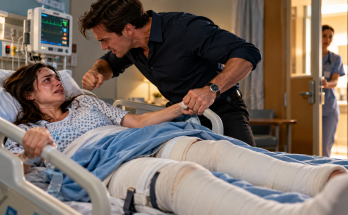
My legs remained immobilized in their casts, and I could not move around independently.
I would need help with basic tasks and follow-up appointments.
I listened carefully.
Then he asked whether I had a safe place to recover.
I looked at him.
The question was direct, but I found it difficult to answer.
For years, I would have said home without thinking.
Our house was where I had raised Emma.
It was where I had cooked meals, paid bills, and kept track of our family's routines.
It was where I had watched my daughter grow from a baby into a little girl who drew houses with red roofs.
I had worked hard to make that place comfortable.
I had cleaned it, organized it, and tried to keep arguments away from Emma whenever possible.
I had believed those efforts were enough to make it a home.
Now I had to consider the possibility that returning there could put me in a position where I was vulnerable again.
“I don't know yet,” I admitted.
The doctor nodded.
He did not appear disappointed in me.
He explained that the team needed to know my concerns so they could plan appropriately.
I told him I was afraid of being alone with Caleb.
I told him what had happened when he visited.
I explained that I could not defend myself physically if he became angry again.
Saying it plainly made the situation feel more real.
I was not a woman who could simply walk away from a confrontation.
I could not even stand without assistance.
My recovery depended on people helping me.
I needed a place where that help would not become another source of fear.
The doctor said he would coordinate with the appropriate hospital staff.
I thanked him.
After he left, I looked toward the window.
The glass reflected the bed and the pale outline of my casts.
I felt grief.
Not only for what Caleb had done, but for the home I had believed I was returning to.
I had imagined coming through the front door with Emma waiting in the hallway.
I had imagined sitting at the kitchen table while she told me about school.
I had imagined returning to the ordinary routines that had once made me feel useful.
Now I had to separate those hopes from the place itself.
I could still love my daughter.
I could still want ordinary family moments.
I could still miss parts of my marriage.
None of those feelings meant I had to return before I was ready.
The support worker came by later that morning.
She had spoken with the medical team and wanted to discuss possible arrangements.
We talked about my mobility, my need for assistance, and the safety concerns I had described.
She explained that any plan would have to account for both my physical condition and the situation with Caleb.
I listened.
Then I asked whether staying with a relative might be possible while I recovered.
She said we could explore that option.
I felt a mixture of relief and embarrassment.
I had been the person who offered help for years.
I was the one relatives called when they needed someone to organize a family gathering or look after a child for an afternoon.
I was used to saying, “Don't worry. I'll take care of it.”
Now I needed someone else to take care of me.
I was afraid of becoming a burden.
The thought came so quickly that I almost said it aloud.
Then I remembered Caleb using that word.
A burden.
I remembered how it had felt to hear it from the person I had trusted most.
I did not want to carry his judgment into every other relationship.
Needing help was not the same as being worthless.
I had to learn that difference.
The support worker asked whether I wanted to contact my relative about a temporary place to stay.
“Yes,” I said.
My voice was quiet, but the answer came without hesitation.
We arranged a call.
When my relative answered, I explained that the hospital was helping me plan for discharge.
I told her I would need practical assistance while my legs healed.
Then I explained that I did not feel safe returning home to Caleb immediately.
There was a pause.
I waited for the questions I had been dreading.
Why hadn't I told anyone before?
What had I done to make him so angry?
Was I sure I wasn't misunderstanding him?
Instead, she asked what the doctors expected me to need.
I described the casts and the restrictions on my movement.
She listened and said we could talk through the practical details.
She did not promise that everything would be easy.
She did not pretend that caring for an injured adult would require no effort.
She simply offered to help me explore what was possible.
That was enough.
After the call, I sat quietly for a while.
I felt grateful.
I also felt sad that I had waited so long to tell someone the truth.
I had spent years worrying that people would judge my marriage.
I had been so concerned about how Caleb would look that I had failed to consider what his behavior was doing to me.
I could not change those years.
But I could stop adding new ones to the same pattern.
That afternoon, I began making a list of things I would need if I recovered somewhere else.
My medication information.
My hospital paperwork.
My phone charger.
Comfortable clothes I could wear without struggling.
The contact details for my doctors.
The notebook with my questions.
I wrote everything down slowly.
Then I stopped at the question about the house.
What would happen to our belongings?
What would happen to the bills?
What would happen to the routines I had maintained for years?
I did not know.
I left space beneath the question.
I would deal with it when I had more information.
For now, I needed to recover.
That evening, Emma sent another short message.
She asked whether I was still looking at her drawings.
I told her I was.
I said they were beside my bed and that I liked seeing them every morning.
She replied that she wanted to bring me another one when she could visit.
I smiled at the screen.
I wanted that too.
I wanted to see her in person.
I wanted to tell her that she did not have to make perfect pictures to make me happy.
I wanted her to know that I would love her whether she drew a house, a tree, or nothing at all.
I wanted her to understand that she did not have to fix my sadness.
I sent her a heart and told her I loved her.
Then I put the phone down.
I looked at the first drawing again.
The little house had a red roof.
For a long time, I had treated that house as the goal.
Get home.
Make things normal.
Return to the life I knew.
Now I understood that getting home was only one possible step.
The more important goal was to recover somewhere I could rest without fear.
I could miss my house and still choose not to return immediately.
I could love Caleb's daughter and still protect myself from Caleb.
I could be grateful for the years I had spent caring for my family without agreeing to spend the rest of my life being treated as less important than everyone else.
I turned off the bedside light.
The room grew quiet.
I did not know where I would be living in a month.
But I had stopped assuming that the only acceptable answer was the house where I had spent the last eleven years.
Click here to continue reading: PART 15: I Had Always Believed an Apology Could Repair Almost Anything, Until I Began to Understand What an Apology Could Never Undo
For Twenty-One Days, I Waited for My Husband to Visit With Flowers, Until I Finally Learned What He Thought My Life Was Worth
Part 14 of 20

One Comment on “PART 14 – When the Hospital Asked Where I Would Recover, I Had to Admit That the House I Had Maintained for Eleven Years Might Not Be Safe for Me”