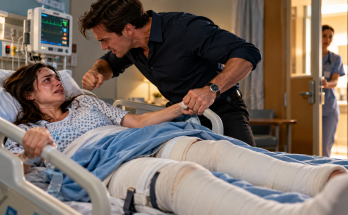
The discharge team came to speak with me several days later.
My pain was still present, but the doctors had been tracking my progress and discussing the support I would need.
They explained the restrictions I would have to follow and the arrangements that had to be confirmed before I could leave.
I listened carefully.
I asked questions about medication, follow-up appointments, and what to do if the pain became worse.
I wrote down the answers.
For years, I had kept track of everyone else's appointments.
Now I was learning to treat my own care as something worth organizing.
The possible stay with my relative was reviewed again.
We discussed the available space, the help I would need, and how I would get to appointments.
There were still practical details to settle.
I did not pretend those details were unimportant.
But the plan was becoming real.
When the social worker asked whether I still wanted to recover there rather than return directly to the house, I did not need to think as long as I had before.
“Yes,” I said.
“I want to recover somewhere safe.”
She nodded and went through the next steps.
We discussed how to communicate the plan and how to avoid putting me in a situation where I had to negotiate alone with Caleb.
I wanted him to know what was happening.
I did not want him to control it.
There was a difference.
I had once believed that a marriage required every decision to be made together.
Now I understood that a decision about my immediate safety did not require the agreement of the person whose behavior had made me afraid.
I could discuss the future of our marriage later.
I could consider counseling, separation, finances, and what would be best for Emma when I had the right support and enough information.
I did not have to decide everything before I left the hospital.
That realization gave me room to breathe.
My notebook was nearly full.
The first pages held questions about my injuries and the dates of my appointments.
Later pages contained the messages Caleb had sent, the unexplained financial transactions I needed to verify, and the details I wanted to remember about the hospital visit.
I had also written down the names of the staff members who had helped me.
The yellow fall-risk notice had remained beside my bed through most of my recovery.
I had looked at it so often that I could remember its placement without turning my head.
At first, it had seemed like another sign of how helpless I was.
Now it reminded me that needing assistance was not a personal failure.
People had seen that I was injured and had taken steps to protect me.
I could accept that help.
I could also ask for protection when the threat came from someone who was supposed to care for me.
The hospital visitor arrangements remained in place.
I did not ask anyone to change them because Caleb had become upset.
I had no desire to punish him.
I simply did not want to be alone with him while I was still vulnerable.
When the social worker asked what I would do if he tried to persuade me to return home immediately, I thought about the brown folder.
I thought about the way he had spoken to me.
“I would tell him I am following the medical advice,” I said. “And I would not discuss it alone with him.”
“That sounds like a reasonable boundary.”
I wrote it down.
Do not discuss discharge alone with Caleb.
It was a short sentence.
It took me eleven years to understand how much I needed it.
That evening, I received a message from him.
I want you to come home when the hospital releases you. We need to stop letting this situation grow.
I read it slowly.
I looked for an acknowledgment of what had happened.
There was none.
I looked for a question about how I was feeling.
There was none.
He wanted the situation to stop growing.
He wanted the hospital stay, the visitor arrangements, and the conversations with the social worker to become things we could put behind us.
I wanted that too, in one sense.
I wanted to stop living inside the memory of his fist striking my stomach.
But I could not put it behind me by pretending it had not happened.
I wrote a reply.
I will follow the medical team's discharge plan. I am not ready to discuss our marriage privately. Communication about my care and arrangements can go through the appropriate people for now.
I read it three times.
It was not cruel.
It was not a threat.
It did not accuse him of anything the hospital staff had not already heard from me.
It stated what I needed.
I sent it.
My heart beat quickly afterward.
I had spent so long anticipating Caleb's reaction that even a simple boundary felt like stepping onto thin ice.
But the room remained quiet.
No one shouted.
No one grabbed my arm.
The monitor continued its steady rhythm.
I set the phone down and breathed until my shoulders relaxed.
The next day, the nurse helped me prepare a list of items I would need for the transition.
I had to think about medication, clothes, personal documents, and the small things that made daily life manageable.
I asked about my belongings from home.
The staff explained that anything essential could be discussed as part of the practical discharge arrangements.
I did not want to create a confrontation over clothes or papers.
I wanted to leave safely, with what I needed, and deal with the rest when I was able.
My relative called again.
“We're still working through the details,” they said. “We'll make sure the place is ready for what the hospital says you need.”
“Thank you for not making promises you can't keep.”
“I want this to work, Rebecca. We need to do it properly.”
I felt the old urge to apologize.
Instead, I said, “That helps me feel less frightened.”
There was a pause.
“You have every reason to take this one step at a time.”
I looked at the drawings beside my notebook.
The house with the red roof.
The two figures under the sun.
The path toward the tree.
Emma had not drawn a perfect family.
She had drawn the things she wanted to hold onto.
I wanted those things too.
I wanted to be there for her.
I wanted to hear her talk about school without checking Caleb's expression to see whether I was allowed to answer.
I wanted to make decisions about work and money without feeling that every question was a betrayal.
I wanted to find out what had happened with the transactions I could not explain.
I wanted to know whether Caleb was capable of taking responsibility for what he had done.
But wanting those things did not mean I had to return home before I was ready.
The day my discharge was confirmed, the nurse went over the instructions with me again.
She explained the medication schedule and reminded me to ask for help rather than attempt tasks that could put me at risk.
I listened and wrote down the important points.
The discharge papers were ordinary documents.
They did not settle my marriage.
They did not explain the financial transactions.
They did not promise that Caleb would change.
They simply recorded what the medical team needed me to know about my recovery.
For once, I was glad that the next step was limited.
I did not need a document to tell me how to feel about the rest of my life.
I needed a safe place to begin healing.
Before leaving, I looked around the room.
The monitor that had sounded when Caleb hit me was quiet now.
The visitor log was no longer something I had to watch anxiously.
The yellow notice had been taken down as part of the discharge process.
I looked at the empty space beside the bed where it had hung.
For a moment, I remembered the first days after the assault.
I had felt trapped by the casts, the pain, and the fear that no one would believe me.
I had wondered whether telling the truth would make everything worse.
It had not made the situation simple.
But it had brought other people into the room.
It had created a record.
It had given me choices I could not see when I was trying to endure everything alone.
The nurse helped make sure I had the items I needed.
My notebook went into my bag.
So did my phone charger and the small envelope containing Emma's drawings.
I kept the drawings flat, careful not to bend the corners.
Before I left, I thanked the staff who had helped me.
I did not know whether they understood how much their actions had mattered.
The nurse who entered the room had interrupted the assault.
The staff who documented what I told them had made it harder for me to dismiss the truth afterward.
The people who discussed my discharge had helped me understand that safety was part of recovery, not a separate problem I had to solve after leaving.
I would remember that.
When the time came to go, I felt frightened.
I also felt ready to take the next step.
I was not walking out under my own power.
I still needed assistance.
My legs were still injured, and my ribs still hurt.
But I was not leaving to obey Caleb's demand that I get out of the bed.
I was leaving because the medical team had assessed my condition and helped arrange the next stage of my care.
That difference mattered to me.
I looked at the door as it opened.
This time, I knew who was coming to help me.
I did not have to wait alone and wonder whether the person entering would hurt me.
I did not have to explain why I needed help.
I did not have to prove that I deserved to be treated gently.
I gathered my bag and the envelope of drawings.
Then I let the staff guide me through the next steps.
My recovery would not be quick.
There would be difficult days, painful appointments, and moments when I missed the familiar parts of home.
There would be questions about money that needed careful answers.
There would be conversations about Emma, about the marriage, and about what would happen next.
I would not pretend those things were already settled.
But I was no longer treating the marriage as the only thing I had to save.
I had to save my health.
I had to protect my relationship with my daughter.
I had to understand my finances and make decisions based on facts.
And I had to stop confusing loyalty with silence.
I still loved parts of the life Caleb and I had built.
I still remembered the years when we laughed together, the early days of our marriage, and the moments when I believed we were a team.
Those memories did not erase the assault.
The assault did not require me to deny every good memory either.
Both things could be true.
I could grieve what our marriage had been and still refuse to return to a situation where I was afraid.
I could love Emma without allowing her to become the bridge over every problem between her parents.
I could wait for answers about the unexplained transactions without turning suspicion into a conclusion.
And I could decide later whether the marriage could ever be repaired, based not on what Caleb demanded but on whether he accepted responsibility and whether change was real and lasting.
I did not know what he would choose.
That was no longer something I could choose for him.
As I left the hospital, I held Emma's drawings against my chest.
The picture of the path was on top.
A simple line led from a door toward a tree.
I had once looked at that drawing and thought only about getting back home.
Now I saw something else.
A path did not have to lead backward.
It could lead toward a place where I could heal, gather my strength, and decide what kind of life I wanted to build.
I was still a mother.
I was still Rebecca.
I was still the woman who had worked in accounting before she left her job, who had kept track of school lunches and household bills, who knew how to organize a mess when she had the time and information she needed.
I was also a woman who had been hurt by her husband and had finally told the truth.
I did not have to become someone else to deserve safety.
I did not have to solve the next eleven years before I could take the next step.
For now, I would recover.
I would keep my appointments, follow the medical instructions, and accept the help I needed.
I would speak to Emma regularly and remind her that none of this was her fault.
I would keep copies of important messages and financial records.
I would ask questions before making decisions.
And I would not return to Caleb simply because he wanted the consequences to disappear.
I did not know whether our marriage would end.
I did know that it could not continue as if the hospital room had never existed.
That truth was painful.
It was also the beginning of something I had not allowed myself to imagine for a long time.
A future in which my safety counted.
A future in which my voice counted.
A future in which loving my family did not require me to abandon myself.
I looked down at Emma's drawing one last time.
The path was uneven.
The tree leaned a little to one side.
The house had a red roof that did not quite line up with the walls.
It was not perfect.
It was still beautiful.
And for the first time in weeks, I did not need to know exactly where the path ended before I was willing to follow it.
The End
Read more original stories on Feel Every Story.
For Twenty-One Days, I Waited for My Husband to Visit With Flowers, Until I Finally Learned What He Thought My Life Was Worth
Part 20 of 20