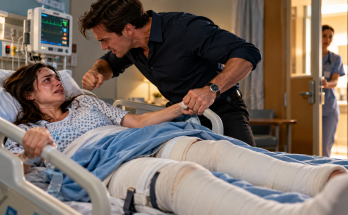
His hand closed around my upper arm.
I felt his fingers press into my skin through the thin hospital gown.
For a moment, I simply stared at him.
I think part of me was waiting for him to realize what he was doing.
I thought he might see the casts.
I thought he might notice the way my wrist trembled against the bedrail.
I thought he might remember that the woman he was gripping was his wife.
He only pulled harder.
"Get up."
I reached for the rail.
My wedding ring struck the metal with a small, sharp sound.
It was such an ordinary noise.
I remember it more clearly than I remember some of the things he said.
The ring had been on my finger for eleven years.
I had worn it while washing dishes, folding laundry, holding Emma when she was a baby, and signing school forms at the kitchen table.
I had kept wearing it through arguments and disappointments.
Now it tapped against a hospital bed while my husband tried to drag me out of it.
"Caleb, stop."
He tugged again.
My body shifted a few inches.
The movement sent pain through my ribs, and I cried out before I could control myself.
He released a frustrated breath.
"You're making this worse than it needs to be."
I could hardly believe what I was hearing.
My legs were broken.
My ribs were fractured.
I had spent three weeks learning how to move without hurting myself.
He was trying to pull me out of bed, and somehow I was the person making things difficult.
I gripped the rail with both hands.
The skin around my knuckles tightened.
"Please. You're hurting me."
He looked at me as though I had said something offensive.
"You think I don't have problems?"
I tried to answer, but my breathing had become shallow.
My ribs hurt too much for a full breath.
The monitor beside me began to beep more quickly.
Caleb glanced toward it.
Then he looked back at me.
"What's that supposed to mean?"
I shook my head.
"Nothing."
It was an old answer.
Nothing.
I had used it when he asked why I looked upset.
I had used it when I wanted to explain something but knew the conversation would become an argument.
I had used it when Emma was in the next room and I did not want her to hear us.
Nothing had become my way of keeping the peace.
But nothing had never really meant nothing.
It meant I was hurt.
It meant I was afraid.
It meant I had something to say and had already decided that saying it would cost more than keeping it inside.
Caleb's grip tightened.
"Then get up."
I pulled against him, trying to keep my body from sliding toward the edge.
The casts made it impossible to move naturally.
My legs felt heavy and distant, as though they belonged to someone else.
I could not push myself upright without help.
I could not place my feet on the floor.
I could not even turn easily enough to escape the pressure on my ribs.
The bedrail was the only thing I could hold.
I clung to it.
The monitor continued sounding beside me.
I could hear it over Caleb's breathing.
I could hear movement in the hallway.
I knew there were people nearby.
The thought should have comforted me.
Instead, I felt trapped between the need to call for help and the old fear of making Caleb angrier.
I wish I could say that fear disappeared the moment he hurt me.
It did not.
Fear is not always sensible.
Sometimes it stays long after you understand that the person you are afraid of has no right to control you.
I was still thinking about what would happen when we got home.
I was still wondering how Emma would react if she saw us arguing.
I was still trying to find a way to make Caleb stop without making him feel challenged.
Even while he was hurting me, some part of me was searching for the right words to calm him down.
Then he said something that made the whole room feel colder.
"I'm not paying for a wife who can't do anything for herself."
I looked at him.
I had heard him complain about money before.
I had heard him complain about the grocery bill, the electricity bill, and the cost of school supplies.
I had listened to him question purchases that made our home more comfortable.
But I had never heard him speak about my life as though it were a service he had paid for and no longer wanted.
I thought about the years I had spent at home.
I thought about Emma's school uniforms, the lunches packed before sunrise, the appointments written on the calendar, and the bills I had paid on time.
I thought about the hours I had spent keeping everything together while Caleb went to work and returned to a house where dinner was ready.
I had never believed those things made me more valuable than anyone else.
I had simply believed they mattered.
Now I wondered whether Caleb had ever considered them work at all.
I felt something changing inside me.
It was not courage in the way people describe courage afterward.
I was not suddenly fearless.
My hands were shaking.
My body hurt.
My husband was standing over me, angry enough to grab me and pull me against the doctor's instructions.
I was frightened.
But I was also tired.
Tired of making excuses.
Tired of waiting for him to become the man I kept telling myself he could be.
Tired of measuring every word against the possibility of his anger.
I had spent eleven years believing that if I refused to fight, the fighting would eventually stop.
I had mistaken silence for safety.
It had not protected me.
It had only made it easier for him to believe I would always give in.
Caleb pulled my arm again.
The mattress shifted beneath me.
Pain spread across my ribs, sharp enough to make my eyes water.
I tightened my grip on the rail.
"No."
The word came out quietly.
I almost did not recognize my own voice.
Caleb stopped.
For a second, he simply stared at me.
"What did you say?"
I swallowed.
I was breathing too quickly.
I could hear the monitor speeding up beside me.
But I looked directly at him.
"I said no."
There was no speech.
No list of everything he had done.
No demand that he apologize for the years I had spent trying to please him.
I did not tell him that I deserved better.
I did not have to explain that a broken body could not be ordered into standing.
I only refused.
It was the smallest act of defiance I could imagine.
It was also the first time I could remember refusing Caleb when he had decided that my answer did not matter.
His face changed.
Not much.
His mouth tightened, and the skin around his eyes became tense.
But I saw the surprise.
He had expected me to obey.
He had expected me to cry, apologize, or find a way to make his demand easier for him.
He had not expected me to hold on to the bedrail and remain where I was.
I wish I could say that seeing his surprise gave me confidence.
It did not.
It made me realize how little room I had been allowed to make decisions for myself.
I had been a wife for eleven years.
I had been Emma's mother for eight.
I had managed a household, handled bills, and made countless decisions that kept our family running.
Yet one quiet refusal seemed to shock him more than any of those responsibilities had ever impressed him.
He leaned closer.
"Don't you dare speak to me like that."
I did not answer.
I was concentrating on keeping my hands steady.
The yellow warning notice on my chart was still visible near the foot of the bed.
The monitor was still beeping.
Emma's picture was still taped to the wall.
COME HOME SOON, MOMMY.
I looked at those words and thought about the promise I had made to myself after the accident.
I would survive.
I would get home.
I would be there for my daughter.
That promise had carried me through nights when I could not sleep and mornings when the pain seemed worse than it had been the day before.
I had thought surviving meant enduring whatever came next.
I had not understood that sometimes survival meant refusing to let someone else decide what you could endure.
Caleb straightened.
For a brief moment, I thought he might step away.
I thought perhaps he had seen how badly I was shaking.
I thought he might finally look at my injuries and understand that this was not a disagreement he could win by being louder.
Instead, he drew back his arm.
I saw the movement.
I saw his hand tighten.
I did not have time to understand what he intended before he struck me.
Both fists drove into my stomach.
The pain was immediate.
It seemed to take the air from the entire room.
I folded forward as far as the casts allowed, and a scream escaped me.
My hands slipped against the bedrail.
The monitor erupted into rapid, frantic alarms.
For a moment, everything became noise.
I could not catch my breath.
I could not make sense of what had happened.
I could only feel the pain spreading through my body and the terrible certainty that my husband had just crossed a line I could never pretend not to see.
He had hit me.
Not in the middle of some distant argument I might later try to explain away.
Not in a moment I could hide beneath another excuse.
He had struck me while I lay injured in a hospital bed.
I had refused to get up because I could not.
He had answered by hurting me.
I tried to draw in a breath.
My stomach tightened, and the pain made me cry out again.
Caleb stood over me.
His face was red.
The blanket was bunched in one hand.
His other hand remained clenched.
I stared at him through tears.
I could not believe I was looking at the man I had married.
I could not believe that eleven years of shared meals, family photographs, and ordinary mornings had brought me to this room.
I could not believe that I was still searching his face for some sign that he understood what he had done.
He bent toward me.
"You don't get to tell me no."
I tried to move away, but the casts and the pain left me almost helpless.
The monitor kept sounding.
I wanted to call for the nurse.
I wanted to shout until someone came through the door.
But my breath came in broken pieces, and I could barely get the words out.
I looked toward the hallway.
Someone needed to see this.
Someone needed to understand that I had not fallen out of bed or injured myself trying to move.
I needed someone to know what had happened.
Caleb was still standing over me when I finally managed to look away from him.
My eyes found Emma's drawing.
The paper had curled slightly at one corner.
Her little house was still there.
The yellow sun was still above it.
Her words had not changed.
COME HOME SOON, MOMMY.
I held on to that picture with my eyes because I could not hold on to anything else.
I had promised my daughter I would return.
And for the first time since the accident, I understood that getting home was not enough.
I needed to make sure I could protect her.
Click here to continue reading: PART 4: The Hospital Had Recorded My Injuries, My Medication, and Every Visitor, but Caleb Still Believed He Could Make Me Stay Silent
For Twenty-One Days, I Waited for My Husband to Visit With Flowers, Until I Finally Learned What He Thought My Life Was Worth
Part 3 of 20