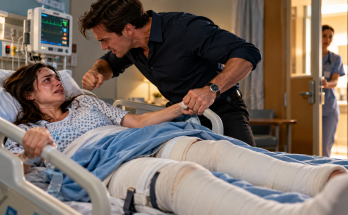
The pain did not disappear when Caleb stepped back.
It remained in my stomach and spread through my ribs, making every attempt to breathe feel like work.
I tried to draw in air slowly.
My body would not cooperate.
The monitor beside me continued its frantic noise.
I had heard alarms before.
I knew they were meant to get someone's attention.
But this time, the sound seemed to come from a place far away.
I could hear it without being able to think clearly about what it meant.
Caleb looked toward the machine.
For the first time since entering the room, he seemed uncertain.
Then his expression hardened again.
"Stop that."
I stared at him.
I could not tell whether he meant the alarm or my crying.
Perhaps he meant both.
I tried to speak, but my throat felt tight.
He looked toward the door and then back at me.
I saw him make a decision.
He was not going to apologize.
He was not going to ask whether I could breathe.
He was not going to reach for the call button or summon the nurse.
Instead, he bent down and gathered the blanket in his hand.
I could hardly believe it.
He was still trying to make me leave.
I tightened my fingers around the bedrail.
My wedding ring pressed against the metal.
The small sound it made earlier returned to me.
Tap.
Tap.
I had worn that ring through so many ordinary days that I had stopped noticing its weight.
Now I could feel it against my skin.
I wondered how many times I had mistaken the ring for proof that I was safe.
How many times had I looked at it during a difficult conversation and reminded myself that marriage meant commitment?
How many times had I used the promises we made to justify staying quiet when I should have spoken?
I did not know.
I only knew that the ring could not protect me.
The monitor kept sounding.
Caleb leaned over the bed.
"You need to get yourself under control."
I tried to answer.
"I can't…"
My voice broke.
He looked irritated.
"What?"
I swallowed and tried again.
"I can't breathe properly."
For one brief second, I thought he might listen.
I thought he might understand that something was seriously wrong.
Instead, he shook his head.
"You always make everything about yourself."
I looked at him.
The words hurt in a different way from the blows.
Not because they were new.
Because they were familiar.
I had heard versions of them for years.
When I was exhausted, I was dramatic.
When I was disappointed, I was too sensitive.
When I wanted help, I expected too much.
When I explained why something hurt me, I was making a problem out of nothing.
I had spent so long hearing those judgments that I had begun to check my own feelings against them before trusting myself.
Even now, in that hospital bed, a small part of me wondered whether I was reacting too strongly.
That thought did not last.
I had broken bones.
I had been attacked.
There was nothing unreasonable about my pain.
I looked at the yellow warning notice near the foot of the bed.
It was bright enough to stand out against the papers attached to my chart.
The notice was there because the hospital staff understood that I could be seriously injured if I tried to stand without assistance.
Caleb had seen it.
He had seen the casts.
He had heard me tell him I could not get up.
None of that had stopped him.
I wondered whether he would have acted differently if another person had been watching.
The thought came and stayed.
He had waited until he was close enough to control my movement.
He had lowered his voice when he wanted to intimidate me.
He had treated my refusal as an insult.
I could not know what he would do next.
But I knew I could no longer assume that he would stop simply because I asked him to.
I looked toward the open doorway again.
The hallway was still moving around us.
A supply cart rolled past.
Its wheels made a soft rattling sound over the floor.
Somewhere farther away, someone laughed.
The ordinary sounds made the room feel unreal.
Outside, people were going about their shifts.
Someone was preparing medication.
Someone was helping another patient.
Someone was probably sitting beside a loved one and holding their hand.
And I was lying in a bed, trying to understand how my own husband had become the person I needed protection from.
Caleb followed my gaze.
"Who are you looking for?"
I did not answer.
He moved closer to the side of the bed.
"Rebecca."
I looked back at him.
"Look at me when I'm talking to you."
I did.
I wish I had not felt the old instinct to obey.
But I did.
For eleven years, I had learned that ignoring his demands could make an argument worse.
I had learned to pay attention to changes in his voice.
I had learned to watch his hands and the set of his shoulders.
I had learned to recognize when an ordinary disagreement was becoming something I needed to escape.
Those lessons had never felt like lessons.
They had felt like the practical knowledge a wife gathered over time.
Only later did I understand what they said about the life I had been living.
Caleb stared down at me.
"You're going to listen to me."
I said nothing.
"You understand?"
I wanted to tell him that I had listened to him for years.
I had listened when he told me to leave my job.
I had listened when he said he needed me to take care of the house.
I had listened when he complained about expenses and when he dismissed the work I did.
I had listened so carefully that I could often predict his response before he spoke.
What I had not done was listen to myself.
I had ignored the small moments when I felt diminished.
I had ignored the way I rehearsed simple requests before making them.
I had ignored how often I felt relieved when he was in a good mood, as though his kindness were a gift I had to earn.
I could not explain any of that to him.
Not then.
I barely had enough breath to speak.
Caleb straightened and looked toward the cabinet.
The brown folder was still lying there.
The hospital paperwork stuck out from its open edge.
I could see several printed pages, but I could not read the details from where I lay.
I wondered what he had been told about the cost of my care.
I wondered whether he had spent the last three weeks worrying about money.
I could understand worrying about money.
I had managed our finances long enough to know that a serious accident could put pressure on a household.
But worrying about expenses did not require him to hurt me.
It did not require him to drag me from a bed.
It did not require him to pretend that my injuries were an act.
There were ways to discuss money.
There were ways to ask questions.
There were ways to make plans.
He had chosen none of them.
He had chosen to make me afraid.
The realization settled slowly.
I had been looking for a reason that would make his behavior understandable.
I had searched for the hidden pressure, the misunderstanding, the problem I could solve if I found the right words.
But I did not need to understand every reason he might have had to recognize what he had done.
He had hurt me.
I was allowed to name it.
I was allowed to want help.
I was allowed to refuse to let him move me.
The monitor continued to sound.
I tried to shift my hand toward the call button.
My wrist hurt, and my fingers trembled.
Caleb noticed.
"What are you doing?"
I stopped.
I hated that I stopped.
He looked at my hand.
"Don't start calling people over here to make me look bad."
I stared at him.
The words told me more than he intended.
He knew how this would look.
He knew that another person entering the room might ask questions.
He knew that the hospital staff would not see a husband trying to bring his injured wife home.
They would see a patient in pain and a man who had been ordered to respect her medical restrictions.
He understood the difference.
He simply believed he could prevent anyone else from seeing it.
I wanted to tell him that he had already made himself look bad.
I wanted to tell him that I had done nothing to him.
I wanted to tell him that if he had come to my bedside with a little kindness, I would have thanked him for it.
Instead, I watched his face and tried to keep breathing.
He reached toward me again.
I flinched.
It was a small movement, but he noticed.
For a moment, neither of us spoke.
I had flinched from my husband.
I had never imagined that sentence describing my life.
When we first married, I used to fall asleep with my head against his shoulder.
When Emma was a baby, we took turns getting up at night, or at least that was how I remembered it before the responsibilities gradually became mine.
There had been good days.
There had been laughter.
There had been moments when I believed we understood each other.
I did not want to pretend those memories had never existed.
But they could not erase what was happening now.
The man in front of me was not reaching out to comfort me.
I was afraid of his hands.
That was the truth.
I looked toward Emma's picture again.
The paper had begun to curl away from the wall.
I wanted to straighten it.
I wanted to reach up and press the loose corner back into place.
I wanted to do something ordinary.
But my arms were trembling, and I did not trust my body to move without hurting myself.
I stayed still.
Caleb bent over the bed once more.
His face was close enough for me to see the tension around his mouth.
"You don't get to talk back to me."
I looked at him.
"Do you understand?"
I could not make myself answer.
He drew his arm back again.
The movement was familiar now, and that frightened me more than I wanted to admit.
I knew what his anger could do.
I knew he had already struck me.
I knew that refusing him had not made him stop.
I held the bedrail with both hands.
My fingers hurt.
My stomach hurt.
My ribs hurt when I tried to breathe.
But I held on.
I thought of Emma.
I thought of the promise I had made beneath the operating-room lights, when I was frightened and uncertain whether I would recover.
I had promised myself that I would see my daughter again.
I had promised myself that I would return to her.
That promise was still there.
I could not let Caleb take it away from me.
He raised his arm.
The monitor beside my bed gave a sharp, continuous warning.
I heard movement in the hallway.
Then I saw the silver handle on my hospital door begin to turn.
I fixed my eyes on it.
For the first time since Caleb had entered the room, I knew I was no longer the only person who might decide what happened next.
Click here to continue reading: PART 5: The Nurse Who Walked Through That Door Saw More Than My Injuries, and for the First Time, Caleb Could Not Control the Room
For Twenty-One Days, I Waited for My Husband to Visit With Flowers, Until I Finally Learned What He Thought My Life Was Worth
Part 4 of 20