Elora called the next morning.
She sounded tired.
Not frightened.
Just tired.
"How did it go?" I asked.
"We ate too much food and talked too little."
I smiled.
"That sounds like a family dinner."
She laughed.
Then she told me what had happened.
Her daughter had arrived first.
She brought a pie and placed it on the counter.
Her younger son came next.
Shane arrived last.
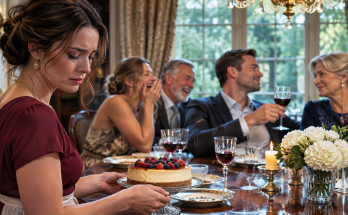
They sat around the dining table.
At first, they talked about the weather and Elora's leg.
Then her daughter asked about the documents.
Elora told her she was reviewing everything with her lawyer.
Her daughter asked why that was necessary.
Elora said because the decisions belonged to her.
Her younger son asked whether she was planning to change the arrangements she had made years earlier.
Elora said she had not decided.
That answer seemed to upset him.
He wanted to know what she was waiting for.
Elora told him she was waiting until she understood every option.
Then Shane asked whether the papers had anything to do with me.
Elora said no.
She told him I had not seen the documents and would not be making decisions about them.
That surprised him.
"Did he believe you?" I asked.
"I don't know."
She paused.
"But I said it anyway."
I could hear a cupboard closing in the background.
She was probably putting away breakfast dishes.
"What happened after that?"
"My daughter cried."
Elora's voice became softer.
"She said she felt I didn't trust them anymore."
"What did you say?"
"I told her trust was not something I could promise on demand."
I stayed quiet.
Elora continued.
"I said I loved them. But I needed them to stop asking me to prove it by signing things."
That was the sentence I remembered most.
She had finally found a way to say what had been hidden beneath all the polite conversations.
Love did not require surrender.
After the call, I thought about the years I had spent with Shane.
I remembered how often I had tried to keep arguments small.
I remembered changing my plans because he was upset.
I remembered apologizing just to end a conversation.
It was strange to see the same habit in his mother.
The difference was that Elora had finally decided to stop.
A few days later, Shane sent me a message.
It was longer than the ones he had sent before.
He said the family dinner had been difficult.
He said Elora seemed determined to keep the documents private.
He also said he understood that I did not want to be involved.
Then he asked whether we could meet for coffee.
I read the message twice.
I did not want to reopen my marriage.
I did not want to become his counselor.
But I also did not want to pretend that five years of shared life had meant nothing.
I replied that I could meet once, in a public place, but I would not discuss Elora's private documents.
He agreed.
We met on Friday morning.
Shane looked older than I remembered.
There was gray at his temples.
He ordered coffee and left it untouched.
"I owe you an apology," he said.
I waited.
"For calling you about Mom. For making you feel responsible."
I looked at him.
"Thank you for saying that."
He rubbed his hands together.
"I think I got used to Mom fixing things."
"What things?"
"Everything."
He looked toward the window.
"When Dad died, she handled the house. When I made mistakes, she covered for me. When my brother needed money, she helped him. When my sister had problems, Mom was there."
He took a breath.
"I suppose we got used to thinking she would always say yes."
I did not interrupt.
He continued.
"When she started saying no, I thought somebody had changed her mind."
"And you thought it was me."
He nodded.
"Yes."
"Why?"
"Because she trusted you."
I looked down at my cup.
"She trusted me because I listened. But I also told her when I disagreed."
Shane gave a small nod.
"I know."
He looked uncomfortable.
Then he said, "I didn't treat you very well either."
It was not a complete apology.
But it was more honest than anything he had said in years.
I told him I appreciated the acknowledgment.
I did not tell him that everything was forgiven.
He did not ask.
Before we left, he said he wanted to speak to Elora again.
I told him that was between them.
He nodded.
Then we went our separate ways.
That afternoon, I called Elora.
I told her Shane and I had met.
She was silent for a moment.
"Did he ask about the papers?"
"No."
"Did he ask about me?"
"He said he wanted to talk to you."
She breathed out.
"That is something."
"Yes."
She did not ask what else we had discussed.
I was grateful.
The next week, Elora invited me to her house.
She wanted help moving a small cabinet away from the wall.
I arrived with a screwdriver and a pair of old gloves.
The cabinet was heavier than it looked.
We moved it slowly.
Behind it, we found a small envelope that had slipped down between the furniture and the wall.
Elora picked it up.
Inside were two old photographs and a receipt.
One photograph showed her and her late husband sitting on the front steps.
The other showed the children when they were young.
Shane had missing front teeth.
His sister wore a yellow dress.
His younger brother was holding a toy truck.
Elora smiled.
"I forgot I had these."
She placed the photographs on the table.
Then she looked at the empty space behind the cabinet.
"Do you remember when you and Shane used to come here for Sunday lunch?"
"I remember."
"You always washed the dishes."
"Because Shane never did."
She laughed.
Then her expression changed.
"I miss those days sometimes."
"I understand."
"I don't miss everything about them."
"Neither do I."
She nodded.
We put the photographs in a frame.
The receipt went into a drawer.
The little envelope was empty again.
It was such an ordinary afternoon.
No one asked about a key.
No one mentioned the lawyer.
No one demanded an explanation.
Before I left, Elora asked whether I would come again for lunch.
I said yes.
She looked relieved.
"I don't want every visit to become a discussion about what happened."
"Then it doesn't have to."
She walked me to the door.
I noticed the yellow plant on her windowsill.
It had grown two new leaves.
Elora followed my eyes.
"It's doing well," she said.
"It is."
She smiled.
For the first time, the house felt like her house again.
Not a place where she had to defend every drawer.
Not a place where her children could make her feel guilty for keeping something private.
Just her home.
Click here to continue reading: PART 20: Months later, I understood that the shoebox had never been a treasure map or a weapon, but a record of a woman learning to protect her own choices.
I Thought I Was Simply Helping a Woman Who Had Never Stopped Treating Me Like Family, But Something About Her Request Stayed With Me
Part 19 of 20