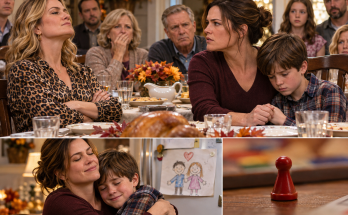
The first time my sister insulted my son, I told myself she didn't understand what she was saying.
That was the excuse I used for years.
By the time I understood what it was doing to him, he had already learned to watch my face whenever she entered a room.
My name was Jenna Carver.
I was thirty-four years old, and I lived outside Richmond, Virginia, in a small apartment with my son, Eli.
I worked as a commercial insurance account manager.
It wasn't glamorous work.
Most days involved phone calls, renewal dates, paperwork, and customers who waited until the last possible moment to report something expensive.
But the paychecks arrived regularly.
The rent got paid.
There was food in the refrigerator.
And Eli had his own bedroom.
I considered that a good life.
Not a perfect one.
A good one.
His father had never been the kind of man a child could depend on.
There had been promises in the beginning.
Phone calls.
Plans for weekends.
A few visits that ended with explanations.
Then the explanations became less frequent.
Eventually, I stopped expecting anything.
The first two years had been difficult.
I remember counting grocery money at the kitchen counter and putting things back because the total was higher than I expected.
I remember buying Eli shoes a size too large because children grew quickly and I couldn't afford to replace them every few months.
But we managed.
By the time he started school, our lives had settled into a routine.
Breakfast.
School.
Work.
Dinner.
A little television before bedtime.
Nothing extraordinary.
Just two people getting through the week together.
I never expected my parents to support us.
I never asked my sister for money.
I wasn't waiting for anyone to rescue me.
But Danielle seemed convinced that my life was some kind of public lesson.
She was five years older than me.
Thirty-nine that Thanksgiving.
She was married to Mark and had a daughter named Lucy, who was nine.
Danielle had everything she believed a woman should have.
A husband.
A child.
A comfortable house.
A family photograph where everybody wore matching clothes.
She liked things to appear orderly.
Especially when other people were looking.
She also liked reminding me that she had done things differently.
Sometimes she spoke about responsibility.
Sometimes she mentioned choices.
And sometimes she didn't bother pretending she was discussing anything except me.
I usually heard her.
She rarely cared whether I did.
The first Thanksgiving happened when Eli was three.
My parents still hosted the holiday at their house, the same place where Danielle and I had grown up.
The dining room had a long wooden table.
The chairs never quite matched.
Mom always put the gravy in a white ceramic boat that had a tiny chip near the handle.
I remembered that chip because Eli once tried to touch it with his finger while waiting for dinner.
He was sitting on his knees, trying to reach the basket of rolls.
A cousin from my mother's side asked how old he was.
I started answering.
Danielle answered first.
She used a word I had never expected to hear directed at my child.
I stared at her.
For a second, I wondered whether I had misunderstood.
Then I saw her smile.
It wasn't an accidental word.
It was deliberate.
"Don't speak about him like that," I said.
Danielle lifted the serving spoon.
"He has no idea what I'm talking about."
"Then there's no reason for you to say it."
Dad looked up from his plate.
He had already started carving the turkey, and he didn't seem interested in stopping.
"Both of you, leave it alone."
Mom reached across the table and took the spoon from Danielle.
Then she looked at me.
"Come help me with the gravy."
I followed her into the kitchen.
The refrigerator was covered with school photographs, grocery reminders, and an old calendar.
Mom stood beside the counter and lowered her voice.
"Just don't pay attention to her."
I looked at her.
"She called my son something horrible."
"She gets carried away sometimes."
"She's thirty-nine, Mom."
Mom sighed.
"I know."
But she didn't go back into the dining room and tell Danielle to apologize.
She didn't ask her to repeat what she had said.
She simply handed me a dish towel.
And I went back to the table.
That was my first mistake.
Not because I stayed for dinner.
Because I let everybody act as though the problem had disappeared just because nobody wanted to discuss it.
Eli was three.
He wanted pie.
He wanted to play with Lucy.
He wanted to show his cousin a little toy car he had brought from home.
He didn't understand the tension between the adults.
At least, I hoped he didn't.
I spent the rest of that afternoon watching him.
He laughed when Lucy showed him the blanket fort upstairs.
He crawled underneath a table with her.
He came downstairs asking for another piece of pie.
I told myself he had enjoyed the day.
That was what mattered.
The next Thanksgiving, Danielle made another comment.
It wasn't exactly the same.
But it carried the same message.
She said something about me choosing an easier path and expecting everyone else to accept the consequences.
I told her to stop.
She called it a joke.
Dad told us not to start an argument during dinner.
Mom found another reason to take me into the kitchen.
And the football game eventually became louder than everybody's voices.
The third year followed much the same pattern.
A remark.
My objection.
Danielle acting offended that I had taken it seriously.
My father wanting peace more than he wanted to correct his older daughter.
My mother trying to move everybody toward dessert.
Then the fourth Thanksgiving came.
By then, Eli was old enough to notice things I couldn't explain away.
He still loved Lucy.
That was one of the reasons I kept going.
She was a good cousin to him.
She saved the red pieces whenever they played board games because she knew he liked that color.
She brought him extra Halloween candy.
When he forgot the rules, she explained them again without making him feel stupid.
They could spend an entire afternoon together on my parents' living room floor.
Sometimes I would hear them laughing from the kitchen.
Those moments made me want to believe the family was worth holding on to.
There was also Grandma Rose.
She had been the one person who never tolerated Danielle's behavior.
Before she died, she used to notice whenever I began gathering Eli's things too early.
She would reach for my wrist.
"Don't let your sister decide where you belong."
I remembered those words.
I remembered them long after Grandma was gone.
Sometimes I think I used them to justify staying in places where I should have left.
That isn't the same thing as being strong.
I know that now.
Click here to continue reading: PART 2: The Red Game Pieces, Grandma’s Warning, and the Promise My Mother Made Before Christmas
I Kept Bringing My Son to a House Where His Own Aunt Made Him Feel Like He Didn’t Belong
Part 1 of 20