The next morning, I asked Evelyn whether there were personal belongings from my grandmother that I could review.
She explained that some items had been preserved at the property.
Others were still being inventoried.
I asked whether there were photographs or letters.
"Some personal records are available," she said. "We can arrange a supervised review."
I agreed.
I didn't know exactly what I was looking for.
Maybe a photograph.
Maybe something written in my grandmother's handwriting.
Anything that could help me understand why she had made such specific arrangements.
That afternoon, I walked into the house with Evelyn.
She led me toward a room near the back of the property.
There was a wooden desk beside the window.
A narrow bookshelf stood against the wall.
Several storage boxes were arranged neatly on the floor.
I recognized the desk immediately.
I remembered it from childhood visits.
My grandmother used to sit there in the afternoons, reading newspapers and sorting letters.
I walked closer.
There was a small brass handle on the top drawer.
I touched it.
For a moment, I felt like I was nineteen again.
I could almost hear her telling me not to leave my shoes on the carpet.
I opened the drawer.
Inside were old envelopes, notebooks, photographs, and a small collection of pens.
Evelyn stood nearby.
"We haven't disturbed these more than necessary."
I nodded.
I began looking through the photographs.
There was one of my grandmother standing in the garden.
Another showed her beside a younger version of my mother.
I picked it up.
They looked happy.
My mother was holding a bouquet of flowers.
My grandmother had one arm around her shoulder.
I stared at the picture.
It was difficult to connect that image with the woman who had stood outside the iron gate.
I placed it carefully on the desk.
Then I found a photograph of myself.
I was much younger.
Maybe twelve.
My grandmother was sitting beside me on the porch.
I was holding a book.
She was looking at me instead of the camera.
I smiled without realizing it.
I remembered that day.
She had told me that I should always learn how to take care of myself.
At the time, I thought she was talking about cooking and paying bills.
Now I wondered whether she had meant something more.
I opened another drawer.
There was a small wooden box inside.
It contained several folded papers.
I carefully removed them.
Most were old household notes.
Then I saw my name.
Written in my grandmother's handwriting.
I stopped.
The envelope was plain.
My full name was written across the front.
There was no stamp.
No address.
Just my name.
I looked toward Evelyn.
"Can I open this?"
She examined it.
"We should confirm that it is part of the personal effects and that there are no restrictions. But it appears to be a personal letter."
She reviewed the inventory record.
Then she nodded.
I sat down.
My hands were shaking.
I opened the envelope carefully.
Inside was a single folded page.
The handwriting was familiar.
I read the first line.
My dear girl,
My throat tightened.
I continued.
The letter wasn't long.
My grandmother wrote about the importance of independence.
She said that money could make people behave in ways they would never admit.
She reminded me that love should not require me to surrender every private decision.
I stopped reading.
I looked at the page.
It felt as though she had written those words for the person I had become.
Then I continued.
She mentioned that she had made arrangements for my future.
She didn't explain every detail.
But she wrote that the arrangements were meant to give me a choice.
A choice about where I lived.
A choice about how I worked.
A choice about who had access to my life.
I read that paragraph several times.
Then I reached the final lines.
If you ever feel that you must give away your independence to keep someone happy, remember that you are allowed to say no.
I lowered the letter.
I couldn't speak.
Evelyn quietly stepped away.
I sat at the desk and cried.
Not loudly.
Not dramatically.
Just enough that the words on the page became blurry.
My grandmother had died before any of this happened.
She hadn't seen my parents throw me out.
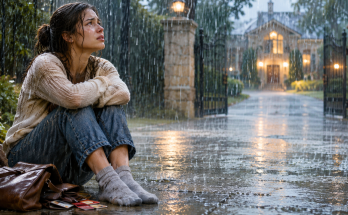
She hadn't seen me walking through the rain.
But somehow, her words reached the exact place that hurt.
I folded the letter carefully.
I didn't want to damage it.
Then I placed it back inside the envelope.
There were other items in the box.
A few handwritten notes.
A small photograph.
And a folded property document.
Evelyn reviewed the papers with me.
Some were related to the administration of the estate.
Others were personal records.
I didn't try to interpret every legal detail.
I wanted everything preserved and reviewed properly.
Before leaving the room, I looked once more at the desk.
My grandmother had sat there writing letters.
She had spent years preparing things I knew almost nothing about.
I wondered how many times she had tried to speak to my parents about her plans.
I wondered whether they had listened.
I also wondered whether I had missed opportunities to understand her better.
That thought stayed with me.
Later that afternoon, my father called again.
I watched the phone ring.
Then I answered.
"What?"
He sounded angry.
"Your mother told me you've been going through your grandmother's belongings."
"I have permission to review them."
"Those things belong to the family."
I looked at the envelope in my hand.
"They're part of the estate."
"Don't start talking like a lawyer."
"I'm not."
He sighed.
"Your grandmother always caused problems between us."
I looked at the old photograph on the desk.
"She was my grandmother."
"She filled your head with ideas."
"What ideas?"
"That you don't need your family."
I felt my eyes sting.
"She told me I should be independent."
"That's not the same thing."
"No. It isn't."
He became quiet.
Then he asked whether I had found anything important.
I didn't answer immediately.
"Why?"
"Because we need to know what's in those documents."
I understood.
He wasn't asking because he missed his mother.
He wasn't asking because he wanted to remember her.
He wanted to know what she had left behind.
"I'll discuss the estate with Evelyn."
My father became furious.
"You're hiding behind that woman again."
"I'm following the legal process."
He ended the call.
I placed my phone on the desk.
Then I looked at the letter.
For years, I had thought being a good daughter meant keeping my parents comfortable.
I had avoided arguments.
I had explained my decisions.
I had given them money.
I had allowed them to ask questions that made me uncomfortable.
I had even left old security permissions connected to my accounts because removing them seemed like an unnecessary insult.
But my grandmother had written something I couldn't ignore.
I was allowed to say no.
That evening, I called Naomi.
I told her about the letter.
She listened quietly.
When I finished, she said, "Your grandmother sounds like she understood you."
I looked toward the window.
"I wish I'd asked her more questions."
Naomi paused.
"Maybe she left you something that answers some of them."
I folded the letter again.
"Maybe."
I placed it inside a protective sleeve Evelyn had provided.
Then I put it in the folder with my personal documents.
I wasn't going to lose it.
Not after everything.
Click here to continue reading: PART 8: My Parents Returned With Apologies and Promises, but I Finally Understood What They Were Really Afraid of Losing
My Father Demanded Access to My Bank Account, but One Quiet Word Changed Everything That Happened Next
Part 7 of 20