Wednesday morning began with a knock at the gate.
The security guard called the house.
I was reviewing a proposal when my phone rang.
"Your father is here."
I looked at the clock.
It was just after eleven.
I closed my laptop.
"Did he make an appointment?"
"No."
I thought for a moment.
"Tell him I can speak with him for a few minutes, but he cannot enter without permission."
The guard acknowledged the instruction.
I walked toward the entrance.
My father was standing outside the iron gate.
He was wearing the same dark jacket he had worn during our previous visit.
His expression was serious.
He looked past the guard when he saw me.
"Finally."
I stopped several feet away.
"What do you want?"
He looked irritated.
"Can we talk without all these arrangements?"
"We can talk here."
He glanced toward the guard.
Then he lowered his voice.
"Your mother told me she came here."
"Yes."
"What did she say?"
I looked at him.
"Why don't you ask her?"
"I am asking you."
"Then ask a real question."
His jaw tightened.
He looked through the gate toward the house.
"You've become very difficult."
I almost smiled.
I had heard that sentence many times.
It used to make me question myself.
Now it sounded like something he said whenever he couldn't get what he wanted.
"What do you want to know?"
He took a breath.
"What documents did Evelyn show you?"
"Estate documents."
"I know that."
"Then you already know what they contain."
He shook his head.
"You don't understand the situation."
I looked at him.
"Explain it."
He remained quiet.
I continued.
"You knew Grandma had created a trust."
He looked away.
"You knew I would become the beneficiary at twenty-eight."
He didn't answer.
"You knew the attorney had been trying to contact me."
He rubbed his forehead.
"And you knew Mom had signed for the letters."
His expression changed.
I watched him carefully.
"Is that true?"
He looked toward the road.
Then he said, "Your mother should not have discussed those things with you."
I felt something tighten in my chest.
So it was true.
He wasn't denying it.
He was angry that she had told me.
I asked another question.
"Why did you tell her to wait?"
He shook his head.
"It wasn't that simple."
"Then make it simple."
He stepped closer.
"Your grandmother had made arrangements that could have affected the whole family."
I stared at him.
"How?"
"She wanted everything to go directly to you."
"That was her decision."
"She didn't understand how much responsibility that would create."
"She understood enough to appoint an attorney."
He looked frustrated.
"You think lawyers know everything about families?"
"No. But they know how to follow legal documents."
He stared at me.
I continued.
"Why did you want access to my bank account?"
He sighed.
"We needed to know whether the transfer had happened."
"You could have asked."
"You wouldn't have told us."
"Because I didn't know about it."
He stopped.
I watched his face.
For a moment, he looked genuinely surprised.
Then he looked away again.
I realized he had been assuming that I knew.
Perhaps he had expected me to discover the inheritance and tell him.
Perhaps he had been waiting for the money to appear.
But I hadn't known anything.
I had been living my ordinary life.
Working.
Paying rent.
Buying groceries.
Trying to keep the peace.
I asked him one final question.
"Did you ever intend to tell me about the letters?"
He didn't answer.
The silence stretched.
Then he said, "We were going to explain everything when the time was right."
"When was that?"
He looked at me.
"After we understood the arrangements."
"After the money was transferred?"
He frowned.
"Don't put words in my mouth."
"I'm asking you."
He stepped back.
I could see his anger rising.
"Your grandmother created this problem."
I shook my head.
"No. She created a trust for me."
"She put us in an impossible position."
I looked at him.
"Nobody forced you to keep the letters."
He said nothing.
Nobody forced him to demand access to my banking application.
Nobody forced my mother to take my cards.
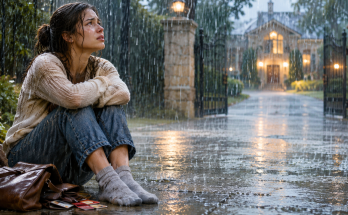
Nobody forced either of them to leave me outside in the rain.
Those were decisions.
And they belonged to them.
My father finally spoke.
"You're choosing a house and some money over your family."
I felt the words land.
For years, that sentence would have destroyed me.
I would have apologized.
I would have tried to prove that I loved them.
I would have offered to give up something just to make him stop being angry.
But I didn't do any of that.
"I'm choosing to make my own decisions."
He looked at me.
"After everything we've done for you?"
I nodded.
"I remember everything you've done for me."
"Then act like it."
"I also remember Thursday night."
His face tightened.
I continued.
"I remember asking for my shoes."
He looked away.
"I remember walking through the rain."
He said nothing.
"And I remember a stranger giving me water while my own parents wouldn't let me back inside."
His expression changed.
For the first time, he looked uncomfortable.
I took a breath.
"I am not asking you to agree with Grandma's decisions. I'm asking you to respect mine."
He shook his head.
"You've been influenced by that attorney."
"No."
"By Naomi?"
"No."
"Then who?"
I looked toward the house.
"Myself."
He stared at me.
I continued.
"I read the documents. I spoke to the attorney. I reviewed my accounts. I made my own decisions."
He looked as though he wanted to argue.
But there was nothing left to demand.
I told him that all estate matters needed to go through Evelyn.
I also told him that I wasn't ready to resume normal family contact.
He looked at me.
"So that's it?"
"For now, yes."
He stood silently.
Then he turned toward his vehicle.
Before opening the door, he looked back.
"Your mother is going to be devastated."
I felt a familiar sadness.
"I know."
He drove away.
I remained beside the gate for several minutes.
The security guard waited until I turned toward the house.
Then he closed the entrance.
The iron bars moved into place.
I walked slowly up the driveway.
Inside, I found my grandmother's letter on the desk.
I picked it up.
The paper was soft from being handled carefully.
I read the final lines again.
I thought about my father standing outside the gate.
I thought about the kitchen table.
I thought about the forty-three dollars.
And I understood something that had taken me twenty-eight years to learn.
I didn't have to hate my parents to stop obeying them.
I didn't have to erase my childhood to protect my adulthood.
And I didn't have to give away what my grandmother had left me to prove that I loved my family.
I placed the letter back inside its sleeve.
Then I returned to my laptop.
There was a client waiting for the next revision.
I had work to do.
And this time, nobody was going to decide whether I deserved to do it.
Click here to continue reading: PART 13: The Estate Attorney Called Me Back After Reviewing My Parents’ Statements, and One Detail Changed How I Understood the Missing Letters
My Father Demanded Access to My Bank Account, but One Quiet Word Changed Everything That Happened Next
Part 12 of 20