The searcher placed the wet paper inside an evidence bag.
I stood behind the deputy, trying to see what was written on it.
The rain had made everything difficult.
The paper was torn along one edge, and the ink had started running.
"Can you tell what it is?" I asked.
"Not yet," the deputy replied.
I looked at the muddy ground.
There were footprints near the wooden structure.
Some were small.
Others were larger and deeper.
I wanted to believe they belonged to the searchers who had already passed through the area.
But I couldn't be sure.
"Could those be Birdie's footprints?"
The deputy crouched to examine them.
"Possibly. We'll document them."
He called another officer over and asked him to photograph the area.
I watched them work.
Every second felt expensive.
My daughter was somewhere out there, and grown men were taking photographs of mud.
I knew they had reasons.
I knew they were doing their jobs.
But being a mother waiting for information was different from understanding what needed to be done.
I wanted answers immediately.
I wanted someone to point toward the trees and tell me my little girl was there.
Instead, I got another radio message.
The northern search team hadn't found anything.
I closed my eyes.
Not again.
Not another empty report.
The deputy noticed my expression.
"Stay with us, Fiona. We're still searching."
I nodded.
Then he asked me something unexpected.
"Does Birdie ever carry paper or drawing materials outside?"
"Sometimes. Why?"
He showed me the evidence bag.
"That could help us identify what we're looking at."
I studied the paper through the plastic.
There was a faint blue line.
A small patch of pink.
And what looked like the corner of a printed picture.
My stomach tightened.
Birdie loved drawing.
She carried little scraps of paper everywhere.
But I couldn't tell whether this belonged to her.
"She sometimes takes drawings outside," I said. "But I don't recognize that."
The deputy wrote something down.
I looked toward the canal again.
The water was moving faster because of the rain.
A searcher was standing near the bank with a flashlight.
Another was checking the area behind the wooden structure.
Then I heard a familiar sound.
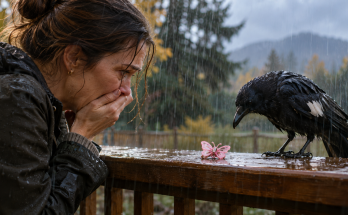
A crow.
I turned.
Edgar was perched on a branch above the trail.
He was almost impossible to see against the dark leaves.
But the white feather on his left wing gave him away.
I pointed.
"He's back."
The deputy looked up.
Edgar called once.
Then he flew toward the lower part of the canal.
I followed him with my eyes.
"That's where he went before."
The deputy raised his flashlight.
"Let's check that section."
Two searchers moved ahead.
I wanted to follow.
But the deputy told me to remain near the trail.
I hated hearing that.
Still, I stayed.
A minute passed.
Then another.
The rain continued.
I could hear someone speaking through a radio, but the words were too distant to understand.
Then one searcher raised his arm.
"Officer!"
The deputy turned.
"What do you have?"
"Something caught near the fence."
I stepped forward.
The deputy stopped me with one hand.
"Wait here."
I watched him approach.
The searcher was pointing toward a section of wire fencing near the canal.
Something was caught between two strands.
It looked like fabric.
Pink fabric.
My heart began racing.
The deputy leaned closer.
He didn't touch it.
He called for a camera.
I could barely breathe.
"Is that her jacket?"
He turned toward me.
"We're checking."
I recognized the color before he said anything.
It was the same shade as Birdie's jacket.
The searcher carefully photographed it.
Then he examined the surrounding area.
A few seconds later, he found another object.
A small plastic piece.
It was white.
He held it up for the deputy.
I couldn't see it clearly.
"What is that?"
The deputy came back toward me.
"We found part of a zipper pull."
I covered my mouth.
It was enough.
I knew that jacket.
I had bought it because Birdie said it looked like the sunset.
She had insisted on wearing it even when I thought the weather was too warm.
Now a piece of it was hanging from a fence beside the canal.
I looked at the water.
My mind went somewhere I didn't want it to go.
The deputy seemed to notice.
"Don't assume the worst."
I nodded.
But I couldn't stop thinking.
What if she had fallen?
What if she had slipped?
What if she had been trying to climb over the fence?
I looked toward the searchers.
"Please look everywhere."
"We will."
"Even near the water."
"We're doing that."
I pressed my hands against my face.
I had never understood how much a person could be afraid until that afternoon.
A few minutes later, another deputy arrived with additional equipment.
The search team began checking the canal bank more carefully.
They examined the muddy ground.
They looked beneath the low branches.
They checked the gaps between the fencing and the wooden structure.
Then one of them called out.
"There's something here."
I turned so quickly that I almost slipped.
The deputy raised his flashlight.
A small object was lying in the grass.
A child's drawing.
Wet.
Folded.
The paper had torn in half.
I recognized the handwriting immediately.
Birdie's.
She had written her name in large, uneven letters.
BIRDIE.
Below it was a picture of a black bird with a white feather.
Edgar.
I began crying before I could stop myself.
"That's hers."
The deputy looked at me.
"You're certain?"
I nodded.
"I know her writing."
He carefully collected the drawing.
I wanted to hold it.
I wanted to press it against my chest.
But it was evidence now.
And I understood that.
The searcher examined the other half of the paper.
It was caught under a small branch.
He lifted it carefully.
There were more drawings.
A fence.
A tree.
And a small rectangle that looked like a door.
I stared at it.
Birdie had drawn that same kind of rectangle on several pictures at home.
She liked drawing little houses.
But this one was different.
There was a black line beneath the rectangle.
And a small mark beside it.
The deputy asked whether I recognized the drawing.
I shook my head.
"Not exactly."
Then I remembered something.
Birdie had been drawing a little house the previous week.
She had shown it to me while I was working.
I had been distracted by a deadline.
I remembered telling her I would look at it later.
She had placed it on my desk.
I didn't know where it was now.
The deputy asked me to describe it.
I tried.
"A little house. Maybe a shed. She drew a door and a tree."
"Did she say where it was?"
I shook my head.
"No."
He looked toward the paper.
Then toward the wooden structure beside the canal.
"We'll check the nearby buildings and access points."
My heart started beating harder.
There were several maintenance structures around the green space.
I had never paid much attention to them.
I knew the canal was maintained by a local irrigation district.
I knew there were service gates and small utility areas.
But I didn't know what was behind them.
I looked at the drawing again.
A door.
A tree.
A black line.
I thought about Birdie standing at our kitchen table, drawing while I answered emails.
I thought about how often I had told her to wait.
Wait until I finish this.
Wait until I send this.
Wait until I have time.
I would have given anything to go back and listen to every little thing she had wanted to tell me.
Then Edgar called again.
I turned.
He had landed on the fence post.
His feathers were still wet.
He looked toward the far side of the canal.
Then he flew toward a group of trees.
The deputy watched him.
"He's moving again."
I wiped my face.
"Please."
He nodded to the searchers.
They began moving in that direction.
And I followed.
Because the paper had given us a place to look.
The torn jacket had given us another reason to keep searching.
And Edgar was still showing us where to go.
Click here to continue reading: PART 6: A Drawing, a Torn Jacket, and a Crow That Refused to Leave Us Alone Led the Search Team to a Place I Had Never Noticed
I Thought the Crow Was Just Another Visitor Until My Daughter Started Treating Its Strange Little Gifts Like Treasures
Part 5 of 20