Three days passed without another letter from the HOA.
I almost began to relax.
Then someone knocked on my front door.
I opened it.
Mr. Dennison was standing outside.
He was holding a folder.
"Fiona."
I didn't invite him in.
"What do you want?"
He looked past me toward the hallway.
"Could we speak?"
"About what?"
"The crow."
I stared at him.
For a moment, I thought I had misunderstood.
"Why?"
He shifted the folder in his hands.
"I heard you were showing the sheriff some objects the bird brought you."
I felt my shoulders stiffen.
"How did you hear that?"
"People talk."
I didn't answer.
He glanced toward the backyard.
"Did they find anything else?"
The question bothered me.
Not because it was unusual.
Because he asked it so quickly.
I folded my arms.
"Why are you interested?"
"I'm the HOA president. I have responsibilities."
I almost laughed.
"Your responsibilities don't include my daughter's disappearance."
He looked uncomfortable.
"I know that."
"Do you?"
He lowered his eyes.
For a few seconds, he seemed to be choosing his words.
Then he said:
"I want to explain something about the maintenance area."
My stomach tightened.
"What about it?"
He looked toward the street.
"There's been trouble with that building before."
I stared at him.
"What kind of trouble?"
"People have complained about the gate."
"Who?"
He hesitated.
"Residents."
I waited.
He opened the folder and removed a piece of paper.
It was a copy of an old neighborhood notice.
The notice mentioned restricted access to the green space near the irrigation canal.
It also warned residents not to enter maintenance areas.
I read it.
"What does this have to do with Birdie?"
He shook his head.
"I'm not saying it has anything to do with her."
"Then why are you here?"
He looked down at the paper.
"I thought you should know."
I took the notice.
It was dated several months earlier.
There was a line near the bottom about a damaged service latch.
I read it again.
The maintenance building.
The latch.
The same place where Birdie had been trapped.
I looked at him.
"You knew the latch was damaged?"
He didn't answer immediately.
"I knew there had been a complaint."
"When?"
"Some time ago."
"Why wasn't it repaired?"
He looked uncomfortable.
"That's not an HOA matter."
I felt anger rising.
"People walk there. Children walk there."
"The irrigation district is responsible for that property."
"And you knew the gate had a problem."
"I knew someone had reported it."
I held the notice tightly.
"Did you report it to them?"
He nodded.
"Yes."
"When?"
"I don't remember the exact date."
I stared at him.
Then I asked:
"Did you ever go inside that building?"
His expression changed.
"No."
"Are you sure?"
"Of course."
He closed the folder.
"I didn't come here to be interrogated."
I stepped back.
"Then you shouldn't have come."
He looked at me.
For the first time, he seemed smaller than the man who had threatened me at the mailbox.
"I am sorry about what happened to Birdie."
I didn't respond.
He continued.
"I shouldn't have made that comment during the search."
"No, you shouldn't have."
"And I shouldn't have threatened the bird."
I looked directly at him.
"Why did you?"
He took a breath.
"I was angry."
"About peanuts?"
He nodded.
I waited.
He looked toward the backyard again.
"I don't like crows."
"That isn't a reason to threaten one."
"I know."
His apology was awkward.
It didn't erase anything.
It didn't change what Birdie had experienced.
And it certainly didn't make me forget the $500 fine.
But it was the first time he had admitted he was wrong.
I handed the notice back.
"I'll give this to the sheriff."
He nodded.
"That's fine."
Then he walked away.
I watched him until he reached his house.
Something about the conversation stayed with me.
He had known about the damaged latch.
He had also asked whether the sheriff had found anything else.
I didn't know whether that meant anything.
I wasn't going to accuse him without evidence.
But I wasn't going to ignore it either.
I called the deputy.
I explained the visit and read him the date on the notice.
He asked me to photograph it.
I did.
He thanked me.
Then he told me the sheriff's office would follow up with the irrigation district about the maintenance records.
I hung up.
Birdie was sitting on the floor nearby.
She had been listening.
"Was that the man who doesn't like Edgar?"
I looked at her.
"Yes."
"Did he say sorry?"
I nodded.
She thought for a moment.
"Did he say sorry to Edgar?"
I smiled sadly.
"No, sweetheart."
She returned to her drawing.
Then she said:
"Maybe he should."
I didn't disagree.
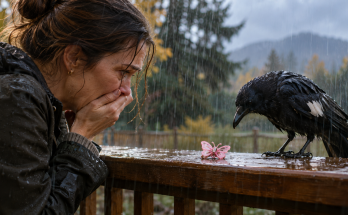
That evening, I checked the porch railing.
There was something new beside the corner.
A small round object.
I picked it up.
It was a button.
Brass.
Similar to the one Birdie had found weeks earlier.
But this one had a tiny symbol stamped into the center.
I turned it over.
There were no letters.
I placed it beside the other objects.
Then I noticed something.
The brass button and the new one had the same unusual shape around the edge.
I called Birdie.
She came running.
"Another gift!"
I nodded.
She held both buttons side by side.
"They match."
I looked at them.
They did.
For the first time, I began to think the objects might belong to the same collection.
Perhaps they had come from the same place.
Perhaps they had been scattered around the maintenance area.
Or perhaps Edgar had simply found them in different places.
I didn't know.
But I photographed both buttons and sent the images to the deputy.
Then I closed the glass jar.
I didn't want to lose another piece of the story.
Click here to continue reading: PART 12: The Irrigation District Confirmed an Old Maintenance Problem, and the Sheriff Returned With Questions That Made Me Look at Edgar’s Gifts Differently
I Thought the Crow Was Just Another Visitor Until My Daughter Started Treating Its Strange Little Gifts Like Treasures
Part 11 of 20