The taxi had barely stopped at the curb when I heard my mother pounding on a locked door somewhere above me.
Not knocking. Not calling politely.
Pounding.
“Samuel!”
Her voice came faintly through the second-floor window, followed by three hard blows that made my stomach tighten.
“Samuel, please! Don’t let her leave me in here!”
I stayed beside the taxi with one hand on my duffel bag, still wearing the uniform I had traveled home in. Sixteen hours earlier, I had been strapped into a military transport plane imagining an entirely different homecoming.
Hot coffee.
My mother Adela’s apple crumble.
Abigail throwing her arms around me before I even made it through the front door.
Instead, my wife stood on our porch talking quietly to Mrs. Smith from next door while two other neighbors lingered beside the hedge.
Abigail wore a cream-colored dress and pearl earrings. Her hair was pinned neatly behind her head. She looked composed enough to be welcoming guests to an afternoon fundraiser.
“She has become terribly confused,” Abigail was telling Mrs. Smith when I approached. “Some days she doesn’t know where she is. Sometimes she becomes agitated.”
Mrs. Smith pressed a hand to her chest. “Adela?”
Abigail nodded sadly.
“We’re considering professional care. Somewhere safe, where people are trained to deal with these episodes.”
Another thump came from upstairs.
Every face turned toward the house.
Abigail recovered first.
“She gets frightened when she’s confused.”
I looked toward the second-story window.
The curtain moved.
Only slightly.
But I knew my mother.
She was standing behind it.
Abigail hurried down the porch steps with both arms open.
“Samuel.”
She embraced me.
I returned the hug automatically, but her body stiffened when I murmured near her ear, “Why is Mom locked in her bedroom?”
For perhaps half a second, everything about my wife changed.
Her shoulders tightened.
Her breathing stopped.
Then she stepped away and smiled.
“For her protection.”
I looked at her.
She held my gaze without blinking.
“She wandered downstairs twice last week,” Abigail continued. “One night I found her trying to leave through the back door. She nearly fell. I’ve been doing everything I can, Samuel.”
My first instinct was to push past her.
My second was considerably stronger.
But years of training had taught me something useful: the person who realizes first that a situation is dangerous should not necessarily be the first person to reveal what he knows.
So I relaxed my shoulders.
I even smiled.
“All right.”
Relief appeared so quickly in Abigail’s face that I almost missed it.
“You understand?”
“You’ve been here handling everything alone.”
Her expression softened.
“Exactly.”
I lifted my duffel.
“Let’s get inside.”
The neighbors stayed another ten minutes. Abigail accepted their sympathy with patient sighs and tired smiles. Mrs. Smith promised she would pray for us.
All the while, I could feel my mother somewhere upstairs.
Waiting.
When the last neighbor finally disappeared behind the hedge, Abigail took my bag.
“You must be exhausted.”
“I am.”
“I’ll make coffee.”
“I’d rather shower first.”
“Of course.”
I walked upstairs without hurrying.
Abigail remained in the kitchen.
I passed our bedroom and stopped outside Mom’s room.
The door had been altered.
I noticed it immediately.
The old interior latch was gone. A keyed lock had been installed on the hallway side, allowing someone outside the room to control whether the person inside could leave.
I touched the handle.
Locked.
“Mom?”
Silence.
Then, very softly, “Samuel?”
“It’s me.”
Something brushed against the other side of the door.
“Is she downstairs?”
“Yes.”
“Are you alone?”
“Yes.”
I lowered my voice.
“Where’s the key?”
A pause.
Then Mom said, “Check Abigail’s jewelry box.”
I went into our bedroom.
The mahogany jewelry box sat exactly where it always had, on Abigail’s dresser beside a bottle of perfume.
I opened the lid.
Necklaces. Earrings. Two watches.
Nothing else.
I remembered Abigail’s habit of storing cash beneath the velvet insert when we traveled.
I lifted it.
A small brass key lay underneath.
My heartbeat slowed rather than accelerated.
That usually happened when I became angry enough.
I returned to the hallway and unlocked Mom’s door.
The smell reached me first.
Stale air.
Sweat.
A faint sourness from a cup of water that had been sitting too long.
The curtains were drawn despite the afternoon sun.
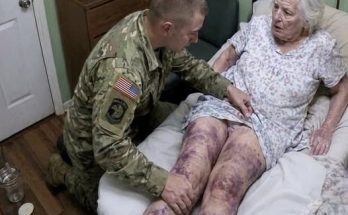
My mother sat on the floor beside the bed.
For several seconds, neither of us spoke.
Adela Mercer was seventy-three years old and normally incapable of sitting still longer than fifteen minutes. She volunteered twice a week, maintained her own garden, handled every bill associated with the house, and still corrected my grammar when I called.
The woman in front of me wore the same blue blouse and gray trousers I remembered seeing during our last video call days earlier.
Her hair was unwashed.
There was no phone anywhere in sight.
The bed had been stripped except for a thin sheet.
A plastic cup stood on the nightstand.
Then I saw her wrists.
Dark bruises wrapped around both of them.
I crouched in front of her.
“Who did that?”
Mom caught my sleeve.
“Listen to me before you do anything.”
“Who touched you?”
“Samuel.”
Her voice was stronger now.
Clear.
Controlled.
“I am not confused.”
“I know.”
Something in her face loosened.
Just slightly.
“I am not senile.”
“I know.”
“I have not been wandering.”
“I believe you.”
Her eyes filled, though no tears fell.
“She has been telling everyone that I am losing my mind.”
“Abigail?”
Mom nodded.
“She took my phone. She changed passwords. She started opening my mail. When I objected, she said my anger proved I was unstable.”
I looked at the bruising again.
“And your wrists?”
Mom’s mouth tightened.
“I tried to leave this room.”
My hands curled.
She noticed.
“Do not do anything stupid.”
“She locked you in here.”
“Yes.”
“She restrained you.”
“Yes.”
“And you want me to stay calm?”
“I want you to think.”
That sounded like my mother.
I sat beside her on the floor.
“Start at the beginning.”
She glanced toward the door.
“Not now.”
“Why?”
“Because she checks.”
I heard nothing.
Mom did.
Footsteps.
Coming up the stairs.
The change in her expression was immediate.
Her shoulders sagged.
Her eyes went unfocused.
Her mouth fell slightly open.
For one stunned moment I thought something was actually wrong.
Then she whispered, “Play along.”
“Mom—”
“Samuel.”
The footsteps reached the landing.
I stood.
Every part of me resisted what I did next.
I walked into the hallway.
Then I closed the door on my mother.
The latch clicked.
I inserted the key.
And locked her inside.
My hand remained on the key for one second longer than necessary.
Through the wood, Mom pressed her fingers briefly against mine from the opposite side.
Then I heard Abigail behind me.
“What are you doing?”
I turned.
She stood near the stairway, watching me carefully.
“I wanted to see Mom.”
Abigail searched my face.
“And?”
I forced myself to shrug.
“She seems tired.”
A little tension left her shoulders.
“She barely slept last night.”
“I told her to rest.”
“That was smart.”
Abigail came closer and placed one hand against my chest.
“You have no idea what the last few months have been like.”
“I’m beginning to understand.”
She kissed my cheek.
“Come downstairs. I opened wine.”
I followed her.
At dinner, she performed beautifully.
There was no better word for it.
Abigail described doctor visits, supposed falls, incidents of Mom wandering outside and accusations Mom supposedly made against neighbors.
She had dates.
Examples.
Little sighs of exhaustion placed at exactly the right moments.
“I didn’t want to worry you while you were deployed.”
I cut into my chicken.
“So you handled it alone?”
“What choice did I have?”
“You could have told me.”
“You were overseas doing something important. I thought I could manage.”
She reached for my hand.
“And I did.”
I looked at the woman I had been married to for seven years and wondered whether I had ever truly understood what she looked like while lying.
“What happens now?”
Abigail exhaled as though she had been hoping I would ask.
“I spoke with our family doctor.”
My fork stopped.
“About Mom?”
“He believes she should undergo a formal psychiatric evaluation.”
“Does he?”
“Yes. If the specialist confirms cognitive decline, we can finally make responsible decisions for her.”
Something about the word finally bothered me.
“What kind of decisions?”
“Medical care. Finances. Housing.”
She rose and retrieved a folder from the counter.
Inside were legal forms.
I recognized the language immediately.
Guardianship.
Authority over financial accounts.
Power of attorney.
Permission to sell property under certain circumstances.
Abigail touched the signature line.
“You’ll need to sign in a few places.”
I looked at her.
She smiled.
The same warm, reassuring smile she had used with the neighbors.
Before joining the military, I had spent four years working as an investigator for the state attorney general’s office.
Most of my cases involved financial fraud.
People often imagined fraud looked complicated.
Usually it did not.
Usually it began with someone gaining control over another person’s information.
Mail.
Passwords.
Bank statements.
Legal authority.
And the most useful weapon was always the same.
A believable explanation.
I closed the folder.
“Tomorrow.”
Abigail hesitated.
“Why not tonight?”
“Because I’m exhausted.”
She studied me.
Then smiled again.
“Of course.”
That night, Abigail fell asleep quickly beside me.
I waited another forty minutes.
Then I slid out of bed, carried my laptop into the downstairs office, and logged into our home security account.
The main video archive was empty.
Three months of footage had been erased.
I stared at the blank timeline.
Then I opened the administrative access records.
Deleting footage removed video.
It did not remove every digital footprint left behind while deleting it.
Each erased block showed the same source device.
Abigail’s laptop.
My pulse thudded once against my throat.
I kept searching.
At 1:18 in the morning, I found something worse.
My mother’s bank correspondence had been redirected.
Not to Mom.
Not to me.
To an email address belonging privately to Abigail.
And sitting in the transaction history was a pending request involving eighty thousand dollars.
I leaned closer to the screen.
The receiving account was unfamiliar.
The authorization contained my mother’s name.
And beneath it appeared a scanned signature that looked almost perfect.
Almost.
I had watched Adela Mercer sign birthday cards, permission slips, mortgage documents, military paperwork, and checks my entire life.
That was my mother’s signature.
But my mother had not written it.
Click here to continue reading: PART 2: My Wife Thought I Believed Her Dementia Story, So Mom and I Gave Her Exactly the Confused Woman She Wanted
I Came Home Expecting My Wife’s Embrace, but the Sound Upstairs Told Me Someone Had Been Waiting Desperately for Me
Part 1 of 10