The next morning, I woke before the first cart rattled down the hallway.
For a moment, I forgot where I was.
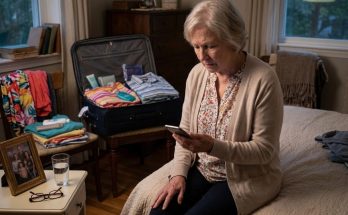
Then I saw the white walls, the narrow window, and Frank's photograph beside my bed.
I reached for my glasses.
The picture was still there, exactly where I had placed it.
I picked it up and brushed a small mark from the glass with my sleeve.
Frank looked the same as he had in the photograph all those years ago.
His smile was quiet.
He had never needed to be the loudest person in a room to make himself heard.
I set the photograph down.
For weeks, I had been trying to understand how Scott could leave me here and stop answering his phone.
I had also been trying to understand why Dr. Reyes reacted so strongly to Frank's name.
Those questions were connected in my mind, but I knew they were not necessarily connected in the way I imagined.
I could not allow one mystery to become an excuse for ignoring the other.
When Gloria came in with my breakfast, I asked whether Dr. Reyes was available.
"She has a busy morning, Mrs. Dunmore, but I can let her know you would like to speak with her."
"Please tell her I am ready to discuss the paperwork."
Gloria set the tray on the table.
"Are you feeling better today?"
"I am feeling more certain about what I need."
She gave me a small, encouraging smile.
"That sounds like progress."
After she left, I ate half my toast and drank my tea.
I was not especially hungry.
Still, I made myself finish the tea because I had spent too many days letting worry decide whether I ate, slept, or moved.
I had lived through harder things than an unanswered telephone.
I had buried Frank.
I had watched my son grow from a little boy into a man.
I had learned to keep a household running when money was tight and when grief made ordinary chores feel impossible.
I could manage one more difficult morning.
Dr. Reyes arrived shortly before lunch.
She carried a folder and pulled the chair closer to my bed.
"Mrs. Dunmore, I wanted to speak with you before making any assumptions about your situation."
"That is what I have wanted from the beginning."
She nodded.
"I understand."
I folded my hands in my lap.
"First, I want to know what your records actually say about my admission."
She opened the folder.
"The paperwork identifies you as a long-term resident. It also lists your son as the responsible party and indicates that he holds power of attorney."
"Does it say that I understood I was agreeing to live here permanently?"
She looked down at the pages.
"It records the placement as permanent, but I want to be careful about what that does and does not establish."
"Then please be careful."
I had not meant the words to sound sharp.
But they came out that way.
Dr. Reyes did not seem offended.
"You are right to ask for a clear explanation."
I took a breath.
"I remember sitting at Scott's dining table. He had papers in front of him, and I trusted him to explain them. I believed I was signing things that would help if I needed assistance."
"Do you remember being told that you would be moving into Willow Creek permanently?"
"No."
The answer came easily.
I had repeated it to myself so many times that I no longer needed to search for the memory.
"I remember being told that I would stay here while the house was being painted. Three nights, perhaps four. That is what Scott said."
Dr. Reyes wrote something in the folder.
I watched her pen move.
"Will that be included in the record?"
"Yes. I will document what you have told me."
"And can I receive a copy of the documents connected to my admission?"
"I will review what can be provided and explain the process to you."
I nodded.
It was not the complete answer I wanted.
But it was a direct answer, and direct answers were something I had been missing.
"Now, the house," I said.
Dr. Reyes closed one section of the folder and opened another.
"The information available to us states that your home was sold."
"Does it tell you when?"
"The record I reviewed does not establish all the details."
"Does it tell you who purchased it?"
She paused.
"Not in the information I have confirmed."
I looked toward the window.
Forty-four years had been reduced to a sentence in a file.
A house that had held birthdays, arguments, Christmas mornings, and the last winter of Frank's life had become an entry on a page.
"Then please do not tell me the matter is settled simply because the file says sold."
"I won't."
I turned back to her.
"And I want you to understand something else. I am not asking you to decide what kind of son Scott is. I am asking you to help me understand what happened to me."
"I understand the distinction."
For the first time since she had entered my room, her expression seemed less guarded.
She looked like a person who had finally been given a clear task instead of a collection of painful suspicions.
"I will continue reviewing the records connected to your admission," she said. "And I will keep your account separate from the history of the building."
"Thank you."
She stood, then hesitated.
"There is one more thing I want to tell you about Frank."
My fingers tightened around the edge of the blanket.
"Have you confirmed something?"
"I have confirmed that his name belongs to the history of Willow Creek. I am still being careful about the precise details."
I waited.
She did not add anything more.
I could have pressed her.
Instead, I asked, "Will you tell me when you know what you can reliably tell me?"
"Yes."
"Not what people assume. Not what someone remembers vaguely. What you can verify."
"That is what I intend to do."
After she left, I sat quietly for a long time.
The room was peaceful.
Somewhere beyond the door, a television played a game show, and a resident laughed at something the host had said.
I looked at Frank's picture again.
His name was on a plaque at the entrance.
That much I had seen with my own eyes.
But I still did not know the full reason for it.
I had spent so many years believing that the most important things about a person were the things they did inside their own home.
Now I was learning that a life could leave marks in places a family never thought to look.
That did not change what Scott had done.
It did not explain why he had stopped answering me.
And it did not tell me whether I would ever return to the house where I had spent most of my adult life.
I could not make those answers appear by staring at a telephone.
So I put my glasses on, opened my book, and began to read.
For the first time in days, I made it through several pages without checking the clock.
Click here to continue reading: PART 22: The Name on the Entrance Plaque Meant Something, but I Refused to Let That Distract Me From What Had Happened to My Home
My Son Promised Me Three Quiet Nights Away From Home, and I Was Foolish Enough to Believe Every Word He Said
Part 21 of 24