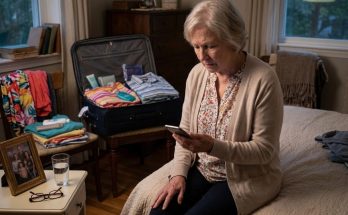
The days at Willow Creek had started to fall into a routine.
Breakfast arrived in the morning.
The nurses checked on me.
The dining room filled with voices at lunchtime, and the halls grew quieter after dinner.
I learned which chair near the window caught the afternoon light.
I learned that the clock outside the nurses' station ran a few minutes fast.
I learned that Gloria hummed when she was concentrating.
These small details gave the days a shape.
They did not make the situation right.
But they kept every hour from becoming nothing more than another hour spent waiting for Scott.
I continued to ask for information about my admission.
Dr. Reyes continued to review what was available.
There were still gaps between what the paperwork recorded and what I remembered being told.
Nobody had yet given me a complete explanation of how those differences would be addressed.
I wanted one.
I also wanted to understand the entry about my house.
The word sold still hurt when I heard it.
Sometimes, when I closed my eyes, I could picture the front steps.
I could see Frank carrying boxes through the doorway when we first moved in.
I could see Scott as a little boy, sitting on the kitchen floor with his toys spread around him.
I could see the bedroom where Frank spent his final winter.
I had never imagined that I would have to ask strangers what had happened to that place.
One afternoon, Dr. Reyes came to my room without the clipboard she usually carried.
She pulled the chair toward the bed.
"I wanted to check in with you," she said.
"Have you found anything new?"
"I am still working through the records. I don't want to tell you that I have a final answer when I don't."
I appreciated her honesty, even though I wished the answer had come sooner.
"Then let me ask something different."
"Of course."
"If you were in my position, what would you want written down first?"
She considered the question carefully.
"I would want the account of what I was told before arriving here, the circumstances of the admission, and the questions I had about the documents."
"Then that is what I want."
She opened her notebook.
We went through the details slowly.
I explained that Scott had described the stay as a short arrangement while the house was being painted.
I explained that Heather had carried my suitcase inside.
I explained that Scott had kissed my forehead at the reception desk and told me he would see me Sunday.
I told her that Sunday passed without a visit.
I told her about the calls that went unanswered.
I told her about the disconnected house line.
And I repeated what Gloria had told me on Wednesday: that the paperwork listed my placement as permanent and the house as sold.
Dr. Reyes listened without interrupting.
When I finished, she read her notes back to me.
I corrected one small detail about the order in which I had made the calls.
She changed it.
That simple act meant more than I expected.
My words had not been brushed aside or softened into something easier for someone else to read.
They had been recorded as I intended them.
"Is that accurate?" she asked.
"Yes."
"Is there anything else you want included?"
I looked at the photograph on the nightstand.
"Only that I did not knowingly agree to what I believed was a permanent move. I understood that I was coming here temporarily."
She wrote that down.
"Thank you," I said.
"You don't need to thank me for listening."
"Perhaps not. But I will thank anyone who does it properly."
She closed the notebook.
Before she left, I asked about the plaque again.
"I have not forgotten it," she said.
"I know."
"I have confirmed that Frank's name is included in the building's history. I am still checking the details behind that connection."
"Will you tell me when you have something definite?"
"Yes."
After she left, I thought about how often people assumed that a woman my age wanted everyone else to make decisions for her.
I could not speak for every older person.
I could only speak for myself.
I wanted help when I needed it.
I wanted someone to explain what was happening.
I wanted the chance to understand a document before it changed the course of my life.
Those things did not seem unreasonable.
I had trusted Scott because he was my son.
That trust had not made me foolish.
But trust could not replace clear information, and it could not make an unanswered question disappear.
Later, I asked Gloria whether I could have paper and a pen.
She brought both.
I began writing down the questions I still needed answered.
What exactly had I signed?
What authority did Scott have under the documents?
What did the records establish about the sale of the house?
What steps could I take to challenge or clarify my placement?
And what, precisely, was Frank's connection to Willow Creek?
I read the list twice.
It was not a dramatic list.
It did not accuse anyone of a crime.
It did not claim to know things I could not prove.
It simply named what I needed to understand.
I folded the paper and placed it beside my glasses.
That evening, I did not call Scott.
I was still his mother.
I still loved the boy I remembered and grieved for the man who had left me here without an explanation.
But I could love him without spending every evening asking his telephone to speak.
I could remember our good years without pretending that the present was harmless.
And I could wait for verified information without surrendering my right to ask for it.
When I turned out the lamp, Frank's photograph caught a small strip of light from the hallway.
I looked at it for a moment.
"I am trying," I whispered.
I did not know whether I was speaking to Frank, to myself, or to the part of me that still wanted everything to be the way it had been.
Then I settled into bed.
For once, the last thought I carried into sleep was not whether Scott would call.
It was the list of questions waiting beside my glasses.
Click here to continue reading: PART 24: I Could Not Change the Days That Had Brought Me to Willow Creek, but I Could Refuse to Let My Questions Go Unanswered
My Son Promised Me Three Quiet Nights Away From Home, and I Was Foolish Enough to Believe Every Word He Said
Part 23 of 24