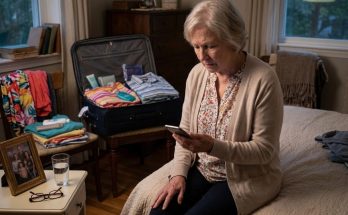
The first night at Willow Creek wasn't terrible.
I ate the dinner they brought to my room and listened to the television in the hallway.
A nurse checked my name before handing me my medication, although I wasn't taking anything unusual.
She was friendly enough.
Everyone seemed to know where they were going except me.
I went to bed early.
The mattress felt different from mine at home, and the hallway lights shone beneath the door.
I woke twice during the night.
Each time, I looked at Frank's photograph.
It was silly, perhaps, but seeing his face made the room feel less unfamiliar.
By Saturday morning, I had begun to settle into the routine.
Breakfast came on a tray.
I drank my tea while looking out at the rose bushes.
A few residents sat together in the common room, speaking quietly about their families.
One woman was expecting her granddaughter to visit.
Another had received a box of chocolates from her son.
I listened without joining their conversations.
I expected Scott to call.
He didn't.
I wasn't particularly worried.
He had work to do, and Heather was probably busy with whatever they had planned for the weekend.
I reminded myself that I had raised a child who sometimes forgot to telephone.
When Scott was young, he could disappear into the neighborhood for hours and come home only when he was hungry.
I had worried then, too.
Eventually, I learned to trust that he would return.
He was a grown man now.
I shouldn't have needed to remind him to keep his word.
Still, I checked my phone several times that afternoon.
There were no messages.
On Sunday morning, I dressed in one of my clean nightgowns before changing into my usual clothes.
I brushed my hair and put on a little lipstick.
I wasn't going anywhere special.
I simply expected my son to come.
I wanted to look presentable when he walked into the room.
At breakfast, I asked a nurse whether visitors usually came in the afternoon.
"They can come whenever the visiting hours allow," she told me.
"Thank you."
I returned to my room and straightened the blanket.
I moved Frank's photograph closer to the wall so it wouldn't be knocked over.
Then I sat beside the window.
The fountain outside made a soft, steady sound.
Cars came up the drive and stopped near the entrance.
Families emerged carrying bags, flowers, and sometimes small children who ran ahead of their parents.
Every time I heard footsteps in the corridor, I looked toward the door.
None of them belonged to Scott.
By late afternoon, I began making excuses for him.
Perhaps the painting had taken longer than expected.
Perhaps something had gone wrong at work.
Perhaps he planned to arrive later and stay only a short while.
There were plenty of explanations.
I chose the ones that hurt least.
Dinner arrived.
I ate slowly, leaving a little of the food untouched.
Then I asked the nurse whether my son had called.
She checked the desk.
"No message for you, Mrs. Dunmore."
I thanked her.
I didn't want to seem demanding.
After all, he had promised to come back, but perhaps promises became harder to keep when life was busy.
I had made excuses for people before.
I was very good at it.
That evening, I sat on the bed with Frank's picture in my hands.
I remembered the first house we rented after we married.
It had two small bedrooms and a kitchen so narrow that we bumped into each other whenever we tried to cook together.
Frank used to say we needed a bigger place.
I would laugh and tell him we needed a bigger kitchen first.
Eventually, we found the house where I had spent forty-four years.
We bought it in 1982.
Frank carried me across the threshold because he had promised he would.
I had laughed at him for making such a fuss.
He told me some promises deserved to be taken seriously.
I put the photograph back on the nightstand.
Then I lay down.
Sunday ended without a visit.
On Monday morning, I decided to call Scott myself.
There was no point sitting around feeling sorry for myself.
I picked up my phone and dialed his number.
It rang briefly before the call went to voicemail.
I waited, then tried again.
The same thing happened.
I left a short message.
"Scott, it's Mom. I hope everything is all right. Give me a call when you can."
I didn't mention that he had promised to visit.
I didn't want him to feel guilty.
That was another mistake I made.
I kept protecting him from feelings he should have been allowed to experience.
Later, I called Heather.
Her phone also went to voicemail.
I listened to the greeting, then ended the call without leaving a message.
There was something humiliating about asking for attention from people who had made it clear they weren't offering any.
Still, I wanted to believe they had a good reason.
Around lunchtime, I asked the staff whether I could use the telephone to call my house.
The receptionist gave me the number I had known for decades.
I dialed it from the phone beside the front desk.
A recorded voice answered.
The line had been disconnected.
I held the receiver against my ear for a few seconds after the message ended.
Then I slowly put it down.
I tried the number again.
The same recording played.
Disconnected.
I stared at the telephone.
Our house had never been without a working line for more than a few hours.
Frank had insisted on keeping it even after mobile phones became common.
He liked knowing that someone could always reach us at home.
After he died, I kept paying the bill.
I used the phone less often, but I wasn't ready to let go of it.
Now it was gone.
I returned to my room and sat on the edge of the bed.
Frank's photograph stood beside the plastic cup.
Everything else I owned was still in the suitcase.
I looked at the three nightgowns hanging in the closet.
I had packed for a long weekend.
I had not packed for a life without my own front door.
I called Scott again that afternoon.
Voicemail.
I called Heather once more.
Voicemail.
For the first time, I wondered whether they were avoiding me.
The thought frightened me enough that I pushed it away.
I had spent years believing that being a good mother meant being patient.
I didn't yet understand that patience could become a way of helping someone hurt you.
Click here to continue reading: PART 3: When I Asked for a Taxi, the Receptionist Looked at Her Computer and Told Me Something My Son Had Never Said
My Son Promised Me Three Quiet Nights Away From Home, and I Was Foolish Enough to Believe Every Word He Said
Part 2 of 24