I thought the hardest thing about getting old was learning to live without the person you loved most.
I was wrong.
Sometimes, the hardest part was discovering that the person you had left in the world to trust was the one who had decided you were no longer worth coming home to.
I didn't understand that when Scott arrived at my house.
He stood in my kitchen with his car keys in one hand and his phone in the other.
He had that hurried look he always wore when he wanted something done without too many questions.
"Mom, we need to get you out of the house for a few days."
I was standing beside the sink, drying a cup.
"Out where?"
He explained that painters were coming.
The house needed to be empty while they worked, he said, and the smell of fresh paint might make me feel sick.
It sounded reasonable enough.
My son had always been better at arranging things than I was.
Since Frank died, I had let Scott handle more and more of the details I once managed myself.
He paid attention to bills, made calls when I couldn't get through to someone, and occasionally reminded me about appointments.
I told myself that was what family was for.
"The place is nice," he said. "You'll have a comfortable room, and we'll pick you up before the weekend is over."
I set the cup on the counter.
"How long will I be staying?"
"Just a few nights, Mom."
He said it as though the question had already become tiresome.
"Maybe three. If the painters run late, four."
I looked around my kitchen.
The curtains needed washing, and one cabinet door had started to hang crooked.
But it was my kitchen.
Frank had installed those cabinets himself in the early eighties, after we bought the house.
He had complained about the measurements for an entire afternoon, then stood back and admired his work as if he had built the whole place from scratch.
I could still remember the sound of his hammer.
"All right," I told Scott.
Looking back, I wish I had asked why I needed to leave the house entirely.
I wish I had asked who had arranged the place where I would stay.
Mostly, I wish I had paid attention to how quickly he changed the subject.
Heather came into the kitchen a few minutes later.
She was dressed to go out, wearing a cream-colored sweater and carrying her handbag.
She smiled at me.
It was a perfectly pleasant smile.
For eleven years, my daughter-in-law had managed to be polite without ever making me feel that I belonged to her family.
I had accepted that.
Not everyone had to love me.
"Have you packed yet?" she asked.
"Not yet. I only just heard about the painters."
"I'll help you."
That surprised me.
Heather had never been the sort of person to offer to carry my shopping bags or fuss over my comfort.
At family dinners, she usually sat beside Scott and talked about work, holidays, and the things they hoped to buy.
I rarely interrupted.
I had learned that asking too many questions could make a room go quiet.
That afternoon, though, she followed me upstairs.
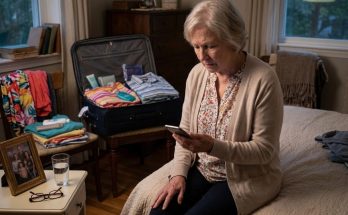
I took a small suitcase from the closet.
Three nightgowns went inside, along with my slippers, a clean cardigan, and my reading glasses.
I packed my toothbrush and the little tin of hand cream I kept beside my bed.
Then I reached for Frank's photograph.
It was an ordinary framed picture.
Frank was sitting outside in the sunshine, smiling at whoever had taken it.
His hair had gone mostly gray by then, and he had a crease beside his left eye that appeared whenever he laughed.
I had kept the photograph on my nightstand since the week he died.
I wrapped it in a soft shirt and placed it between the folded nightgowns.
Heather watched from the doorway.
"Are you bringing that?"
I looked down at the suitcase.
"Of course."
She didn't argue.
She simply reached for the handle.
"I'll carry it."
For a moment, I almost told her I could manage.
Instead, I let her take it.
Perhaps I was grateful.
Perhaps I wanted to believe that this small kindness meant something had changed between us.
I know now that I was looking for reassurance wherever I could find it.
Scott drove us out of town.
The afternoon was bright, and the trees along the road had begun to turn at their edges.
I sat in the passenger seat with my hands folded in my lap.
Heather sat behind me.
Scott talked about the painters, the schedule, and the inconvenience of having workers in the house.
He never mentioned what I would do while I was away.
I assumed I could read, rest, and perhaps call a friend.
Three nights wasn't a long time.
That was what I kept telling myself.
When the car turned onto the road leading up the hill, I saw the building ahead.
Willow Creek Care Center.
It had tall white columns at the entrance, a fountain near the drive, and neatly arranged rose bushes along the walkway.
The place looked peaceful.
There were benches near the front doors and large windows that caught the afternoon light.
I had driven past it before.
I had never imagined checking in.
Scott parked close to the entrance.
Heather climbed out first and retrieved my suitcase from the back.
Then she stood beside me while I adjusted my cardigan.
"You'll be fine here," she said.
I smiled because I didn't know what else to do.
Inside, the reception area smelled faintly of flowers and cleaning products.
A young woman sat behind the desk.
Scott spoke to her while I looked around.
There were comfortable chairs near the windows, a bowl of wrapped candies, and a framed notice about activities for residents.
I could hear a television somewhere down the corridor.
The receptionist asked Scott to sign several papers.
He answered her questions without looking at me.
I thought he was simply handling the arrangements.
I didn't know what he was signing.
When he finished, he turned toward me.
He leaned forward and kissed my forehead.
"Have a nice little break, Mom."
I touched his sleeve.
"You'll come back for me on Sunday?"
"Of course."
He said it easily.
That was what made it believable.
I watched him walk toward the doors.
Heather followed him.
Neither of them looked back until they reached the car.
I stood near the reception desk, holding my reading glasses in one hand.
Then the receptionist showed me to my room.
It was small but clean, with a narrow bed, a bedside table, and a window facing the gardens.
The walls were a pale yellow.
A plastic cup sat beside the bed, and a folded blanket rested at the foot.
I placed Frank's photograph on the nightstand.
For a little while, I stood looking at it.
Then I unpacked my three nightgowns and hung them in the closet.
I told myself I had nothing to worry about.
Sunday was only a few days away.
Click here to continue reading: PART 2: The First Sunday Passed Without My Son, and the Silence From Home Began to Feel Different From Ordinary Busyness
My Son Promised Me Three Quiet Nights Away From Home, and I Was Foolish Enough to Believe Every Word He Said
Part 1 of 24