I used to believe that family was the one thing a man could count on.
I was fifty-eight years old when I finally understood how wrong that belief could be.
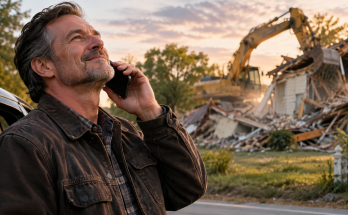
The realization came while I was standing outside a hotel in Denver, holding my phone and listening to my mother explain something she seemed to consider wonderful news.
She sounded happy.
Not nervous.
Not embarrassed.
Happy.
She had just told me that my grandfather's house in Noblesville was gone.
Not damaged.
Not partly cleared.
Gone.
I remember looking down at the pavement beside my rental car.
There was a little piece of gravel near my shoe.
For some reason, I kept staring at it while she continued talking.
My mother said my father had arranged everything.
She said the workers had finished that morning.
She said there was no reason to keep arguing about the property because the house was finally out of the way.
Then she mentioned the money they had spent.
Fourteen thousand dollars.
Apparently, I was supposed to appreciate their effort.
My father took over the conversation before I could answer.
He sounded just as pleased.
He spoke about the expense as though he had done me a personal favor.
I asked about Clifford Barnes.
That was the only question that mattered to me at that moment.
Clifford was seventy-four.
He had been living in my grandfather's house because I had rented it to him.
He wasn't an obstacle.
He wasn't some unwanted piece of furniture that needed to be moved before a property sale.
He was a man who had trusted me with his home.
My mother said he had gone to stay with his daughter.
She didn't sound particularly concerned.
I asked whether he was all right.
She acted as if I were being unreasonable.
Then she told me I was becoming too attached to an old building.
I closed my eyes.
And I laughed.
I didn't laugh because the situation was funny.
I laughed because I suddenly understood something about my parents that I had spent most of my life trying not to see.
They believed they could make decisions for me.
They believed they could take something that belonged to me, destroy it, and explain afterward why I should be grateful.
They had no idea what I knew.
They also had no idea how long I had been preparing for a future that did not include their plans.
But to understand that phone call, I need to go back.
Back to a little house on Sycamore Drive.
Back to a man named Everett Miller.
And back to the first place where I ever felt that somebody was genuinely proud of me.
I was fourteen when I started riding my bicycle to Grandpa's house.
It wasn't a short ride.
I had to travel about six miles, and I usually arrived with my shirt sticking to my back.
I never minded.
Grandpa's house had green shutters and a small porch with a swing.
It wasn't impressive.
There was nothing fancy about it.
The place had been built in 1952, when Grandpa was still working as a machinist.
He had saved his money carefully and done much of the work himself.
The floors showed their age.
The stairs creaked.
The kitchen had the kind of cabinets that belonged to another generation.
But it was a home.
And Grandpa treated it that way.
I remember the smell of the basement workshop more clearly than I remember the smell of my own childhood bedroom.
There was metal, old wood, machine oil, and the faint smell of dust.
A green filing cabinet stood near the water heater.
A workbench occupied one side of the room.
Tools hung where Grandpa could reach them without searching.
He never seemed to need much.
A wrench.
A screwdriver.
A little patience.
That was enough to make something broken useful again.
My younger brother, Rodney, didn't share my interest in those things.
He preferred sports.
My parents preferred his interests too.
When Rodney wanted a new bicycle, they found a way to get one.
When he wanted to attend expensive baseball camps, they made arrangements.
When something didn't work out for him, they encouraged him to try again.
I learned to expect less.
That wasn't something anybody said directly.
It was simply how things worked.
I was the dependable one.
The one who was expected to understand.
The one who was supposed to accept that there wasn't always enough money or attention for everyone.
I don't remember being particularly angry about it at fourteen.
I just learned not to ask.
Grandpa never treated me that way.
He didn't make a big speech about fairness.
He didn't criticize my parents.
He simply made room for me in his workshop.
Sometimes he would hand me a tool and wait for me to figure out what it was used for.
Other times, he would show me how to fix something and then ask me to try it myself.
He was patient.
That mattered.
One Saturday, he was working on something at the bench when he stopped and looked at me.
He told me that a person's word was worth protecting.
He said a man should be careful about promising something because people remembered whether he kept his promises.
I didn't fully understand the importance of that advice at the time.
But I remembered it.
I carried it into my working life.
Eventually, I built a regional freight company in Fort Wayne.
It took years.
There were difficult customers, long days, financial decisions, and more problems than I care to remember.
But I had learned something in that basement.
You didn't abandon something simply because repairing it took effort.
You figured out what was wrong.
Then you did the work.
That was how I thought about business.
It was also how I thought about family.
For a long time, I believed that was a good thing.
I would later discover that being willing to do the work didn't mean other people would appreciate it.
Especially when they had grown accustomed to letting you do everything.
Click here to continue reading: PART 2: I Was the Grandson Who Showed Up Every Weekend, but My Family Had Already Decided What His House Was Worth
The Phone Call That Made Me Laugh While My Grandfather’s House Was Being Destroyed Without My Permission
Part 1 of 20