My next meeting with Warren was different.
We had spent a long time reviewing the documents.
By then, I understood the history of the property much better than I had when I first found the envelope.
Warren had organized the surveys and planning information.
He placed the older proposal beside the updated documents.
I looked at the two sets of papers.
The original offer had been rejected because the development plan threatened the white oaks.
The newer information showed that the access route had changed.
That difference had been the reason we continued examining the possibility.
Warren explained the relevant details again.
I listened.
I wanted to make sure I wasn't confusing the old proposal with the newer one.
The land had potential.
But the original problem still mattered.
I asked whether the wooded section could remain protected under the alternative arrangement.
Warren said that was the central consideration in the approach we had been examining.
I looked at the survey.
The creek was marked.
The trees were identified.
I remembered Grandpa standing near the property and talking about the land.
He had never treated it as an empty space behind the house.
It was part of what he had built his life around.
I told Warren I wanted to continue with the revised proposal.
He agreed that we could keep working through the details.
I asked him to make sure we didn't lose sight of the original reason Grandpa had refused the earlier offer.
He said he understood.
We spent the rest of the meeting reviewing the records.
There were still things to examine.
I wasn't interested in rushing through them.
When I returned to my office, I felt calmer.
For the first time in months, I was thinking more about the future than the demolition.
That didn't mean I had forgotten what my parents had done.
I hadn't.
But I didn't want their actions to determine every decision I made.
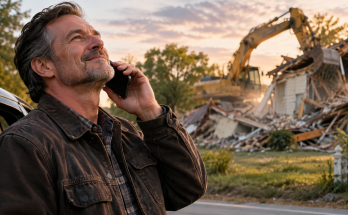
The house had been demolished.
I couldn't change that.
The photographs were safe.
The furniture was safe.
The tools were safe.
And the land remained.
I needed to work with what I still had.
Later that week, I called Clifford.
He answered from his daughter's home.
I asked how he was doing.
He said he was getting settled.
I asked whether he had found everything he needed.
He said he had.
Then he asked about the property.
I told him I was still working through the details.
He said he hoped things would work out.
I told him I appreciated the way he had cared for the house.
He said it had been a pleasure.
We spoke about the flowers again.
He remembered planting the geraniums near the porch.
He remembered working on the rose bushes.
I listened.
Those small details had become important to me.
They reminded me that the house hadn't been merely a building.
It had been a home to somebody after Grandpa died.
Clifford had continued caring for it.
I told him I wished things had ended differently.
He said there wasn't much either of us could do about that now.
He was right.
Before hanging up, I told him I would let him know when I had a clearer understanding of the property's future.
He thanked me.
I put the phone down.
Then I opened the inventory file.
I found the photographs of the house again.
The porch swing was visible.
So were the green shutters.
I studied them for a while.
I didn't want to pretend that the old building could simply be restored.
It was gone.
But I could still make a decision that reflected the values Grandpa had passed on to me.
I closed the photographs.
Then I returned to the property documents.
I was ready to move forward.
Click here to continue reading: PART 19: My Parents Finally Realized I Was Not Giving Them the Inheritance, and Their Last Argument Changed Nothing About My Decision
The Phone Call That Made Me Laugh While My Grandfather’s House Was Being Destroyed Without My Permission
Part 18 of 20