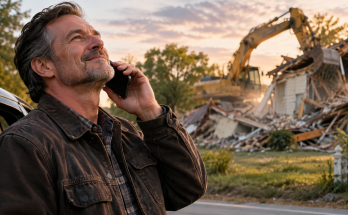
The next morning, I called Warren again.
I told him I had spoken to Clifford.
He asked how the man was doing.
I said he seemed all right, although I could tell the experience had upset him.
Warren listened.
Then he asked me to send him everything I had received or written down about the property.
I gathered the information available to me.
There weren't many documents connected to the demolition because I hadn't known it was going to happen.
But I had the ownership paperwork.
I had the structural inspection.
I had the records from the earlier work on the property.
And I had the information we had been examining for months.
The brown envelope was especially important.
Its contents explained why the acreage behind the house mattered.
It also showed that Grandpa's original decision had been based on more than the value of the property.
He had rejected the earlier development proposal because of the white oaks.
That was the part I couldn't stop thinking about.
My parents had treated the house as though it were an inconvenience.
They hadn't understood why I wanted to preserve it.
I wasn't even certain they had bothered to learn what was behind it.
The old surveys had changed my understanding of the inheritance.
The house had been important to me long before I discovered the development offer.
The land had a separate significance.
And the trees mattered because Grandpa had specifically refused to sacrifice them.
Warren had already been studying the revised development plans.
The changed access route was what made a different arrangement possible.
I wanted to continue that work.
I wasn't going to let the demolition change the decisions we had been carefully considering.
I asked Warren what he thought our next step should be.
He said we needed to keep the facts separate from the emotions.
That was easier said than done.
I was still angry.
But I understood his point.
He wanted the relevant property records examined.
He wanted to know exactly what had been done and what remained.
I agreed to let him handle the legal side while I concentrated on getting home and speaking with the people involved.
There was another reason I wanted to return to Indiana.
I needed to see the property myself.
I needed to stand where the house had been.
I needed to know whether anything of Grandpa's had been left behind.
And I needed to understand how Clifford had been removed.
I finished the conference as best I could.
I answered questions.
I attended the scheduled discussions.
But my attention kept returning to Sycamore Drive.
Whenever I had a moment alone, I thought about the basement.
I remembered the filing cabinet.
I remembered the brown envelope.
I remembered sitting on that overturned bucket and reading the five-million-dollar offer.
At the time, I had believed the discovery was going to give me a new way to protect Grandpa's property.
I hadn't imagined my parents would try to destroy the house while I was away.
The strange thing was that their announcement hadn't changed what I intended to do with the surrounding land.
It had only made the situation more urgent.
The next day, Warren contacted me.
He wanted to discuss the documents again.
He reminded me that we had spent a long time working through the property details.
There had been surveys.
There had been negotiations.
There were records showing the acreage and the earlier development interest.
The revised access route still mattered.
I told him I understood.
He said he would continue examining the available information.
I appreciated that.
Warren wasn't someone who made promises simply to make another person feel better.
If he said something needed checking, he checked it.
That was one reason I trusted him with my business contracts.
When I returned to my hotel room that evening, I called Clifford again.
He answered more quickly this time.
I asked whether he needed anything.
He said his daughter was helping him settle in.
He didn't want me to worry about him.
I told him I was worried.
He gave a small laugh.
Then he said he had enjoyed living in the house.
I could picture him sitting on the porch with a glass of sweet tea.
I could picture the geraniums beside him.
He told me he had spent time bringing the rose bushes back because he thought they deserved another chance.
I didn't know what to say.
He said he hoped the flowers had survived.
I told him I hoped so too.
We spoke for a few more minutes.
He didn't ask me for compensation.
He didn't demand that I make my parents apologize.
He simply wanted to know what would happen next.
I told him I couldn't answer that yet.
But I would make sure he knew when I had something definite to tell him.
After the call, I sat quietly.
There was a difference between losing a building and losing the trust of someone who had lived inside it.
I had never wanted Clifford to become part of a family dispute.
He had only wanted a comfortable home near his daughter.
Now he had been pulled into something he hadn't asked for.
I made a note to speak with him again when I returned.
Then I opened my laptop.
I looked through the property documents Warren and I had been working on.
The old survey was there.
So were the planning letters.
I found the development proposal that Grandpa had rejected.
The trees along the creek were marked on the map.
I studied their location.
I remembered the reason Grandpa had refused the earlier offer.
He had wanted those trees left standing.
I closed the document.
Then I called Warren once more.
I told him I wanted to continue with the work we had started.
He said that was what he had expected.
I didn't know exactly how everything would turn out.
But I knew I wasn't going to abandon Grandpa's intentions because my parents had made an unauthorized decision.
The house was part of his legacy.
So was the land.
And I still had a responsibility to both.
Click here to continue reading: PART 7: When I Finally Returned to Sycamore Drive, the Missing Porch Swing Told Me More Than My Parents Ever Would
The Phone Call That Made Me Laugh While My Grandfather’s House Was Being Destroyed Without My Permission
Part 6 of 20