Several months after I found the brown envelope, I sat at my desk and looked through the property records one final time.
The green filing cabinet was still easy to picture.
So was the basement.
I could remember forcing the bottom drawer open.
I could remember the cotton string around the brown envelope.
At the time, I had no idea how much those papers would matter.
Now I understood why Grandpa had kept them.
They explained the history of the land.
They showed the earlier development offer.
And they recorded the reason he had refused it.
Five million dollars.
That was the amount he had been willing to walk away from.
Not because he didn't understand money.
Because he understood what he would lose.
The white oaks along the creek had mattered more to him than the offer.
I had spent months working with Warren to understand the updated plans.
The changed access route had created a possible alternative to the original proposal.
We had examined the surveys, the ownership records, and the planning information.
I wanted to continue with an approach that respected the wooded section.
I wasn't interested in repeating the earlier plan.
That was the decision I had reached.
The house was gone.
There was no point pretending otherwise.
But the property still had a future.
And I could make choices about that future without forgetting why Grandpa had rejected the original offer.
My parents never really understood.
My mother continued to believe I should have divided the inheritance.
My father continued to mention the fourteen thousand dollars.
Rodney remained disappointed that the property had not been sold and divided according to my mother's expectations.
I couldn't change their opinions.
I could only refuse to let them make my decisions.
I also thought often about Clifford.
He had moved in because he wanted to live closer to his daughter.
He had planted flowers.
He had cared for the rose bushes.
He had offered me sweet tea whenever I visited.
Then my parents had arranged for him to leave.
I wished that hadn't happened.
I couldn't give him back the house.
I couldn't give him back the time he had spent making it a home.
But I could remember that he had been treated unfairly.
I had made sure to tell him that I appreciated what he had done.
He deserved to hear it.
One afternoon, I visited the storage facility again.
I checked Grandpa's belongings.
The furniture was accounted for.
The photographs were safe.
The tools were still listed in the inventory.
I found the old wrench.
I held it for a moment.
It was an ordinary tool.
Nothing special.
But I remembered the first time Grandpa had put it in my hand.
I remembered how patient he had been.
He hadn't expected me to know everything.
He had simply shown me how to begin.
I put the wrench back.
Then I looked through the photographs.
There was one of the house with its green shutters and porch swing.
I kept looking at it.
The picture reminded me of something I had nearly forgotten.
The house had never been valuable to me because of what somebody might pay for it.
It was valuable because of the life that had happened there.
Grandpa had built it.
I had grown up visiting it.
I had helped him remain there when his health failed.
And after he died, Clifford had cared for it.
That was its history.
No demolition crew could erase those memories.
Before leaving, I checked the inventory one more time.
Everything was safe.
I felt grateful that I had arranged for the belongings to be moved before my parents took action.
That decision had protected something important.
Later, I spoke with Warren.
We discussed the remaining property matters and the work connected to the revised development information.
I told him I wanted to continue keeping the white oaks protected in the decisions we were considering.
He understood.
I didn't need to explain it again.
When I returned home, I placed the brown envelope in the drawer.
I didn't tie the string particularly tightly.
I knew I would probably need to look through the papers again.
But I no longer felt that I was searching for some hidden answer.
I understood what Grandpa had wanted me to understand.
The inheritance wasn't simply a number.
It wasn't the five-million-dollar offer.
It wasn't the amount my parents thought they could divide.
It was a responsibility.
And I had finally stopped confusing responsibility with making everybody else happy.
My father never apologized for the demolition.
My mother never admitted that she had been wrong to arrange it.
Rodney never seemed to accept that the property wasn't his to claim.
Those things remained unresolved between us.
I couldn't force them to understand.
I also couldn't rebuild the house just to make the family feel better.
Some losses couldn't be repaired.
But some things could still be protected.
The trees were still standing.
The creek was still there.
And Grandpa's photographs, furniture, and workshop tools were safe.
I sometimes drove past Sycamore Drive.
Whenever I did, I looked toward the wooded section.
I remembered the man who had built a modest home in 1952 with money he had saved from working as a machinist.
I remembered the grandfather who had taught me to use a wrench.
I remembered the old workshop.
And I remembered the advice he had given me about keeping my word.
I had spent years trying to be the son my parents wanted.
I had spent even longer trying to keep everybody satisfied.
But Grandpa had taught me something more important.
A person had to decide what mattered and stand by that decision.
He had done that when he refused the original offer.
Now I had to do it with the property he left behind.
The house was gone.
I still missed it.
I still wished my parents had never made that call from Indiana while I was standing outside a hotel in Denver.
But I no longer thought of the inheritance as something they had taken from me.
They had destroyed a building.
They had pushed a tenant out.
They had damaged a part of my family's history.
But they hadn't changed the reason Grandpa had left the property to me.
And they hadn't changed the promise I had made to myself.
I would not forget the trees.
I would not forget Clifford.
And I would not forget the man who taught me that the things worth keeping were not always the things with the highest price.
Sometimes, the greatest inheritance was knowing what you should never sell.
The End
Read more original stories on Feel Every Story.
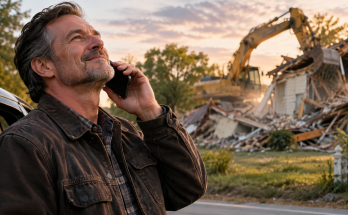
The Phone Call That Made Me Laugh While My Grandfather’s House Was Being Destroyed Without My Permission
Part 20 of 20