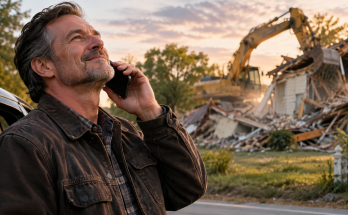
I returned to Indiana with a different feeling about home.
The trip from Denver had given me too much time to think.
I had replayed my mother's phone call more times than I wanted to admit.
I had also remembered the way my father had spoken about the fourteen thousand dollars.
He seemed proud of the amount.
As if the cost of destroying something proved he had done the right thing.
I drove toward Noblesville as soon as I had taken care of the immediate business waiting for me.
I didn't call my parents first.
I wanted to see the property.
The familiar roads brought back memories.
I remembered riding my bicycle along those streets when I was fourteen.
I remembered arriving at Grandpa's house with a dirty shirt and a list of things I wanted to learn in the workshop.
I remembered the porch swing.
The green shutters.
The old front steps.
When I finally reached Sycamore Drive, I slowed down.
Then I stopped.
The house was gone.
There was no roof.
No front door.
No windows.
No green shutters.
The place where Grandpa had spent his life was now an empty area.
I got out of the car.
For a few moments, I didn't move.
The space looked wrong.
I had expected to feel angry when I saw it.
Instead, I felt something heavier.
The house had been old.
It had needed repairs.
I knew that.
But I had never imagined standing there and seeing nothing where it had once stood.
I looked toward the place where the porch swing had hung.
There was no swing.
I looked toward the front of the property.
The familiar details were missing.
The kitchen where Grandpa had eaten his meals was gone.
The stairs that used to creak were gone.
The basement workshop where I had learned to use tools was gone.
I walked farther across the property.
I was careful about where I stepped.
I didn't know what the demolition crew had left behind.
The thought of Grandpa's belongings crossed my mind.
Then I remembered the inventory and storage arrangements.
At least those things had been protected before this happened.
I stood there longer than I intended.
A neighbor noticed me.
He came over and asked whether I had just arrived.
I told him I had.
He looked uncomfortable.
He knew who I was.
He had seen my parents outside the property before the demolition.
I asked whether he had witnessed the work.
He explained what he had seen as best he could.
He had noticed activity around the house.
Then the crew arrived.
He knew Clifford had been living there.
He also knew Clifford had left before the demolition.
I thanked him for telling me.
I didn't ask him to take sides.
I didn't want to turn the neighborhood into another place where my family argued.
I walked back toward my car.
Then I looked at the property again.
I thought about the old white oaks behind the house.
They were still there.
That was important.
The wooded section had been the reason Grandpa had rejected the original offer.
The trees along the creek were the part he had wanted protected.
I looked toward them.
The house was gone, but the trees remained.
I stood quietly.
That was when I realized that my parents had focused on the most visible part of the property.
They had treated the house as the entire inheritance.
But Grandpa's land was more than the building.
The acreage behind it had its own history.
Its own value.
And its own possibilities.
I couldn't undo what had happened to the house.
I couldn't bring back the porch swing.
But I could still honor the decision Grandpa had made about the trees.
I took a few photographs of the property.
Then I left.
I didn't go straight to my parents' house.
I drove to meet Warren.
He was waiting with some of the records we had been reviewing.
I told him I had seen the site.
He asked how I was doing.
I said I was fine.
It wasn't entirely true.
But I didn't want to spend the meeting talking about my feelings.
We discussed the property.
Warren brought up the older surveys.
He explained that the revised access route remained an important part of the possibilities we had been examining.
We reviewed the documents connected to the development proposal.
I asked him whether the loss of the house changed the work we had been doing.
He explained that we needed to keep the different elements of the property in perspective.
The house had been demolished.
The surrounding acreage remained a separate matter.
The wooded section was still there.
The white oaks were still there.
And the records still needed to be handled carefully.
I listened.
I didn't want to make decisions while I was upset.
That was something Grandpa would have understood.
He had never been a man who rushed into repairs without first figuring out what was broken.
Warren and I continued through the paperwork.
I asked him to keep working through the details.
He agreed.
When the meeting ended, I sat in my car for a few minutes.
I thought about the house again.
I thought about Clifford.
I thought about the people who had decided I would simply accept what they had done.
Then I started the engine.
I wasn't finished with Sycamore Drive.
Not even close.
Click here to continue reading: PART 8: My Parents Thought the Demolition Had Settled the Inheritance, but They Still Didn’t Understand What Grandpa Had Left Me
The Phone Call That Made Me Laugh While My Grandfather’s House Was Being Destroyed Without My Permission
Part 7 of 20