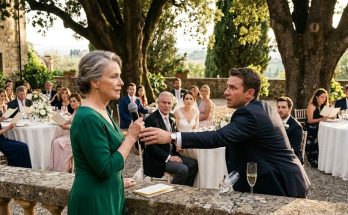
The first thing I learned about my son's wedding was that loving someone could make you blind.
I was sixty-eight years old, and I thought I knew better than that.
I'd spent most of my working life teaching teenagers to question what they heard, check what they read, and think carefully before believing anyone who sounded too certain.
Then my son fell in love.
And I stopped asking questions.
His name doesn't matter for what happened next, but his face does.
He was thirty-eight, old enough to know his own mind, and successful enough to have built a commercial business without asking his mother to rescue him every time something went wrong.
I was proud of him.
His father would have been proud, too.
My husband had been gone for years, but there were still moments when I looked at our son and saw the boy he'd once been, standing in the kitchen with a scraped knee and pretending he hadn't cried.
When my son called to tell me he intended to marry, I sat down before he had even finished speaking.
Not because I was worried.
Because I was happy.
He told me about the woman he loved, about their plans, and about her family in a southern European country I'd never visited.
She was beautiful, he said.
She was kind.
She made him feel understood.
I listened to every word, smiling at the telephone as if he could see me through it.
When he finally asked whether I would come to the wedding, I told him there was no question.
Of course I would.
I wanted to meet the people who had raised the woman he intended to spend his life with.
I wanted to see where she came from.
Most of all, I wanted my son to look across the wedding celebration and know that his mother was there, happy for him.
I had no idea how much I would come to regret that happiness.
At first, my only problem was deciding what to give them.
I'd saved money carefully after retirement.
I had never been extravagant, and I didn't have a great deal of interest in expensive things for myself.
My house was comfortable.
My clothes were perfectly good.
I had enough books to last me the rest of my life, and I could still make a meal from whatever happened to be in the refrigerator.
I didn't need more possessions.
But my son and his fiancée were beginning a new life, and I wanted to help them begin it well.
I considered jewelry.
Then I thought about household gifts.
Neither seemed right.
I wanted to give them something that would be useful long after the flowers had wilted and the wedding photographs had been put away.
So I decided on money toward their first home.
I would bring a cashier's check, a substantial gift drawn from savings I'd built over many years.
I kept that decision private.
I also decided to give them something money couldn't buy.
That was where the trouble began, though I didn't know it yet.
The bride's family spoke a language I couldn't understand.
Whenever my son talked about visiting them, he described the place with enthusiasm, and I listened with the interest of a mother trying to picture her child's future.
I wondered what it would be like to sit at their table.
I wondered whether I'd understand their jokes.
I wondered how lonely I might feel among people who could speak to one another easily while I sat smiling and waiting for someone to explain.
Then an idea came to me.
I would learn their language.
Not a few polite greetings.
Not enough to order dinner or thank someone for holding a door.
I would learn enough to stand before the wedding guests and give a proper toast in the language they spoke at home.
It would be my surprise.
I could already imagine my son's face when he realized what I'd done.
That picture was enough to get me started.
I found an elderly tutor who agreed to teach me privately.
I told nobody in my family.
Not my son.
Not his fiancée.
Not a single friend who might accidentally mention it.
For a year, I kept the lessons to myself.
Twice each week, I sat down with my tutor and worked through unfamiliar sounds, unfamiliar grammar, and words that seemed determined to slip out of my memory the moment I needed them.
Some evenings, I felt as though I had made a terrible mistake.
My tongue wouldn't cooperate.
I would repeat a sentence until I was certain I'd finally said it correctly, only to discover that I'd missed a small sound that changed its meaning.
My tutor would correct me.
I would try again.
Then again.
I was a retired schoolteacher, so I knew how to study.
I also knew how humiliating it could feel to be a beginner after spending decades as the person standing at the front of the room.
I didn't enjoy that part.
But I kept going.
Every night, I devoted another two hours to practice.
I wrote words on paper.
I repeated phrases aloud.
I listened carefully to the recordings my tutor gave me and tried to make my voice sound less like a visitor reading from a book.
Slowly, the words began to stay.
I could understand more than I could speak.
Then I could answer simple questions without translating every word in my head.
Eventually, I could follow longer conversations, provided the speakers didn't talk too quickly.
My tutor told me I was making progress.
I pretended not to be pleased.
Inside, I was delighted.
I began composing the wedding toast.
I wanted it to sound natural, not like something a foreigner had memorized from a phrasebook.
I wanted to thank the family for welcoming me.
I wanted to honor the woman my son had chosen.
And I wanted to say something about the life they were beginning together, something simple enough to remember and sincere enough that no translation could make it feel empty.
I revised the speech repeatedly.
I practiced it standing up.
I practiced it sitting down.
I learned where to pause and how to keep going when a word didn't come as quickly as I expected.
Eventually, I could deliver the entire toast without looking at the page.
That was the moment I decided the surprise would work.
I pictured my son listening to me.
I pictured his new family realizing that I had spent an entire year preparing to speak to them in their own language.
I imagined laughter, perhaps a few tears, and the kind of welcome that makes strangers feel like relatives.
I didn't imagine anyone laughing at me.
Why would I?
I had no reason to suspect that the woman my son loved might be part of something ugly.
She had always been pleasant with me.
When we spoke, she seemed attentive.
She asked about my life and listened when I answered.
I had taken those small courtesies as signs of affection.
Perhaps I wanted them to mean more than they did.
Looking back, that possibility hurts almost as much as what happened afterward.
Still, I refused to begin a relationship with suspicion.
My son was happy.
I wanted to share that happiness, not search for reasons to spoil it.
As the wedding approached, I made the final arrangements.
The check was secured among my belongings.
The speech was memorized.
My travel documents were ready.
I checked everything more than once, because that was the sort of woman I had always been.
If something mattered, I prepared.
If someone depended on me, I tried not to let them down.
I thought those habits would serve me well overseas.
I thought the hardest part would be remembering my speech while standing in front of a crowd.
I was wrong about that, too.
The morning I left, I carried two gifts for my son.
One was the money I had saved to help him begin his married life.
The other was a year of my own time, carefully folded into sentences I could speak without a page.
Neither gift came with conditions.
I didn't expect repayment.
I didn't expect praise.
I only wanted to give him a beginning he would remember fondly.
When I boarded the plane, I was nervous in the ordinary way a mother gets nervous when her child is about to make a major life change.
I imagined the wedding.
I imagined the family photographs.
I imagined coming home with stories about a country I'd never seen and people I was certain I would soon love.
I even practiced the opening of my toast quietly to myself.
The words came easily.
I smiled.
For the first time in months, I let myself believe that everything had gone exactly as I planned.
I had prepared for the language.
I had prepared for the journey.
I had prepared the gift.
What I had not prepared for was the possibility that the people waiting for us might already have decided what sort of woman I was.
Click here to continue reading: PART 2: Their Smiles Were Warm Whenever My Son Was Watching, but the Conversations Changed the Moment They Thought I Could Not Understand
I Spent a Year Preparing a Gift for My Son, Never Imagining That the Secret Would Become the Only Thing Protecting Him
Part 1 of 24