
The weeks after our return were quieter than I expected.
There were no dramatic announcements.
No public arguments.
No sudden explanations that made everything clear.
My son went back to his work.
I returned to the ordinary routines of my life.
We spoke regularly.
Sometimes we talked about what had happened overseas.
Sometimes we discussed everyday things instead.
I learned not to ask about the bride every time he called.
He learned that he could tell me about her without needing to defend every feeling he still had.
The truth had hurt him.
It had not made his feelings disappear.
He was still working through what the deception meant for the relationship he had believed he was building.
I did not rush him.
I had spent enough time watching other people try to hurry him toward the decisions they wanted him to make.
I would not become another person demanding an answer.
He told me that he had refused to transfer his savings.
That decision remained firm.
The money he had saved for his own home would stay his.
The bride's family had their own financial problems to address.
He could feel sympathy for them without accepting responsibility for a debt that had never been honestly presented to him.
I was relieved.
I had feared that his love for the bride would make him feel obligated to rescue her family.
But he had begun to understand that a marriage could not be built on a promise made under pressure.
The cashier's check stayed with me for a while.
I did not rush to give it away.
It had been intended as a gift toward my son's first home with his wife.
That future was uncertain now.
I wanted to respect what the money had meant to me when I saved it.
It had come from years of work.
It represented care, patience, and the desire to help my child.
I did not want the memory of the wedding to turn that gift into something bitter.
Eventually, I decided to keep the money until my son knew what he wanted to do next.
There was no deadline.
No family expectation.
No wedding schedule.
Just time.
That was something we had not been given enough of overseas.
My son and I also spoke about the false speech.
At first, he seemed embarrassed whenever he remembered the guests reading those words.
I told him that the embarrassment belonged to the people who had written them.
He said he knew.
Then he admitted that he still felt ashamed of having trusted the bride's family so completely.
I reminded him that trust was not a failure.
Trust was what people offered when they wanted to build something together.
The failure came when someone used it as a way to gain an advantage.
He listened.
I could tell he was trying to believe me.
I hoped he would.
I did not want him to become suspicious of every kind word or every offer of help.
The lesson was not that no one could be trusted.
The lesson was that trust had to leave room for honesty.
A few weeks later, I returned to my language lessons.
My tutor greeted me as she always had.
She asked how the trip had gone.
For a moment, I could not answer.
Then I told her the truth.
I explained the wedding speech, the printed cards, and the conversation at the restaurant.
I told her how the bride's father had assumed I could not understand him.
My tutor listened without interrupting.
When I finished, she placed her hands on the table.
She said she was sorry the language had been used in such an ugly way.
I nodded.
Then she asked whether I wanted to continue studying.
I looked down at the notebook between us.
The pages were filled with words I had practiced for months.
Some had small corrections beside them.
Others were marked with notes about pronunciation.
I thought about the speech I had written for my son.
I thought about the way I had stood in the courtyard with the microphone.
I thought about the guests looking down at the cards.
And I thought about the moment the bride's father realized I understood him.
"Yes," I said. "I want to continue."
My tutor smiled.
We began with a simple exercise.
I read a sentence.
She corrected one word.
I repeated it.
Then we moved to the next.
It was ordinary work.
That was what I needed.
I did not need the language to become a weapon.
I did not need every lesson to remind me of the wedding.
I wanted to keep what I had learned without allowing the people who had deceived me to decide what it meant.
The original toast remained in my drawer.
Sometimes I took it out and read it.
The words were still simple.
They thanked the family for welcoming me.
They wished my son and his wife patience, kindness, and a home built on mutual care.
They honored the bride's grandmother.
Nothing in the speech had changed.
Only my understanding of the people who were supposed to receive it had changed.
I never delivered that toast as I had planned.
I never stood before the 140 guests and watched them raise their glasses in response to my words.
I never saw the bride's father smile with genuine gratitude.
That future was gone.
But I had not lost the ability to offer kindness.
I had not lost the desire to help my son.
And I had not lost my voice.
Those things mattered more than the ceremony I had imagined.
My son continued to work through his decisions in his own time.
He did not give the family his savings.
He did not pretend the false speech had been harmless.
And he did not ask me to deny what I had heard simply because the truth made his life harder.
I could not tell him exactly what his future would look like.
I could only hope that whatever he chose, he would choose with his eyes open.
One evening, he came to visit.
We sat at my kitchen table and drank tea.
He noticed the language notebook beside me.
"Still studying?"
"Still studying."
He smiled.
Then he asked whether I had kept the speech.
I told him where it was.
He nodded.
"I'm glad."
I asked him why.
He thought about it before answering.
"Because it says what you meant to give us."
I looked at him.
He continued.
"It wasn't your fault that they changed it."
I felt something loosen inside me.
For weeks, I had carried a quiet sadness about that speech.
I had imagined the words printed on the cards, the guests reading them, and the bride's family laughing at what they believed would be my helplessness.
I had worried that the ugliness of the deception would overshadow the kindness with which I had prepared the toast.
My son was reminding me that the original words still belonged to me.
I reached across the table and touched his hand.
"Thank you."
He squeezed my fingers.
We sat together for a while without speaking.
There was no microphone between us.
No printed card.
No audience waiting for someone else to tell them what our words meant.
Just a mother and her son, speaking honestly.
I still thought about the wedding sometimes.
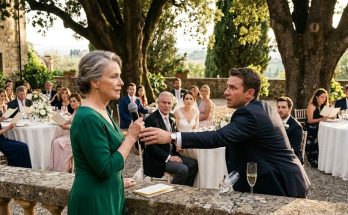
I remembered the old trees and the golden afternoon light.
I remembered the champagne glasses and the cream-colored cards with their gold borders.
I remembered how cold my hands had felt when I first heard the family's plan.
And I remembered how carefully I had set my own card face down before taking the microphone.
I had gone overseas believing that learning another language would be the most meaningful gift I could offer my son.
In the end, it gave me something I had not expected.
It allowed me to hear the truth before someone else could tell me what I was supposed to believe.
I could not make the bride's family honest.
I could not undo what they had planned.
I could not give my son back the certainty he had carried into that wedding.
But I could refuse to let them take anything more from us.
The cashier's check remained safe.
My son's savings remained his.
The original toast remained in my drawer.
And the language I had learned remained mine.
I was sixty-eight years old when I discovered how much damage people could do when they believed another person was too old, too trusting, or too unfamiliar with the world to understand them.
I was also sixty-eight when I learned that I did not need to shout to defend myself.
I only needed to know what I had heard.
I only needed to tell the truth.
And I needed to remember that kindness was not weakness, trust was not foolishness, and love did not require me to close my eyes.
I had gone overseas hoping to welcome a new daughter into our family.
I returned home with a different understanding of what a family should be.
It should not demand silence.
It should not treat generosity as an entitlement.
And it should never ask someone to accept a lie simply because the truth is inconvenient.
The speech I had prepared for the wedding never reached the guests in its intended form.
But its meaning survived.
I had written it because I loved my son.
I still did.
And that was the one thing the people who planned to humiliate me had never been able to change.
The End
Read more original stories on Feel Every Story.
I Spent a Year Preparing a Gift for My Son, Never Imagining That the Secret Would Become the Only Thing Protecting Him
Part 24 of 24

One Comment on “PART 24 – The Speech I Never Delivered Remained in My Drawer, but the Truth Changed What My Son and I Would Accept From the People We Loved”