The journey home began without any grand farewell.
There was no final family gathering.
No one asked us to stay and celebrate again.
We left with our belongings and the things we had learned.
My son was quiet during the first part of the journey.
I sat beside him.
Neither of us tried to fill every silence.
I watched the countryside pass beyond the window whenever the road allowed it.
I had once imagined that I would remember this country for the wedding.
The flowers.
The old trees.
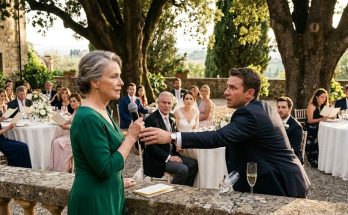
The courtyard filled with guests.
The moment my son and his bride stood together at the beginning of their marriage.
Instead, I knew I would remember the cream-colored cards.
I would remember the gold borders.
I would remember the false words printed beneath my name.
And I would remember the expression on the bride's father's face when I spoke to him in a language he had assumed I could not understand.
That moment had not made me feel powerful.
It had made me feel awake.
There is a difference.
For days, I had watched people speak around me as though I were absent.
They had mistaken my silence for ignorance.
They had believed that because I did not understand their words, I could not understand their intentions.
They were wrong about both.
My son turned toward me.
"What are you thinking about?"
I smiled faintly.
"My lessons."
He looked surprised.
"After everything that happened?"
"Especially after everything that happened."
He waited for me to explain.
I told him that I had begun learning the language because I wanted to make a gift of myself.
I had wanted to show his new family that I respected them enough to learn how they spoke.
I had wanted my toast to sound natural.
I had wanted to pronounce their words correctly.
I had even worried about whether I would speak too quickly when I became nervous.
Those concerns seemed very small now.
My son listened.
Then he said he wished the family had deserved the effort.
I looked out the window again.
"So do I."
We traveled on.
At one point, he asked whether I thought I would keep studying the language.
I had not considered it.
For a few seconds, I imagined returning to my tutor and explaining what had happened.
I imagined sitting at the same table with the same notebook.
I imagined repeating the words I had worked so hard to learn.
The thought did not hurt as much as I expected.
"Yes," I said. "I think I will."
He smiled a little.
"Good."
I told him that the language had not done anything wrong.
He nodded.
Neither had my effort.
Neither had the gift I had wanted to give him.
The fault belonged to the people who had decided to use my lack of knowledge as an opportunity.
My son looked down at his hands.
"I don't know whether I can forgive her."
I did not answer immediately.
I had learned something about forgiveness during those days.
People often spoke about it as though it were a decision made in a single moment.
As though someone could hear an apology, accept it, and return to life exactly as it had been.
But trust was not a light switch.
It was built through ordinary choices.
It could be damaged in a moment and take years to rebuild.
Sometimes it could not be rebuilt at all.
"You don't have to decide that today," I told him.
He nodded.
Then he asked whether I thought the bride's family would contact him again about the money.
I told him I could not know.
But I reminded him that he had already made his decision.
He would not transfer his savings because the family expected it.
He would not give away the gift I had brought.
If he ever chose to help someone financially, he would do so because he understood the situation and wanted to help.
He agreed.
We returned to that point several times during the journey.
Not because he had forgotten.
Because repeating the decision seemed to make it more real.
He was learning to separate love from obligation.
I was learning that protecting someone did not always mean preventing them from being hurt.
Sometimes it meant standing beside them after the hurt had happened.
When we finally reached home, the familiar surroundings felt almost strange.
The streets were the same.
The houses looked the same.
The ordinary rhythm of our lives had continued while we were away.
I unlocked my door and stepped inside.
My home smelled faintly of the cleaning products I had used before leaving.
The small papers I had used to practice the language were still where I had left them.
One was tucked beside a shelf.
Another sat near my desk.
I stood looking at them.
For a moment, I thought about throwing them away.
I could have decided that the language belonged to the trip and the trip belonged to the worst day of my life.
But I did not.
I picked up one of the papers and read the words aloud.
My pronunciation was better than it had been a year earlier.
I smiled.
Then I put the paper back.
My son helped me carry my suitcase inside.
Before he left, he hugged me.
He held on longer than usual.
"I'm sorry," he said.
I rested my hand against his back.
"I know."
He pulled away and looked at me.
"Thank you for telling me the truth."
I wanted to say that he should never have needed proof from a printed card to believe his mother.
But I did not say it.
He had already understood that.
Instead, I told him I loved him.
He said he loved me too.
Then he went home to think about his future.
I watched him leave.
The house became quiet again.
I unpacked slowly.
I put my clothes away.
I placed the original toast in a drawer where I kept papers I wanted to preserve.
I took the cashier's check out of my purse and set it on the table.
For a long time, I looked at it.
I had saved that money because I wanted my son to begin his marriage with something useful.
That wish had not changed.
But the circumstances had.
I would not hand the check to anyone simply because I had brought it for the wedding.
I would wait until I knew what I wanted to do with it.
Then I put it away.
I closed the drawer.
And for the first time since leaving home, I felt that I could breathe without waiting for someone to tell me what I had misunderstood.
Click here to continue reading: PART 24: The Speech I Never Delivered Remained in My Drawer, but the Truth Changed What My Son and I Would Accept From the People We Loved
I Spent a Year Preparing a Gift for My Son, Never Imagining That the Secret Would Become the Only Thing Protecting Him
Part 23 of 24