The morning after our conversation, I found my father sitting at the kitchen table.
His coffee was getting cold.
He was staring at the family photograph Emily had placed beside his chair.
It showed the three of us smiling at the park.
Emily had insisted that Grandpa keep it close.
"Morning, Dad."
He looked up.
"Morning, sweetheart."
I poured myself some coffee.
"Did you sleep?"
"Not particularly well."
I pulled out the chair opposite him.
"Are you uncomfortable?"
He shook his head.
"Just thinking."
I knew what he meant.
The doctor's appointment was approaching, and neither of us knew what to expect.
I reached for my phone.
"I was thinking we should call the doctor's office today."
He sighed.
"Again?"
"Yes. I want to make sure we're following everything correctly."
He rubbed his fingers together.
"I don't want to spend the rest of my life visiting hospitals."
I looked at him.
"Neither do I. But ignoring what's happening won't make it disappear."
He didn't answer.
A few minutes later, Emily came downstairs.
She was carrying her stuffed rabbit.
"Grandpa, look!"
She showed him a small paper heart she had drawn.
It had three names written inside.
Mom.
Emily.
Grandpa.
My father smiled.
"That's beautiful."
She placed it beside his coffee cup.
"Now you have to keep it."
"I will."
He carefully moved the cup away from the drawing.
I watched him.
His hands were still trembling, but he was making an effort not to hide them.
After breakfast, I called the doctor's office.
They confirmed the next appointment and reminded us to bring a list of his symptoms and any medications he was taking.
I wrote everything down.
The trembling.
The dizziness.
The difficulty standing.
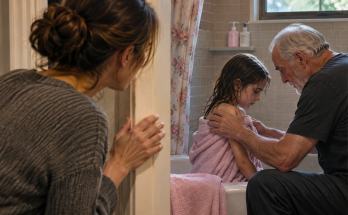
The fall in the bathroom.
And the occasions when he had struggled with ordinary movements.
I didn't want to forget anything.
My father watched me writing.
"You make it sound terrible."
"I'm writing what happened."
He looked away.
I understood that he didn't like seeing his problems listed on paper.
It made them feel real.
But they were real.
And we needed to face them.
Later that afternoon, I found him sitting beside the window.
He was holding my mother's old wedding photograph.
I stood behind him.
"Missing her?"
He nodded.
"Every day."
I sat beside him.
"She would have wanted you to take care of yourself."
He smiled faintly.
"She used to tell me I was too stubborn."
"She was right."
He laughed.
Then his expression became serious.
"I never thought getting old would feel like this."
I didn't interrupt.
He continued.
"One day, you're carrying your child around. The next, you're asking that same child to help you stand."
I felt my throat tighten.
"Dad, helping you doesn't make me uncomfortable."
He looked at me.
"I know."
"Then stop treating it like something shameful."
He nodded.
That evening, Emily asked whether Grandpa could help her with a puzzle.
My father agreed.
They spread the pieces across the living room floor.
I watched from the sofa.
Emily found the corner pieces.
My father helped her match the colors.
Every now and then, he needed to rest his hands.
Emily didn't complain.
She simply waited.
At one point, she placed a blue piece in the wrong place.
My father laughed.
"That doesn't belong there, princess."
She frowned.
"Are you sure?"
"Very sure."
She tried another piece.
It fit.
She raised both arms.
"I did it!"
My father applauded.
I smiled.
It was such a small moment.
But it reminded me that our family still had ordinary happiness waiting for us.
The following morning, we prepared for the doctor's appointment.
My father put on his favorite blue shirt.
He insisted on buttoning it himself.
I stood nearby in case he needed help.
He struggled with the second button.
Then he stopped.
"Could you help me?"
I smiled.
"Of course."
I fastened it carefully.
He looked embarrassed.
I pretended not to notice.
On the drive, he remained quiet.
Emily was staying home with a trusted family friend.
Before we left, she had hugged him and told him to come back soon.
My father had promised.
At the hospital, the doctor reviewed his symptoms and asked more questions.
He explained that further testing was necessary before anyone could determine the cause.
My father listened carefully.
I asked about his balance and the trembling in his hands.
The doctor explained that these symptoms should not be dismissed as ordinary aging.
He wanted us to monitor changes and follow the recommended evaluation.
I wrote everything down.
When we finished, my father looked tired.
On the way home, he finally spoke.
"I suppose I should have gone sooner."
I glanced at him.
"Yes."
He gave a small laugh.
"You could at least pretend to disagree."
I smiled.
"I'm done pretending everything is fine."
He looked out the window.
Then he nodded.
For the first time, I felt that he understood.
We weren't trying to take away his independence.
We were trying to make sure he stayed safe.
And that was something he would have done for me without hesitation.
Click here to continue reading: PART 10: Emily Found the Old Family Photograph in Grandpa’s Drawer, and Her Question Made Both of Us Remember What Really Matters
My Little Girl Asked Me to Keep a Secret From Grandpa, But What She Told Me That Night Changed Everything
Part 9 of 20