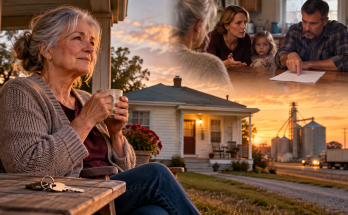
I used to believe that family would always make room for you when life took something away.
Then I turned sixty-seven, lost my husband, and discovered that even a place to sleep could come with a price I wasn't prepared to pay.
It happened on a Saturday afternoon at Michelle's house.
We had finished lunch, and I was sitting at the kitchen table when Todd, my son-in-law, slid a piece of notebook paper in my direction.
He didn't say anything at first.
He just tapped the page with his finger.
In the middle, he'd written a number in thick blue ink.
$800.
There were two circles around it.
Michelle folded her hands and leaned forward.
"We've been talking about what to do when you leave the farmhouse, Mom."
I looked at the paper.
"And what have you decided?"
"We thought you could stay with us."
For a moment, I felt relieved.
Then she continued.
"You'd have the basement room, of course. Eight hundred dollars a month would cover your share of the household expenses, including food and utilities."
Todd nodded as though he'd just finished explaining something perfectly reasonable.
Michelle added another condition.
"And we'd need you to watch the children four days a week."
I looked up.
"Four days?"
"Just while we're working. It would help everyone."
She said it gently, almost cheerfully.
Then she used a phrase that stayed with me long after that afternoon.
"That way, you'd be contributing to the household, Mom."
Contributing.
I looked down at the circles around the number.
I was sixty-seven years old.
I'd spent most of my life contributing to somebody else's household, somebody else's future, or somebody else's peace of mind.
I had raised Michelle on the small wages her father, Dale, brought home from working as a hired hand on local farms.
We didn't have much.
But our daughter never went hungry, and she never had to wonder whether someone would be waiting for her when she came home from school.
When Dale died, nearly two years earlier, I thought the hardest part of my life had already arrived.
I was wrong.
Todd picked up the salt shaker and moved it a few inches across the table.
He wouldn't meet my eyes.
My Social Security check was $1,640 a month.
I'd spent twenty-two years keeping accounts at the local lumberyard, so numbers had never frightened me.
Eight hundred dollars would leave me with $840 before paying for anything else.
That was supposed to cover my clothes, my medicine cabinet, my car, unexpected bills, and whatever might happen when I was too old to work.
And in return, I would be sleeping downstairs in their basement.
I remembered the little window.
I remembered the humming dehumidifier.
I remembered the smell of dampness near the bottom of the stairs.
"Could I see the room again?" I asked.
Michelle smiled quickly.
"Of course."
We walked toward the basement door.
There were thirteen stairs from the kitchen to the bottom.
I counted them without meaning to.
At my age, I had developed the habit of noticing things that might become difficult later.
The stairs were narrow.
The railing felt loose beneath my hand.
The room at the bottom had a single window that looked out at the foundation wall.
A dehumidifier sat in the corner, making a steady mechanical noise.
There was enough room for a bed, a small dresser, and perhaps a chair if I turned it sideways.
The air smelled like laundry detergent and something that had been wet for too long.
I stood near the doorway and tried to imagine waking up there every morning.
Then Sadie appeared on the stairs.
She was four, with tangled hair and one sock slipping down around her ankle.
"Grandma, is this where you're going to sleep?"
I knelt so I could look at her properly.
"Maybe, sweetheart."
She glanced around the room.
"Will you be downstairs when I wake up?"
My throat tightened.
"I don't know yet."
She seemed satisfied with that answer and ran back upstairs.
I stayed where I was for another moment.
I wanted to tell Michelle that I couldn't accept the arrangement.
I wanted to explain that I wasn't looking for a business agreement with my only child.
I wanted to say that I had spent enough years being useful to people who loved me.
But I could already imagine the argument.
Michelle would say I was being difficult.
Todd might remind me how expensive everything had become.
And I would leave their house feeling as though I had done something wrong simply by wanting a little privacy.
So I swallowed my objections.
When we returned to the kitchen, I picked up the paper and folded it carefully.
"Thank you for thinking of me," I said. "I'll consider it."
Michelle kissed my cheek.
"Good. We just want to make sure you're taken care of."
I smiled because I didn't know what else to do.
The truth was that I had very little time.
I needed to leave the farmhouse before November first.
The house had come with Dale's farm job, and after he passed away, the Olson family had graciously allowed me to remain there for two additional years.
They hadn't been unkind.
They had given me time to grieve, sort through Dale's belongings, and figure out what came next.
Now their son was returning to work the farm with his wife and new baby.
They needed their house.
I couldn't blame them for that.
Still, every time I thought about packing up the place where Dale and I had lived, I felt as though I were losing him a second time.
I drove home that afternoon with Todd's paper tucked inside my handbag.
On the way, I stopped at the feed store.
Mr. Brandt had posted a small handwritten notice beside the cash register several weeks earlier.
It advertised a modest house with two rooms and a bathroom.
I'd read it every time I stopped for supplies.
That afternoon, I finally asked whether it was still available.
Mr. Brandt took down his cap and scratched his head.
"Nobody's taken it yet, Judy. You want to look?"
"Yes, please."
The house stood on a quiet street behind the grain elevator.
It had white siding, a small porch swing, and a front entrance with just one step.
Harvest season had left a fine coating of corn dust on the porch railing and the windowsills.
Nothing about the place was impressive.
The rooms were small.
The kitchen cabinets were old.
The bathroom needed a fresh coat of paint.
But the front door opened directly onto the outside world, and the windows looked toward the street instead of a concrete foundation.
Mr. Brandt watched me inspect the kitchen.
"It's not much to look at," he said.
I ran my fingers over the edge of the countertop.
"Does the water run properly?"
"Yes."
"Does the front door lock?"
"Sure does."
"And the rent?"
"Five hundred and fifty a month. Electricity is separate."
I calculated the cost in my head.
It would leave me with $1,090 before utilities and my other expenses.
Not a fortune.
But enough to begin.
I went outside and wrote the deposit check against the hood of my Buick.
Mr. Brandt handed me a small metal ring with two keys.
One was for the front door.
The other opened the back.
I held them in my palm for a long time.
I had been a daughter, a wife, a mother, and a grandmother.
I'd spent years sharing bedrooms, kitchens, bills, and decisions with people I loved.
But those keys belonged to a place I had chosen for myself.
Nobody had told me what I would have to pay beyond the rent.
Nobody had assigned me days to watch children.
Nobody had drawn circles around a number and explained how much of my life it should buy.
I slipped the keys into my pocket.
For the first time since Dale died, I felt something close to excitement.
I was going to have a home again.
Click here to continue reading: PART 2: I Kept My New Address Secret for Nine Days, Until My Son-in-Law Saw My Car and My Daughter Asked Whose Side I Was On
My Daughter Put a Price on Being Her Mother, but Two Keys in My Hand Reminded Me That I Still Had a Choice
Part 1 of 20