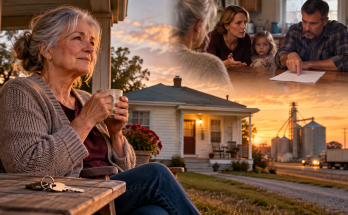
February arrived with a stretch of gray days.
The snow melted, froze again, and left the road beside the grain elevator full of muddy patches.
I spent more time indoors.
I mended a loose button on Dale's old jacket and reorganized the kitchen cupboards.
I also began thinking about spring.
I wanted to plant flowers in two pots beside the front steps.
Nothing fancy.
Just something that would brighten the entrance when the weather warmed.
One morning, the mail carrier brought a letter from the Olson family.
I recognized the handwriting on the envelope.
It was from Mrs. Olson, who had always been kind to me.
I opened it at the kitchen table.
She wrote that their son and his wife were settling into the farmhouse.
The baby was growing quickly.
They had begun repairing the old shed and were planning to plant a larger vegetable garden in the spring.
She also asked how I was managing in my new home.
I read that part twice.
Then I sat back.
For months, I had thought of the little rental as a place I had chosen because I had no better option.
A temporary answer to a problem created by Dale's death.
But I had lived there through autumn, winter, and Christmas.
I had learned which floorboard creaked near the kitchen.
I knew how long the furnace took to warm the living room.
I had watched the grain trucks come and go.
I had made cookies with my grandchildren.
I had sat beneath the Christmas lights and remembered my husband.
This was no longer simply a place to stay until something better came along.
It was my home.
I took out a sheet of paper and wrote back to Mrs. Olson.
I thanked her for the letter and told her I was doing well.
I described the little Christmas tree, the porch swing, and the children who visited.
I told her I was thinking of planting flowers.
Then I signed my name.
Judy.
I put the letter in an envelope and set it beside my keys.
That afternoon, I went to the feed store to buy flower seeds.
Mr. Brandt greeted me from behind the counter.
"Getting ready for spring already?"
"I thought I'd give it a try."
He showed me a packet of hardy flowers that would do well in pots.
I bought two packets and a small bag of soil.
When I returned home, I placed them on the kitchen table.
I looked around the room.
The little house wasn't perfect.
The cabinets were old.
The bathroom needed fresh paint.
The porch swing creaked.
But the place had become familiar in a way I hadn't expected.
I knew where the morning light fell.
I knew which window to open when I cooked something that smoked.
I knew how to make the furnace stop rattling by checking the panel at the side.
And I knew that if I wanted to spend a whole afternoon reading, nobody would ask me why I wasn't doing something useful.
That evening, Michelle called.
She wanted to know whether I could join them for supper on Sunday.
I told her I could.
Then she asked whether I had received the heating bill.
I laughed.
"Yes, and I have decided to wear two sweaters instead of turning the thermostat up every time I feel cold."
She laughed, too.
"Mom, you don't have to freeze."
"I'm not freezing. I'm being economical."
"Those sound suspiciously similar."
We both laughed.
Then she asked whether I had started planning the garden.
I told her about the flower seeds.
She offered to bring the children over to help fill the pots.
I accepted.
When Sunday came, they arrived with a small trowel and a pair of children's gloves.
Sadie wanted to plant every seed in the same pot.
Her brother insisted that the flowers needed separate houses.
I let them help.
We spilled soil on the porch and tracked some into the kitchen.
Todd brought a broom from the shed and cleaned it up.
Nobody complained.
When we finished, the pots stood on either side of the front door.
They looked ordinary.
But I was pleased.
I had put something into the ground and expected it to grow.
That was a hopeful thing to do after a winter spent learning how to live alone.
Later, while the children played, Michelle came into the kitchen.
She noticed the envelope beside my keys.
"What's that?"
"A letter to Mrs. Olson."
I told her about the farmhouse and the new baby.
Michelle smiled.
"I'm glad they're doing well."
"So am I."
She looked toward the living room.
"Do you ever wish you could go back there?"
I considered the question.
Sometimes I missed the farmhouse.
I missed the space, the familiar yard, and the years Dale and I had spent there.
But I didn't wish to return to the life I had been living after his death.
That life had been shaped by grief and uncertainty.
I had stayed because I was allowed to stay, not because I had chosen to remain forever.
"No," I told her. "I miss the memories. But I don't need to live inside them."
She nodded slowly.
"I think I understand."
I looked at her.
"I hope you do."
She pulled out a chair.
"Mom, when Dad died, I wanted to make sure you were safe. I think I was so worried about what might happen to you that I stopped asking what you wanted."
I sat down opposite her.
"That happens sometimes."
"I don't want to do that again."
"Then keep asking."
She smiled faintly.
"I will."
We sat together for a while.
Then she reached for the letter envelope.
"Would you like me to mail this for you?"
I handed it to her.
"Thank you."
She placed it in her handbag.
When she left that evening, I stood at the door and watched the children climb into the car.
Sadie waved through the window.
Her brother held up his soil-covered gloves.
I waved back.
Then I closed the door and turned the lock.
The little house was quiet.
I walked to the kitchen and checked the flower pots through the window.
They stood in the fading light.
I thought about the years ahead.
I didn't know how long I would remain in that house.
I didn't know what changes would come with age, money, or health.
But I knew I didn't need to decide my entire future at once.
For now, I had a home I could afford, a family that was learning to respect my choices, and a life that belonged to me.
I picked up the two keys from the dish and carried them to the bedroom.
I placed them beside the photograph of Dale.
Then I turned off the light.
For the first time since his death, I wasn't simply waiting for the next thing to happen.
I was making plans of my own.
Click here to continue reading: PART 17: When Spring Returned to the Grain Elevator, I Discovered That the Hardest Part of Starting Over Was Believing I Deserved the Life I Had Chosen
My Daughter Put a Price on Being Her Mother, but Two Keys in My Hand Reminded Me That I Still Had a Choice
Part 16 of 20