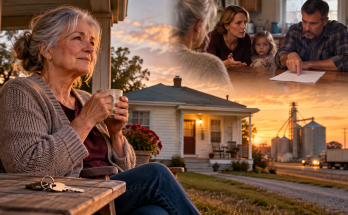
A year passed more quickly than I expected.
The flowers beside the front door bloomed again.
The porch swing still creaked.
The kitchen faucet still needed a firm turn to stop dripping.
And the grain trucks continued lining up beside the elevator, carrying the harvest through the changing seasons.
I was sixty-eight now.
My Social Security check was still $1,640 a month.
The rent was still $550.
I still had to watch my spending.
But I had learned how to manage the little house, and I no longer thought of it as a temporary solution.
It was home.
On a Saturday afternoon, Michelle and Todd came over with the children.
They brought groceries for supper and a small cake.
Sadie ran inside carrying a folded piece of paper.
"Grandma, I made you something!"
I took it from her.
It was another drawing of my house.
This time, the front door was brown.
The porch swing was the right size.
And there were four people standing outside.
I looked at the figures.
"Who's the fourth person?"
Sadie pointed.
"That's Grandpa."
My throat tightened.
The figure was wearing a blue shirt and had a smiling face.
I bent down and hugged her.
"That's a lovely picture, sweetheart."
She looked pleased.
"Mommy helped me remember what he looked like."
I looked toward Michelle.
She smiled.
"I thought it was time we talked about him more often."
I nodded.
"That would be nice."
We put the drawing on the refrigerator with a magnet shaped like a red apple.
Then Todd carried the groceries into the kitchen.
He had brought chicken, potatoes, vegetables, and a loaf of bread.
Michelle unpacked the bags while the children sat at the table.
Nobody needed to ask what I could contribute.
We had agreed beforehand that they would bring the food and I would provide the kitchen.
It was simple.
It worked.
While the potatoes cooked, Todd came over to help me move a chair away from the table.
Then he looked at me.
"Judy, do you remember the legal pad?"
I smiled.
"I remember it."
"I've thought about that thing more times than I can count."
He laughed softly.
"I still can't believe I wrote down thirty-two hours of childcare and thought that was a reasonable part of the arrangement."
I shook my head.
"You were trying to solve a problem."
"I was trying to solve it without asking the person who was going to live with it."
I looked at him.
"That's a better way to put it."
He leaned against the counter.
"Michelle and I talk about it sometimes. Not because we want to keep feeling bad about what happened, but because we don't want to repeat it."
I appreciated that.
The mistake had hurt me.
But I didn't want my family to spend the rest of their lives apologizing for it.
"I don't expect you to keep punishing yourselves," I said.
Todd nodded.
"I know."
"I just expect you to remember that other people get a say in decisions that affect them."
"We remember."
Michelle came into the kitchen carrying a bowl.
"I certainly do."
She smiled at me.
Then she looked toward the refrigerator, where Sadie's drawing was hanging.
"Mom, can I ask you something?"
"Of course."
"Do you ever wish you'd accepted the basement offer?"
I thought about the question.
There had been moments when I missed being able to see the children without arranging a visit.
There had been cold evenings when I wished someone else were in the house.
There had been unexpected expenses that made me nervous.
But I had never wished I had accepted an arrangement that made me feel I needed to earn my place in the family.
"No," I said. "I wish we had talked honestly before it became an argument. But I don't regret choosing this house."
Michelle nodded.
"I understand."
I looked at her.
"And I'm glad we worked things out."
She reached for my hand.
"Me too."
We stood together for a moment.
Then the timer on the oven rang, and we both laughed.
Some things still needed doing.
The children helped set the table.
Todd carried the food out.
Michelle poured the drinks.
We ate together, and the conversation moved from school to work to the price of groceries.
At one point, Sadie asked whether she could sleep over at my house during the summer.
I looked at Michelle.
She smiled.
"We can work out a night that suits everyone."
I turned back to Sadie.
"That sounds lovely."
The children cheered.
I laughed.
It was such a simple conversation.
But I remembered how the first offer had felt.
A room.
A price.
A schedule.
A list of expectations.
Now we were making a plan by talking to one another.
Nobody had to surrender anything to prove they loved the family.
After supper, Todd washed the dishes while Michelle dried them.
I sat with the children in the living room.
Sadie brought me a book.
Her brother sat beside me and leaned against my arm.
I read the story slowly, even though I knew most of the words by heart.
When they left, the house seemed quieter than before.
But it was the ordinary quiet of a home after company.
I carried the cups to the kitchen and wiped the table.
Then I opened the drawer beside the refrigerator.
The envelope was still there.
Inside were the original offer and Todd's legal pad.
I took them out and placed them on the table.
I unfolded the first sheet.
Eight hundred dollars.
Two circles.
I remembered the woman I had been when I first saw it.
She had been frightened of losing her home.
She had been frightened of hurting her daughter.
She had been frightened that refusing the offer would mean losing the grandchildren, too.
She had nearly agreed because she didn't know how to say no without feeling guilty.
I wished I could go back and sit beside that woman.
I would tell her that needing help didn't make her weak.
I would tell her that being a mother didn't mean she had to agree to every request.
I would tell her that a small house with a porch swing could be a better home than a larger one where she felt she had to justify her presence.
Most of all, I would tell her that she was allowed to choose.
I folded the paper.
Then I looked at the yellow legal pad.
The pages were still filled with calculations.
I could see Todd's handwriting in the margins, the dates, the childcare hours, and the figures he had once thought would make the arrangement fair.
I didn't hate him for writing them.
I didn't hate Michelle for agreeing.
They had been worried and had handled their worries badly.
They had hurt me.
Then they had listened, apologized, and begun to change.
That mattered, too.
I put the legal pad back into the envelope.
Then I took out the original offer.
I held it for a moment before tearing it into small pieces.
I dropped them into the wastebasket beside the kitchen counter.
I wasn't destroying the memory.
I was letting go of the need to keep proof of the hurt.
The lesson would remain.
I didn't need the paper to remind me.
I placed the legal pad in the drawer and closed it.
Then I went to the front door.
The two keys were resting in their little dish beside the clock.
I picked them up.
One opened the front door.
The other opened the back.
They were ordinary keys, scratched from a year of use.
But they represented the first home I had chosen entirely for myself.
I unlocked the door and stepped onto the porch.
The evening air was cool.
A truck rumbled past the grain elevator.
The porch swing creaked when I sat down.
I thought about Dale.
I thought about Michelle as a little girl.
I thought about the woman I had become after his death.
I couldn't change the day Todd put that paper in front of me.
I couldn't erase the silence that followed my decision.
But I could be grateful that we had learned to speak differently afterward.
My daughter no longer treated my time as something she could automatically claim.
Todd no longer believed a column of numbers could replace an honest conversation.
And I no longer believed that saying no made me a bad mother.
I was still willing to help.
I still wanted to be there for the grandchildren.
I still loved my family more than I could explain.
But I had learned that love didn't require me to give away the little life I had rebuilt.
I could be a mother without being a tenant.
I could be a grandmother without being a permanent babysitter.
I could accept help without surrendering my choices.
And I could live alone without being abandoned.
The front door stood behind me.
My house waited quietly in the fading light.
I slipped the keys into my pocket and watched the last truck disappear beyond the elevator.
For the first time in a long while, I wasn't wondering whether my independence was worth the loneliness.
I knew the answer.
Independence hadn't taken my family away.
It had taught us how to find one another without turning love into a bill that somebody had to pay.
I went inside, locked the door, and set the keys beside the clock.
Then I made myself a cup of tea.
There was no one else in the kitchen.
No one asking for anything.
No one waiting for me to prove that I deserved to be there.
Just me, my little house, and the quiet life I had chosen.
And that was enough.
The End
Read more original stories on Feel Every Story.
My Daughter Put a Price on Being Her Mother, but Two Keys in My Hand Reminded Me That I Still Had a Choice
Part 20 of 20