By the middle of October, the mornings had grown colder.
I began wearing Dale's old flannel jacket when I went outside.
It was too large in the shoulders, but I liked the weight of it.
The pockets still smelled faintly of the soap he had used.
I kept a small notebook beside the telephone to record my expenses.
Rent.
Electricity.
Groceries.
Gasoline.
The numbers weren't frightening, but they required attention.
I had always managed money carefully.
After Dale died, I became even more cautious because there was no second income to rely on if something went wrong.
One Thursday, I went to the grocery store with a list folded inside my purse.
Milk.
Bread.
Eggs.
Apples.
Coffee.
I compared prices, chose the smaller carton of milk, and put a package of chicken in my basket.
At the checkout, the total came to more than I expected.
I paid and carried the bags to the Buick.
Then I sat behind the steering wheel and looked at the receipt.
Nothing on it was unreasonable.
The prices had simply crept upward.
I thought about the $800 Todd had proposed.
I understood why he had worried about expenses.
I understood why Michelle had felt pressure.
But understanding a person's worries didn't mean agreeing with every solution they came up with.
I drove home and put the groceries away.
Then I opened the notebook and updated my figures.
Rent first.
Electricity next.
Food.
Gas.
A little money set aside for emergencies.
The amount left over wasn't generous.
But it was mine to manage.
I could buy a new pair of shoes when the old ones wore out.
I could visit the doctor without asking whether someone thought the expense was justified.
I could leave the house on a Tuesday morning and return whenever I wanted.
Those things seemed small until I imagined giving them up.
That afternoon, Michelle called.
"Mom, are you busy Saturday?"
"Not yet."
"We were thinking of taking the children to the pumpkin patch. Would you like to come?"
I smiled.
"I'd love to."
She told me what time they planned to leave.
Then she asked whether I needed a ride.
"I can drive myself, honey."
"All right."
There was no argument.
No suggestion that I shouldn't be driving.
No implication that my participation depended on what I could contribute.
After we hung up, I sat quietly for a moment.
I was beginning to see how many ordinary conversations had become difficult because I expected to be judged before I had even answered.
The fear hadn't come from nowhere.
But I didn't want it to become the way I lived.
Saturday was bright and cold.
The pumpkin patch stood outside town, beside a field where the corn had already been cut.
The children ran ahead while Michelle and Todd followed with a wagon.
I walked more slowly.
My knees didn't appreciate the uneven ground, and I had to stop once to catch my breath.
Sadie noticed.
"Grandma, do you need help?"
I smiled.
"Just a minute, sweetheart."
She took my hand.
Her little fingers were warm inside her mittens.
We chose a small pumpkin for my porch and a larger one for the children to carve.
Todd offered to carry them to the car.
I thanked him.
On the drive home, I thought about Dale.
He would have liked that afternoon.
He'd have complained about the price of the pumpkins, then bought an extra one because Sadie wanted it.
He would have pretended not to notice when the children got mud on his jacket.
And he would have told Michelle to stop worrying so much about things that could be worked out with a conversation.
I missed him.
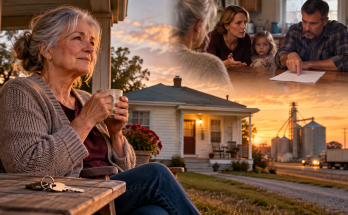
That evening, I placed the small pumpkin beside the front door.
The porch swing creaked when I sat down.
A truck rolled past the grain elevator, its headlights cutting through the dust.
I looked at the pumpkin and began to laugh softly.
It was such a small thing to own.
A pumpkin.
A porch.
A pair of keys.
But those things belonged to a life I had chosen.
I wasn't choosing to live without my family.
I was choosing to live with them in a way that didn't require me to disappear inside their needs.
The next week, Todd called me.
He asked whether I would be willing to look over the figures on his legal pad with him again.
I hesitated.
"Why?"
"Because I want to understand what I got wrong."
I considered saying no.
I had no desire to return to the conversation that had hurt me.
But I also knew that avoiding it forever wouldn't help either of us.
"Bring it over on Sunday," I said. "We'll look at it together."
He arrived after lunch carrying the same yellow pad.
This time, he didn't put it in front of me as though it were a finished proposal.
He sat down and opened it himself.
"I've been thinking about what you said about the childcare hours," he began.
I listened.
He had compared the time he expected me to provide with the hours they would otherwise need to arrange.
He had also looked at the cost of renting a separate room in town.
"I should have considered whether this arrangement actually worked for you," he said.
"Yes."
"And I should have asked what you wanted before calculating what we needed."
"Yes."
He gave a small, embarrassed smile.
"You don't make it easy to argue with you when you keep agreeing with me."
I laughed.
"That's because you finally started saying something sensible."
He laughed, too.
Then we turned to the figures.
I pointed out that some of his household estimates were higher than my own expenses would have been.
He explained that he'd included extra costs he thought might arise.
We talked about food, electricity, and the difference between sharing a home and renting a room.
It was a useful conversation.
Not because we reached a new agreement.
We didn't.
I had already chosen my home.
But because we were finally discussing the real problem instead of pretending the first number had solved it.
At the end, Todd closed the pad.
"I won't ask you to move into the basement again."
I looked at him.
"You don't have to promise that."
He seemed surprised.
I continued.
"You can ask me anything. Just don't decide my answer before I give it."
He nodded.
"That's fair."
After he left, I put the legal pad back in the drawer.
The figure was still there.
Eight hundred dollars.
Two circles.
It no longer made me feel ashamed.
It reminded me that I could say no without ending a relationship.
And that sometimes the most important thing a person can do is ask a question before making a plan.
Click here to continue reading: PART 8: When November Drew Near, I Packed Away the Last of Dale’s Things and Learned That Keeping a Home Was Different From Keeping Everyone Happy
My Daughter Put a Price on Being Her Mother, but Two Keys in My Hand Reminded Me That I Still Had a Choice
Part 7 of 20