The invitation arrived in the mail on a Wednesday.
Mrs. Olson had written that her family was having a small supper at the farmhouse to celebrate the end of the planting season.
She asked whether I would like to come.
I read the letter at the kitchen table.
Then I placed it beside my notebook and sat quietly.
I hadn't visited the farmhouse since collecting the last of Dale's belongings.
Part of me wanted to go.
Another part of me was afraid of what I might feel when I walked through the door.
The house held so many memories.
Dale's boots near the back entrance.
Michelle's childhood drawings.
The kitchen where we had celebrated birthdays with homemade cakes.
The yard where Dale had spent countless hours repairing things that didn't need to be perfect to be useful.
I had been happy there.
I had also spent the final months of my stay feeling uncertain about where I belonged.
The two truths could exist together.
I folded the letter and put it in my handbag.
That afternoon, I called Mrs. Olson.
"Thank you for inviting me."
"We'd be delighted to have you, Judy."
"I'd like to come."
She sounded pleased.
"Wonderful. The children will be glad to see you."
After the call, I took out Dale's photograph and looked at it.
He was standing beside the old farmhouse, wearing the same work jacket I still kept in my closet.
I ran my thumb along the frame.
"I suppose we're going back for supper," I whispered.
It felt strange speaking to him aloud.
But I did it anyway.
The following Saturday, I drove to the farm.
The fields were beginning to turn green.
The driveway was lined with fresh tire tracks, and a small wagon stood near the shed.
When I pulled up, Mrs. Olson came outside to greet me.
She hugged me warmly.
"I'm so glad you came."
"Thank you for having me."
The house looked different.
Not dramatically.
There were new curtains in the kitchen and a baby seat near the table.
The young couple had moved some furniture, and the living room looked less like the place Dale and I had known.
But the old clock was still hanging on the wall.
I stopped beneath it.
Mrs. Olson noticed.
"We decided to leave that there."
I looked at her.
"Thank you."
She smiled.
"It seemed right."
I touched the edge of the clock's wooden case.
For a moment, I could almost hear Dale calling from the porch, asking whether supper was ready.
Then the baby began crying, and the young mother hurried toward the next room.
Life had moved forward.
That was how it was supposed to be.
During supper, we talked about the farm.
Their son told me about the planting schedule and the repairs he had made to the shed.
Mrs. Olson asked about my little house.
I told them about the porch swing, the flowers, and the children who came to visit.
"Do you like living there?" she asked.
"I do."
I thought for a moment.
"At first, I thought of it as somewhere to stay until I figured out what came next."
"And now?"
"Now I think of it as home."
She nodded.
"I'm glad."
After supper, I stepped outside.
The air smelled of damp soil and cut grass.
I walked toward the yard where Dale used to sit on summer evenings.
The bench was still there, although the wood had been replaced.
I sat down.
I remembered the years when Michelle was small.
I remembered Dale coming home tired from the fields.
I remembered the way he would take off his boots and leave them beside the door, no matter how many times I asked him to put them on the mat.
I smiled.
Then I remembered the day I had learned I would have to leave.
The uncertainty.
The embarrassment of needing somewhere to go.
The fear that my daughter might see me as a burden.
Those memories still hurt.
But they no longer controlled the way I felt about the farmhouse.
It was a place where I had lived.
It wasn't the only place where I could belong.
Mrs. Olson came outside and sat beside me.
"Are you all right?"
I nodded.
"Yes. Just remembering."
She looked toward the fields.
"Dale was a good man."
"He was."
"He spoke about you often."
I turned toward her.
"What did he say?"
She smiled.
"He said you were the reason he never worried about the bills. He knew you would make the money stretch."
I laughed softly.
"Some months, I wasn't sure I could."
"He said you always found a way."
I looked down at my hands.
It was good to hear that.
Not because I needed proof that Dale had loved me.
I had known that.
Because I had spent so long thinking about the things I had lost that I had forgotten how much I had already done.
I had raised a daughter.
I had managed a household.
I had worked for twenty-two years at the lumberyard.
I had helped my husband build a life.
And when he died, I had found the courage to build another one.
I wasn't simply a widow who needed somewhere to live.
I was still Judy.
I was still capable of making choices.
I was still allowed to want things for myself.
When I left the farmhouse that evening, Mrs. Olson walked me to the car.
"Come back whenever you like," she said.
"I will."
I meant it.
On the drive home, I passed the grain elevator.
A few trucks were waiting near the scale.
The porch light was on when I reached my house.
I parked the Buick and sat for a moment before getting out.
I thought about the farmhouse.
I would always love the memories I had made there.
But I didn't need to return to it to prove that those years mattered.
I opened the front door and stepped inside.
The flowers beside the porch had grown taller.
The little tree was gone, packed away until next Christmas.
Dale's photograph stood on the dresser.
I went to the kitchen, poured a glass of water, and looked out the window.
I had a home.
I had a family.
I had a life that was not finished simply because one part of it had ended.
That night, I slept well.
Click here to continue reading: PART 20: One Year After the Eight Hundred Dollar Offer, I Opened My Kitchen Drawer and Finally Knew What I Wanted to Keep and What I Could Let Go
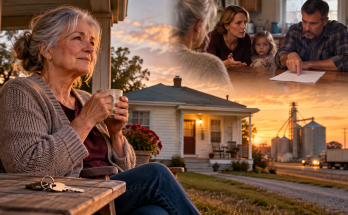
My Daughter Put a Price on Being Her Mother, but Two Keys in My Hand Reminded Me That I Still Had a Choice
Part 19 of 20