Raymond tapped a page on the dining table while Abigail sat across from him.
The old camera’s microphone was weak, forcing Mom and me to lean toward the laptop.
But the important words were unmistakable.
“Incompetent.”
“Guardianship.”
“Sale.”
“Below market.”
Raymond spoke with the detached confidence of someone explaining ordinary paperwork.
Once Adela had been legally declared incapable of managing her affairs, he said, the property could be transferred quickly.
There would be fewer objections.
Less scrutiny.
Abigail asked about the price.
Raymond gave her a number.
Mom inhaled sharply beside me.
It was less than half what her house was worth.
“That bastard.”
I paused the video.
Mom stood.
“No.”
“Mom—”
“No. Play it.”
I looked at her.
“I want to hear everything.”
So I continued.
Raymond explained that a discounted private transaction could benefit everyone involved.
He referred to a payment.
A consulting fee.
He laughed when he said it.
Abigail laughed too.
Then Raymond reached across the table.
My wife took his hand.
The touch lasted too long.
Mom turned toward me.
I kept staring at the screen.
Raymond moved around the table.
Abigail stood.
He put one hand against her waist.
Then he kissed her.
I stopped the video.
The room became completely still.
Mom said my name.
“I’m fine.”
“You are not.”
“I need a minute.”
I walked outside.
The evening air smelled like cut grass and rain.
For seven years, Abigail had been the person I called whenever something went wrong.
During deployment she was the voice I waited to hear.
She had mailed photographs, complained about the washing machine, sent ridiculous pictures of neighborhood cats sitting on our porch.
Ordinary things.
Trusted things.
Now I had watched her kiss the man apparently helping her take my mother’s home.
I wanted to drive to wherever Raymond lived.
I wanted to wake Abigail from whatever errand she was pretending to run and demand an explanation.
Instead I remembered Emily’s warning.
Facts first.
I returned inside.
Mom had not touched the computer.
“I’m sorry,” she said.
“For what?”
“For you seeing that.”
“You didn’t do it.”
“I know.”
“Then don’t apologize.”
I sat down again.
“We keep going.”
There were more recordings.
Raymond appeared twice.
During the second visit, he and Abigail discussed a company called Hearthstone Residential Holdings.
Raymond insisted paperwork had to move quickly after the psychiatric determination.
Abigail asked when she would receive the rest of her money.
I froze the image.
“The rest?”
Mom frowned.
“You think he already paid her?”
“I think we need to find out.”
I called Emily.
She answered on the first ring.
“I have a name.”
“Samuel.”
“Raymond Clayton.”
Silence.
Then keyboard clicks.
“Spell it.”
I did.
More typing.
“You’re certain?”
“He’s on video with Abigail discussing Mom’s property.”
“And?”
I hesitated.
“They appear personally involved.”
Emily understood what I meant.
“That part may matter to your marriage. Stay focused on what matters legally.”
“I know.”
“Hearthstone Residential Holdings?”
I looked at the frozen frame.
“Yes.”
Another pause.
“I’ve seen the name before.”
My anger narrowed into attention.
“Where?”
“Give me ten minutes.”
She called back in seven.
Hearthstone had appeared in an older investigation involving suspicious purchases from elderly homeowners.
Nothing had resulted in criminal charges at the time.
The company had changed ownership twice.
But Raymond’s name appeared in several associated filings.
“Can you connect him to Abigail’s transfer?”
“Not without proper process.”
“What can you tell me?”
“I can tell you to stop playing detective.”
“Emily.”
“And I can tell you there is enough here for an immediate report of suspected financial exploitation.”
Mom, listening from across the table, nodded.
“We do it,” she said.
I relayed her answer.
The report was made that evening.
Emily also instructed us to contact Adult Protective Services and preserve every original file without alteration.
I copied the old camera’s memory card exactly as it was.
One copy went into a locked case.
Another into encrypted storage.
A third was prepared for law enforcement.
When Abigail returned, the kitchen looked ordinary.
Mom was upstairs.
The camera components were hidden.
The papers were gone.
I was slicing vegetables.
Abigail kissed my cheek.
“How was your day?”
“Quiet.”
“Your mother?”
“Resting.”
“Good.”
She poured herself wine before removing her shoes.
That was unusual.
Abigail rarely drank before dinner.
I watched without appearing to watch.
“You seem tense.”
“Just tired.”
She studied me.
For one moment, I wondered if she knew.
Then she smiled.
“The evaluation tomorrow will make everything easier.”
“For Mom?”
“For everyone.”
I turned back to the cutting board.
“What happens to her money if she’s declared incompetent?”
Abigail went still.
Only briefly.
“That depends on the guardianship arrangement.”
“You’ve researched this.”
“I had to.”
“Of course.”
She took a longer drink.
“Someone had to be responsible.”
The recorder beneath the table was already running.
I served dinner.
Halfway through the meal, Abigail began criticizing Mom.
She said Mom had always disliked her.
Said Adela had never accepted that her son might put his wife first.
“She has spent years trying to make me look selfish.”
I swallowed a bite of food.
“She might recover.”
Abigail laughed.
“Recover from dementia?”
“I meant her wrists.”
The wineglass stopped halfway to her mouth.
For the first time since I came home, Abigail’s mask slipped completely.
“What about them?”
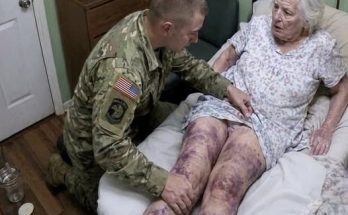
“The bruises.”
“She falls.”
“The marks don’t look like falling.”
Her eyes hardened.
“You’ve been away a long time, Samuel.”
“That’s true.”
“You haven’t seen what she’s like.”
“I’m trying to understand.”
“Then understand this.”
Abigail leaned toward me.
“No one in this neighborhood believes anything your mother says anymore.”
My heartbeat stayed even.
She continued.
“I have spent months dealing with her accusations, her screaming, her lies. People know she forgets things. They know she falls. Tomorrow a doctor will confirm what everyone already understands.”
My hand rested casually beside my plate.
Underneath us, the recorder captured everything.
“Everyone?”
“Yes.”
“What if Mom says you hurt her?”
Abigail’s mouth tightened.
“She can say whatever she wants.”
“Would people believe her?”
“No.”
The certainty in that answer chilled me.
“Why not?”
“Because I made sure they understood her condition before it became this bad.”
There it was.
Not a confession to every act.
But an admission that Abigail had deliberately shaped how others viewed my mother.
I raised my wineglass.
“To tomorrow.”
Her tension eased.
She touched her glass to mine.
“To tomorrow.”
Later that evening, Mom and I listened to the recording upstairs.
When Abigail’s voice said she had made sure the neighbors distrusted Mom, Adela closed her eyes.
“That’s how she did it.”
“What?”
“I kept wondering why everyone suddenly spoke to me differently.”
Mom looked toward the window.
“Mrs. Smith stopped letting me drive her to church. Nancy asked whether I remembered her name. Even the pharmacist started looking at Abigail before answering questions about my own prescriptions.”
“She isolated you before she locked the door.”
“Yes.”
I saved another copy.
The following morning, Emily sent preliminary information gathered through proper channels.
Mom had recently signed documents that were presented as limited medical authorization.
The version later submitted by Abigail gave far broader authority.
That discrepancy was now under review.
The bank had also flagged the eighty-thousand-dollar transfer because details about the receiving account did not match supporting trust information.
It had not been completed.
Mom sat down when I told her.
“The money is still there?”
“For now, yes.”
She covered her face.
Her shoulders shook once.
I sat beside her.
She lowered her hands after several seconds.
“I thought she had taken it.”
“We’re freezing what we can.”
Mom nodded.
“And the house?”
“No transfer has been completed.”
Her eyes closed.
A breath escaped her.
Then the relief disappeared.
“What did she receive from Raymond?”
That was the unanswered question.
Emily found it later that afternoon.
A payment.
Thirty-seven thousand five hundred dollars.
Transferred to an account controlled by Abigail.
Listed as a consulting advance.
When I saw the amount, it stopped feeling like money.
It became evidence.
A choice.
A date showing when my wife’s involvement had moved beyond conversation.
Emily sat across from me while Mom rested at my sister Rachel’s house, where we had finally moved her for safety.
“Do not contact Raymond,” Emily said.
“I won’t.”
“Do not contact Hearthstone.”
“I know.”
“And don’t text Abigail accusing her of anything.”
“I know.”
Emily narrowed her eyes.
“That sounded exactly like a man preparing to ignore me.”
Despite myself, I almost smiled.
“I won’t.”
She turned the laptop toward me.
“We need to be careful about what this payment means.”
“He paid her.”
“Yes.”
“For Mom’s house.”
“We don’t know that yet.”
“He met her inside the house and discussed the sale.”
“I agree that it looks extremely serious. That is different from proving exactly what the money was for.”
I leaned back.
Years earlier I had given junior investigators the same lecture.
Never fall in love with your first theory just because it satisfies your anger.
Facts first.
What could we establish?
Abigail had restricted Mom’s access to communication.
She had redirected financial correspondence.
A suspicious legal document existed.
She had accepted money connected to a man involved with Hearthstone.
That man had discussed Mom’s property with her.
And Mom had been portrayed as cognitively impaired before any independent specialist had established such a condition.
Serious.
Damning, perhaps.
But the process still mattered.
“What happens now?”
“Adult Protective Services already has the report. The bank is cooperating. Financial investigators will handle what they are authorized to handle.”
“And me?”
Emily shut the laptop.
“You be her son.”
That sounded easier than it was.
Mom formally revoked every questionable authorization that afternoon with independent legal counsel present.
Outgoing transactions were restricted while the bank reviewed what had happened.
Her property title remained unchanged.
The house was hers.
The eighty thousand dollars was still in her account.
When Mom heard that, she cried quietly.
Rachel sat beside her.
“I thought I’d lost everything.”
“You didn’t,” Rachel said.
Mom looked toward me.
“I want to go home.”
My answer came immediately.
“No.”
Her expression sharpened.
“Samuel.”
“Abigail still has access.”
“Change the locks.”
“She could come back.”
“Then tell her she isn’t welcome.”
“Mom, I’m trying to protect you.”
She stared at me.
The room became uncomfortable.
Then I realized what I was doing.
Speaking around her.
Deciding for her.
Exactly what she had spent months begging people not to do.
I exhaled.
“All right.”
Mom waited.
“What would make you feel safe enough to return?”
The anger left her face.
“New locks.”
I nodded.
“My own phone.”
“Yes.”
“Rachel stays a few nights.”
Rachel said, “Gladly.”
“A doorbell camera controlled by me.”
“Done.”
“No one has my passwords except me.”
“Absolutely.”
“A medical alert pendant.”
“Okay.”
Mom hesitated.
“One more thing.”
“What?”
“No lock on my bedroom door.”
I swallowed.
“Done.”
Three days later, I drove her home.
The first thing Mom did was open every curtain.
Sunlight flooded the rooms one by one.
Then she walked upstairs carrying a screwdriver.
Rachel and I followed.
Mom stood in front of the bedroom door.
The lock Abigail had installed remained on the outside.
I reached for the screwdriver.
Mom pulled it away.
“I’m doing this.”
She removed the first screw.
Then the second.
She worked slowly.
Nobody helped.
When the final piece came free, the lock dropped into her palm.
Mom handed it to me.
“Throw that away.”
I did.
The following morning, Abigail asked for a meeting.
Not at home.
Not privately.
Her attorney would be present.
Emily arranged a conference room.
When I entered, Abigail was already seated at the table.
For the first time since I returned from deployment, she looked frightened.
Then she saw me.
And her expression changed.
Not to guilt.
Not yet.
To anger.
“Where is your mother?”
I sat across from her.
“Safe.”
Abigail’s lawyer touched her arm, warning her silently.
Abigail ignored it.
“You took her away from her own home.”
“No.”
I held her gaze.
“I took her away from you.”
Click here to continue reading: PART 4: Abigail Arrived With a Lawyer and a Carefully Prepared Explanation, but One Question About Raymond Destroyed the Story She Had Built
I Came Home Expecting My Wife’s Embrace, but the Sound Upstairs Told Me Someone Had Been Waiting Desperately for Me
Part 3 of 10